About the Journal

JPPMI | JOURNAL INFORMATION

About the Journal

Community engagement, empowerment, and sustainable community development.

Journal Overview

Jurnal Pengabdian dan Pengembangan Masyarakat Indonesia (JPPMI) is a nationally accredited, peer-reviewed, open-access scholarly journal published by CV Media Publikasi Cendekia Indonesia.

JPPMI publishes scholarly contributions arising from community engagement, empowerment, knowledge transfer, capacity building, and sustainable community development programs.

The journal emphasizes meaningful community participation, systematic program implementation, credible evaluation, and evidence-supported outcomes. JPPMI prioritizes academically documented community interventions rather than conventional research without substantive community engagement.

Journal Information

Journal Title Jurnal Pengabdian dan Pengembangan Masyarakat Indonesia
Abbreviation JPPMI
e-ISSN 2830-2567
DOI Prefix 10.56303
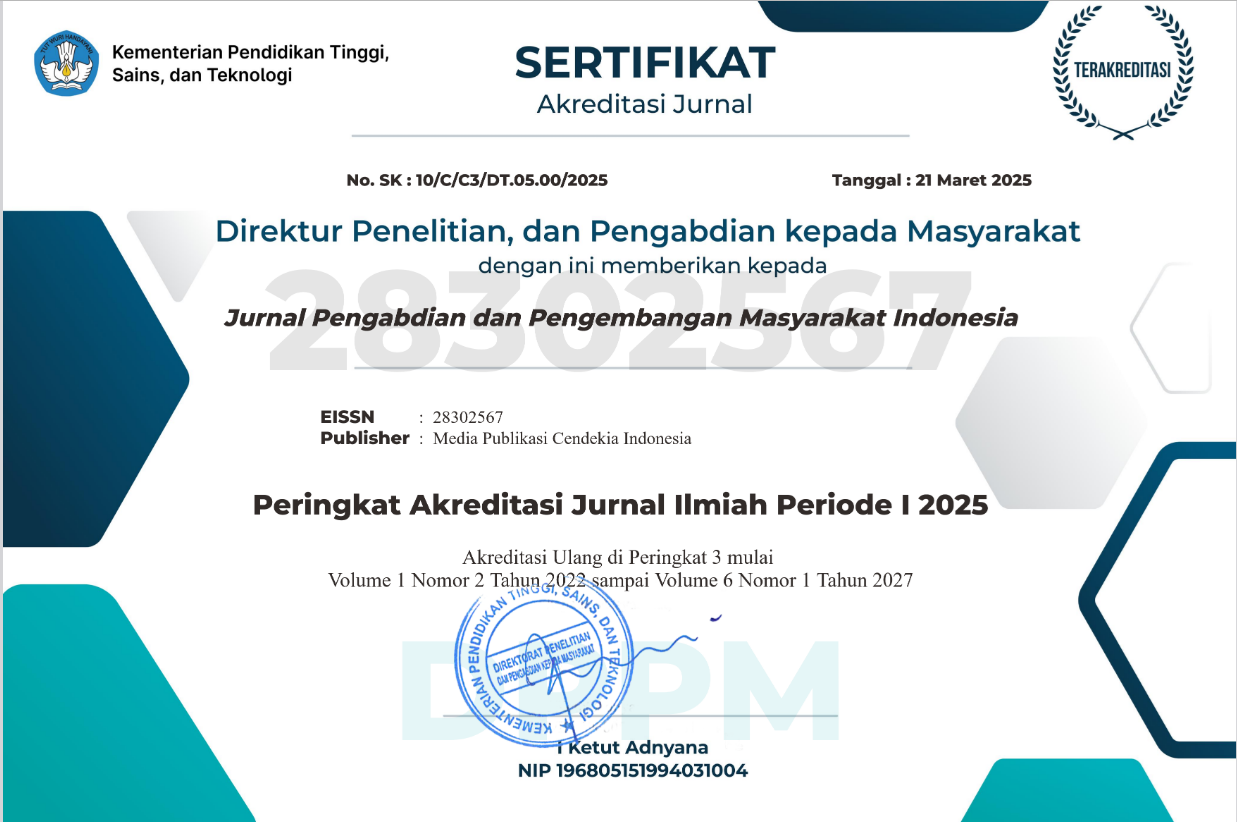
Accreditation SINTA 3
Frequency Two issues per year (May and November)
Languages Indonesian and English
Peer Review Double-anonymous
Access Model Open access
License CC BY-NC-SA 4.0

Mission and Editorial Purpose

JPPMI provides an academic platform for lecturers, community engagement practitioners, educators, health professionals, local governments, civil society organizations, and other stakeholders to disseminate scholarly knowledge derived from community-based programs.

Its mission is to encourage systematic documentation, critical evaluation, and responsible dissemination of interventions that address identified community needs, strengthen local capacities, and support sustainable community development.

Focus and Scope

JPPMI welcomes multidisciplinary community engagement contributions in the following areas:

  • Community Empowerment and Social Development: Participation, capacity building, social inclusion, and resilience.
  • Community Health and Well-Being: Health promotion, nutrition education, disease prevention, and community health initiatives.
  • Education and Human Capacity Development: Literacy, training, mentoring, and community learning.
  • Local Economic Development: Entrepreneurship, microenterprises, cooperatives, and local product development.
  • Appropriate Technology: Technology transfer, digital literacy, and practical community innovation.
  • Environment and Sustainable Communities: Agriculture, food security, environmental management, and community resilience.
  • Culture and Local Knowledge: Cultural preservation, local wisdom, and participatory community development.

View Complete Focus and Scope →

Scholarly Standards for Community Engagement

JPPMI expects manuscripts to provide scholarly evidence beyond descriptive reports of community activities.

  1. Identification of a community problem supported by relevant evidence or needs assessment.
  2. Clear objectives and meaningful participation of community partners.
  3. Systematic description of intervention methods and implementation stages.
  4. Appropriate quantitative, qualitative, or mixed-method evaluation.
  5. Transparent reporting of outputs, outcomes, and limitations.
  6. Critical discussion supported by relevant scholarly literature.
  7. Realistic consideration of program sustainability or replication.

Editorial Scope: Conventional research without substantive community engagement and descriptive activity reports without meaningful evaluation are not normally considered suitable for JPPMI.

Editorial Screening and Peer Review

Submitted manuscripts undergo initial editorial screening to assess relevance, originality, ethical compliance, reporting completeness, and conformity with the journal's guidelines.

Eligible manuscripts proceed to double-anonymous peer review by at least two independent reviewers selected according to relevant expertise.

01. Editorial Screening — Scope, originality, structure, and ethical compliance.

02. Independent Review — Evaluation by qualified reviewers.

03. Author Revision — Response to reviewer and editorial comments.

04. Editorial Decision — Decision based on scholarly merit and review evidence.

Read Peer Review Process →

Publication Frequency

JPPMI publishes two regular issues annually, in May and November.

Publication scheduling depends on the successful completion of editorial assessment, peer review, author revision, copyediting, layout, and production quality control.

Publication Frequency →

Open Access and Licensing

JPPMI provides immediate open access to published articles without reader subscription charges.

Authors retain copyright and grant JPPMI the right of first publication and applicable non-exclusive publication rights.

Unless otherwise indicated, articles are distributed under the Creative Commons Attribution-NonCommercial-ShareAlike 4.0 International License (CC BY-NC-SA 4.0).

Copyright and License Policy →

Article Processing Charges

JPPMI applies an Article Processing Charge only after formal editorial acceptance.

Submission Fee No fee
Peer-Review Fee No fee
Article Processing Charge IDR 1,500,000

APC payment does not influence reviewer recommendations or editorial decisions. Waiver or reduction requests are considered according to the published fee policy.

Complete Author Fee Information →

Publication Ethics and Community Protection

JPPMI promotes responsible scholarly publication through policies addressing originality, plagiarism, authorship, conflicts of interest, ethical oversight, correction, and retraction.

Community engagement programs must respect the rights, dignity, privacy, and welfare of participating individuals and communities. Authors must obtain relevant permissions, consent, and ethical approval where required.

Animal-related community programs must follow applicable animal welfare and professional requirements.

Publication Ethics →

Ethical Oversight of Community Engagement and Animal Welfare →

Ownership and Editorial Management

Owner and Publisher CV Media Publikasi Cendekia Indonesia
Editor-in-Chief Dr. Muhammad Darma Halwi, S.E., M.M.
Editorial Affiliation Universitas Abdul Aziz Lamadjido, Indonesia
Academic Collaboration Faculty of Medicine and Health, Universitas Sultan Ageng Tirtayasa; Ikatan Sarjana Gizi Indonesia
Editorial Email jurnalmpci@gmail.com
Business Address Persada Banten, Serang, Banten, Indonesia

Editorial decisions are based on manuscript quality, journal scope, publication ethics, and independent peer-review evidence.

Ownership and Management →

Accreditation and Discoverability

JPPMI holds SINTA 3 national journal accreditation, with published coverage from Volume 1 Number 2 (2022) through Volume 6 Number 1 (2027).

The journal supports scholarly discoverability through GARUDA, Google Scholar, Dimensions, and article DOI registration via Crossref. Coverage and available records are determined by the respective services.

National Accreditation: SINTA 3

Indexing and Accreditation Information →

Essential Journal Information

Authors and readers may consult the following official pages for detailed journal policies and submission requirements.

Focus and Scope →

Author Guidelines →

Editorial Team →

Peer Reviewers →

Peer Review Process →

Copyright and License →

Online Submission →