A Systematic Review of Fish Protein Hydrolysates in Functional Foods: Balancing Nutritional Fortification with Sensory Acceptance
Keywords:
Fish protein hydrolysate, Food fortification, Functional ingredients, Nutritional quality, Sensory acceptanceAbstract
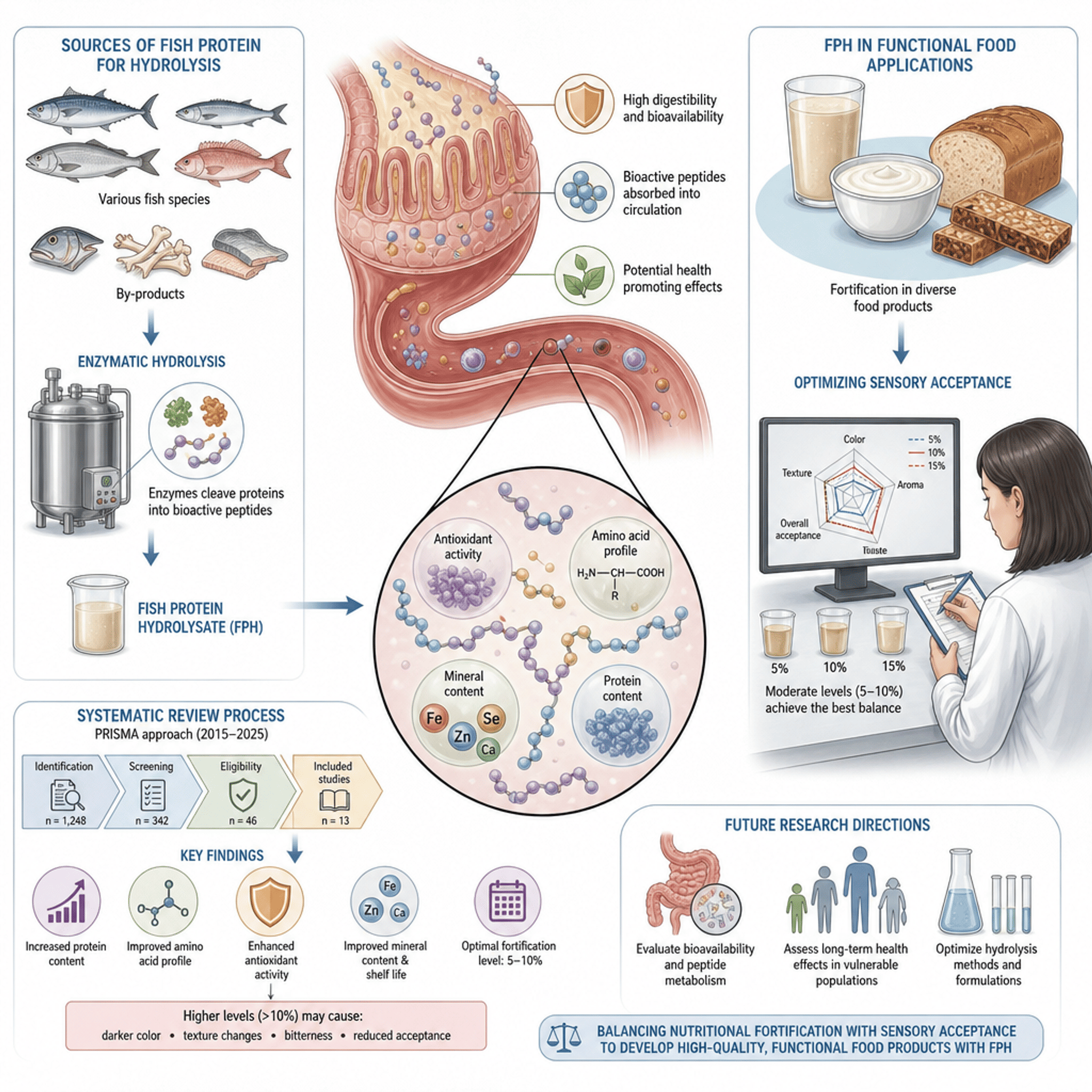
Fish and fish by-products are rich in high-quality protein and bioactive compounds, but their use in value-added food products is still limited. Fish protein hydrolysate (FPH) has outstanding digestibility and functional properties, making it a potential ingredient for food fortification. However, differences in fish species, hydrolysis methods, and fortification levels can affect nutritional quality and sensory acceptance. This literature review aims to synthesize the latest evidence on the impact of adding various types of fish protein hydrolysates to food products, with a focus on nutritional value, physicochemical properties, and sensory characteristics. The literature review was conducted using the ScienceDirect and PubMed databases following the PRISMA approach. Thirteen eligible studies published between 2015 and 2025 were analyzed using descriptive qualitative analysis. The reviewed studies indicated that FPH derived from salmon, tilapia, seabass, anchovy, tuna, cod, sea bream, and mullet consistently increased protein content, improved amino acid profiles, increased antioxidant activity, and, in some cases, improved mineral content and shelf life. Moderate fortification levels (around 5–10%) provided the best balance between nutritional improvement and sensory acceptance, while higher levels tended to cause darker color changes, texture changes, and unpleasant tastes such as bitterness. Fish protein hydrolysates are promising functional ingredients for nutritionally enriched food products. Optimization of hydrolysis methods and fortification levels is necessary to maximize nutritional benefits while maintaining sensory quality. Further research is needed to evaluate bioavailability and long-term health effects, especially in nutritionally vulnerable populations.
Downloads
References
Noreen S, Hashmi B, Aja PM, Atoki AV. Health benefits of fish and fish by-products—a nutritional and functional perspective. Front Nutr. 2025;12:1564315. doi:10.3389/fnut.2025.1564315 PubMed PMID: 40416371.
Dawson BR, Mantzioris E, Connell SD, Nagelkerken I, Hall T, Mellin C. Fish by-products as reliable proxies to evaluate nutritional fatty acid contents in commercial fish fillets. Food Chem. 2025 Feb 28;466(1):142223. doi:10.1016/j.foodchem.2024.142223 PubMed PMID: 39616699.
Silalahi Y, Masfria M, Sinaga SM, Siburian R. The Nutritional Lipid Profiles of Marine Fish from Medan, Indonesia. Open Access Maced J Med Sci. 2023 Jan 22;11(E):104–9. doi:10.3889/oamjms.2023.11376
Chalamaiah M, Dinesh Kumar B, Hemalatha R, Jyothirmayi T. Fish protein hydrolysates: Proximate composition, amino acid composition, antioxidant activities and applications: A review. Food Chem. 2012 Dec 15;135(4):3020–38. doi:10.1016/j.foodchem.2012.06.100 PubMed PMID: 22980905.
Waqar M, Sajjad N, Ullah Q, Vasanthkumar SS, Ahmed F, Panpipat W, et al. Fish By-Products Utilization in Food and Health: Extraction Technologies, Bioactive, and Sustainability Challenges. Food Sci Nutr. 2025 Nov 1;13(11):e71184. doi:10.1002/fsn3.71184
Wisuthiphaet N, Kongruang S, Chamcheun C. Production of Fish Protein Hydrolysates by Acid and Enzymatic Hydrolysis. J Med Bioeng. 2015;4(6):466–70. doi:10.12720/jomb.4.6.466-470
Dinakarkumar Y, Krishnamoorthy S, Margavelu G, Ramakrishnan G, Chandran M. Production and characterization of fish protein hydrolysate: Effective utilization of trawl by-catch. Food Chemistry Advances. 2022;1:100138. doi:10.1016/j.focha.2022.100138
Cassol GZ, Almeida FLC, de Castro RJS, Sato HH. Unlocking the potential of fish protein hydrolysates: Bioactive and technofunctional properties, applications, challenges, and future perspectives. Food Research International. 2025 Aug 1;213:116609. doi:10.1016/j.foodres.2025.116609 PubMed PMID: 40436582.
Honrado A, Ardila P, Leciñena P, Beltrán JA, Calanche JB. Transforming ‘Bonito del Norte’ Tuna By-Products into Functional Ingredients for Nutritional Enhancement of Cereal-Based Foods. Foods. 2023 Dec 1;12(24). doi:10.3390/foods12244437
Asare SN, Gruber Ijong F, Rieuwpassa J, Setiawati NP. Penambahan Hidrolisat Protein Ikan Lemuru (Sardinella lemuru) pada Pembuatan Biskuit. Jurnal Ilmiah Tindalung. 2018;4(1).
Charoensri P, Kijroongrojana K, Sukkwai S, Nilsuwan K, Benjakul S. Physical, sensory, antioxidant and nutritional properties on Riceberry rice porridge fortified with bio-calcium and protein hydrolysate from salmon (Salmo salar) frame for elderly. J Agric Food Res. 2025 Mar 1;19:101679. doi:10.1016/J.JAFR.2025.101679
Pinheiro ACDAS, Schouten MA, Tappi S, Gottardi D, Barbieri F, Ciccone M, et al. Strategies for the valorization of fish by-products: Fish balls formulated with mechanically separated amberjack flesh and mullet hydrolysate. LWT. 2024 Oct 1;209. doi:10.1016/j.lwt.2024.116724
Asharaf F, Blossom KL, Safeena MP, Martin Xavier KA, Abdullah S. Debittered tilapia protein hydrolysate incorporated functionalized nutrition bar: Application of fuzzy modeling for sensory analysis. Food and Humanity. 2025 May 1;4. doi:10.1016/j.foohum.2025.100568
Honrado A, Ardila P, Leciñena P, Beltrán JA, Calanche J. Nutritional enrichment of cereal foods: feasibility study and characterisation of biscuits fortified with seabass by-products. Int J Food Sci Technol. 2024 Aug 1;59(8):5376–88. doi:10.1111/ijfs.17230
Sharma K, Chanchi Prashanthkumar M, Patil U, Ma L, Benjakul S. Characteristics and nutritional value of cookies fortified with debittered salmon (Salmo salar) frame protein hydrolysate. J Agric Food Res. 2025 Mar;19:101732. doi:10.1016/j.jafr.2025.101732
Canti M, Putra MF, Hutagalung RA, Hartanti AT, Della F. Physicochemical and sensory properties of novel cookies enriched with soy and anchovy protein isolate (Stolephorus insularis). Applied Food Research. 2025 Jun 1;5(1). doi:10.1016/j.afres.2025.100946
Oprea OB, Sannan S, Tolstorebrov I, Claussen IC, Gaceu L. Effects of Fish Protein Hydrolysate on the Nutritional, Rheological, Sensorial, and Textural Characteristics of Bread. Foods. 2024 Feb 25;13(5):698. doi:10.3390/FOODS13050698
Tekle S, Goktas H, Agan C, Develioglu-Arslan A, Tekin-Cakmak ZH. Using Fish Skin Gelatin Hydrolysate as Stabilizer and/or Emulsifier Agent in Ice Cream Production and Melting, Textural, Rheological, and Sensory Characteristics. Gels. 2025 Aug 1;11(8). doi:10.3390/gels11080643
Khodaei D, Noci F, Ryan L. Optimizing Protein Bars With Whey Protein Isolate, Pea Protein Isolate, and Blue Whiting (Micromesistius poutassou) Fish Protein Hydrolysate: A Simplex-Centroid Mixture Design Study. Food Sci Nutr. 2025 Jan 1;13(1). doi:10.1002/fsn3.4701
Vakili N, Ataee M, Kakoolaki S, Ahari H, Ghorbanzade A. Effect of nanoemulsified and encapsulated Planiliza abu protein on fortified yogurt. Food Sci Nutr. 2024 Dec 1;12(12):10433–47. doi:10.1002/fsn3.4150
Prabhu L, Skuland AV, Varela P, Rosnes JT. Fish Protein Hydrolysate as Protein Enrichment in Texture-Modified Salmon Products. Foods. 2025;14(2). doi:10.3390/foods14020162
Hajfathalian M, Jorjani S, Ghelichi S. Characterization of fish sausage manufactured with combination of sunflower oil and fish oil stabilized with fish roe protein hydrolysates. J Food Sci Technol. 2020 Apr 1;57(4):1439–48. doi:10.1007/s13197-019-04179-6
Unnikrishnan P, Puthenveetil Kizhakkethil B, Anant Jadhav M, Sivam V, Ashraf PM, Ninan G, et al. Protein hydrolysate from yellowfin tuna red meat as fortifying and stabilizing agent in mayonnaise. J Food Sci Technol. 2020 Feb 1;57(2):413–25. doi:10.1007/s13197-019-04069-x
Ratnawati R, Satriani S. The Effect of Giving Biscuits Made from Haruan Fish Flour and Yellow Pumpkin on the Nutritional Status of Toddlers. Journal of Health and Nutrition Research. 2024 Aug 21;3(2):144–8. doi:10.56303/jhnresearch.v3i2.261
Gao R, Yu Q, Shen Y, Chu Q, Chen G, Fen S, et al. Production, bioactive properties, and potential applications of fish protein hydrolysates: Developments and challenges. Trends Food Sci Technol. 2021 Apr 1;110:687–99. doi:10.1016/j.tifs.2021.02.031
Maulani A, Poernomo A, Lisyana H, Sumandiarsa IK. Karakteristik Gluten Free Cookies Fortifikasi Hidrolisat Protein Ikan Lele. Jurnal Pascapanen dan Bioteknologi Kelautan dan Perikanan. 2024 Jun 30;19(1):73. doi:10.15578/jpbkp.v19i1.991
Faroj MN. Pengaruh Substitusi Tepung Ikan Teri (Stolephorus commersonii) Dan Tepung Kacang Merah (Vigna angularis) Terhadap Daya Terima Dan Kandungan Protein Pie Mini. Media Gizi Indonesia. 2019 Jan 31;14(1):56–65. doi:10.20473/MGI.V14I1.56-65
Rofidah K, Putriana N, Roqimah AGC, Arini LDD. Membangun Kesehatan Dari Dalam Dengan Menu Sehat Berprotein Tinggi. 2. 2024;(3). doi:https://doi.org/10.55606/jig.v2i3
Mentari AD, Setiawan B, Palupi E. Pengembangan Rutf (Ready To Use Therapeutic Food) Berbahan Serealia Dan Kedelai Bagi Balita Malnutrisi Akut Berat. Media Gizi Indonesia (National Nutrition Journal) 2022. 2022;17(1):11–20. doi:10.204736/mgi.v17i1.11-20
Putriana AE, Damayanthi E, Palupi E, Nasution Z, Handharyani E. Evaluation of Dietary Fiber, Antioxidant Capacity, Physicochemical Properties, and Consumer Acceptability of a Green Okra (Abelmoschus esculentus L.) Pudding. Journal of Health and Nutrition Research. 2025 Aug 1;4(2):718–26. doi:10.56303/jhnresearch.v4i2.461
Mardiyah U, Jasila I, Arianty D. Pembuatan Hidrolisat Ikan Rucah Sebagai Penyedap Rasa Alami dengan Memanfaatkan Enzim Bromelin pada Buah Nanas (Ananas comosus). Samakia : Jurnal Ilmu Perikanan. 2024 May 2;15(1):69–75. doi:10.35316/JSAPI.V15I1.4781
Peinado I, Koutsidis G, Ames J. Production of seafood flavour formulations from enzymatic hydrolysates of fish by-products. LWT - Food Science and Technology. 2016 Mar 1;66:444–52. doi:10.1016/j.lwt.2015.09.025
Tejpal CS, Vijayagopal P, Elavarasan K, Linga Prabu D, Lekshmi RGK, Asha KK, et al. Antioxidant, functional properties and amino acid composition of pepsin-derived protein hydrolysates from whole tilapia waste as influenced by pre-processing ice storage. Journal of Food Science and Technology 2017 54:13. 2017 Oct 17;54(13):4257–67. doi:10.1007/s13197-017-2897-9
Septiyanti S, Patimah S, Bur N. Penja Fish Flour Cookies: Nutritional Composition and Sensory Acceptability as a Local Food-Based Intervention for Child Undernutrition. Journal of Health and Nutrition Research. 2025 Dec 1;4(3):950–9. doi:10.56303/jhnresearch.v4i3.512
Hassan T, Buy I, Mata M. Effect of Sorghum Flour and Anchovy Meal Substitution on Organoleptic Properties of Biscuits. Journal of Health and Nutrition Research. 2024 Dec 11;3(3):185–91. doi:10.56303/jhnresearch.v3i3.284
Laishram M, Desai AS, Bhave SG, Pathan DI, Pawase AS, Wasave SM, et al. Valorisation of Fish Side Stream Through Development of Fish Protein Hydrolysate to Enhance Physiochemical and Sensory Characteristics of Pasta. Journal of Aquatic Food Product Technology. 2025 Jul 3;34(6):414–27. doi:10.1080/10498850.2025.2534101
Kaushik N, Falch E, Slizyte R, Kumari A, Khushboo, Hjellnes V, et al. Valorization of fish processing by-products for protein hydrolysate recovery: Opportunities, challenges and regulatory issues. Food Chem. 2024 Nov 30;459. doi:10.1016/j.foodchem.2024.140244 PubMed PMID: 38991448.
Nemati M, Shahosseini SR, Ariaii P. Review of fish protein hydrolysates: production methods, antioxidant and antimicrobial activity and nanoencapsulation. Food Sci Biotechnol. 2024 Jun 1;33(8):1789. doi:10.1007/S10068-024-01554-8 PubMed PMID: 38752116.
Zhang X, Dai Z, Zhang Y, Dong Y, Hu X. Structural characteristics and stability of salmon skin protein hydrolysates obtained with different proteases. LWT. 2022 Jan 1;153:112460. doi:10.1016/j.lwt.2021.112460
Rusydan AM, Zulfaidah NT. Bioactive Peptides: Exploring Potentials and Overcoming Challenges for Future Foods. Jurnal Farmasi Syifa. 2024;2.
Xiang Q, Xia Y, Fang S, Zhong F. Enzymatic debittering of cheese flavoring and bitterness characterization of peptide mixture using sensory and peptidomics approach. Food Chem. 2024 May 15;440. doi:10.1016/j.foodchem.2023.138229 PubMed PMID: 38159315.
Yolandani, Liu D, Raynaldo FA, Dabbour M, Zhang X, Chen Z, et al. Comparison of prediction models for soy protein isolate hydrolysates bitterness built using sensory, spectrofluorometric and chromatographic data from varying enzymes and degree of hydrolysis. Food Chem. 2024 Jun 1;442. doi:10.1016/j.foodchem.2024.138428 PubMed PMID: 38241997.
Yarnpakdee S, Benjakul S, Kristinsson HG, Kishimura H. Antioxidant and sensory properties of protein hydrolysate derived from Nile tilapia (Oreochromis niloticus) by one- and two-step hydrolysis. J Food Sci Technol. 2015 Jun 29;52(6):3336–49. doi:10.1007/s13197-014-1394-7
Idowu AT, Benjakul S. Bitterness of fish protein hydrolysate and its debittering prospects. J Food Biochem. 2019 Sep 1;43(9). doi:10.1111/jfbc.12978 PubMed PMID: 31489658.
Fu Y, Chen J, Bak KH, Lametsch R. Valorisation of protein hydrolysates from animal by-products: perspectives on bitter taste and debittering methods: a review. Int J Food Sci Technol. 2019 Apr 1;54(4):978–86. doi:10.1111/ijfs.14037
Zulkipli AS, Salleh RM. Flavour Improvement of Protein Hydrolysates Derived from Cephalopods Byproducts Using Maillard Reaction: A Short Review. ASM Science Journal. 2021;15:1–13. doi:10.32802/ASMSCJ.2021.694
Chen J, Wei C, Hou J, Wang J, Ruan Q. Debittering and antioxidant improvement of soy protein hydrolysates using curcumin as hydrophobic core. J Sci Food Agric. 2025 Mar 15;105(4):2506–14. doi:10.1002/jsfa.14023 PubMed PMID: 39535324.
Nesse KO, Nagalakshmi AP, Marimuthu P, Singh M. Efficacy of a Fish Protein Hydrolysate in Malnourished Children. Indian Journal of Clinical Biochemistry. 2011 Oct 15;26(4):360–5. doi:10.1007/s12291-011-0145-z
Published
How to Cite
Issue
Section
Copyright (c) 2026 Salsabila Mega Kencono Ganggi, Ahmad Syauqy, Gemala Anjani, Fitriyono Ayustaningwarno, Widya Rusyanto, Diana Nur Afifah

This work is licensed under a Creative Commons Attribution-NonCommercial-ShareAlike 4.0 International License.
Most read articles by the same author(s)
- Ade Chairina, Munifa Majdiyyah, Diana Nur Afifah, Ahmad Syauqy, Jeruju (Acanthus ilicifolius) Leaf Infusion Modulates Superoxide Dismutase (SOD) and Glutathione Peroxidase (GPx) Enzyme Activity in Streptozotocin-Nicotinamide (STZ-NA) Induced Diabetic Rats (Rattus norvegicus) , Journal of Health and Nutrition Research: Vol. 4 No. 2 (2025)
- Luti Bilqisthi Putri, Adriyan Pramono, Siti Fatimah Muis, Endang Mahati, Diana Nur Afifah, The Effect of Moringa Leaf Powder and Egg Supplementation on Nutritional Status and Appetite: A Quasi-Experimental Study in Undernourished Children , Journal of Health and Nutrition Research: Vol. 5 No. 1 (2026)
- Rahma Agniya Nugraha, Ahmad Syauqy, Diana Nur Afifah, Potential of Fish Protein Hydrolysates as Bioactive Ingredients for Antidiabetic Functional Snacks: A Narrative Review , Journal of Health and Nutrition Research: Vol. 5 No. 2 (2026)
- Ariny Poespitasari, Fitriyono Ayustaningwarno, Ninik Rustanti, Potential of Analog Rice for Diabetes and Dyslipidemia: A Narrative Review of In Vivo Insight , Journal of Health and Nutrition Research: Vol. 5 No. 2 (2026)
- Dwi Yuniar Intan Sari, Dila Lintang Harmanto Putri, Lilis Wijayanti, Suyatno Suyatno, Ahmad Syauqy, The Coastal Iodine Paradox: A Narrative Review of Food Security and Dietary Patterns as Determinants of Iodine Status , Journal of Health and Nutrition Research: Vol. 5 No. 2 (2026)
- Fenny Anggreany Nasution, Ninik Rustanti, Ahmad Syauqy, Association Between Dietary Inflammatory Index Scores and Hemoglobin Levels Among Pregnant Women in Asahan Regency: A Cross-Sectional Study , Journal of Health and Nutrition Research: Vol. 5 No. 2 (2026)
Similar Articles
- Rahma Agniya Nugraha, Ahmad Syauqy, Diana Nur Afifah, Potential of Fish Protein Hydrolysates as Bioactive Ingredients for Antidiabetic Functional Snacks: A Narrative Review , Journal of Health and Nutrition Research: Vol. 5 No. 2 (2026)
You may also start an advanced similarity search for this article.