Association Between Dietary Inflammatory Index Scores and Hemoglobin Levels Among Pregnant Women in Asahan Regency: A Cross-Sectional Study
Keywords:
Anemia, Dietary Inflammatory Index, Hemoglobin, Pregnant Women, Maternal Nutrition, InflammationAbstract
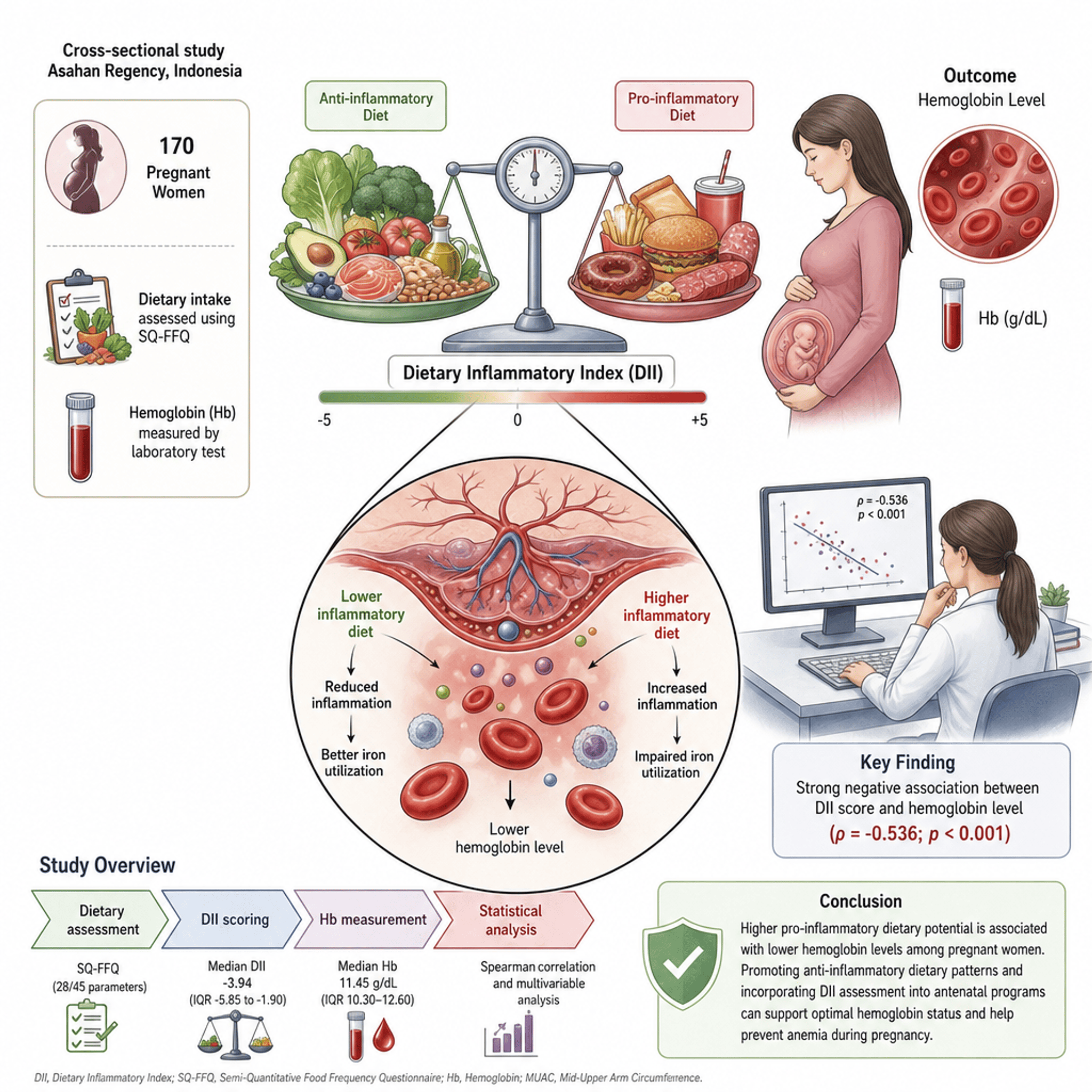
Anemia during pregnancy remains a major public health concern and is influenced not only by iron intake but also by dietary patterns that modulate inflammatory processes. The Dietary Inflammatory Index (DII) is a validated tool used to quantify the inflammatory potential of an individual’s diet and may be associated with hemoglobin (Hb) levels. This study aimed to examine the association between DII scores and hemoglobin levels among pregnant women in Asahan Regency, Indonesia. A cross-sectional study was conducted among 170 pregnant women selected through purposive sampling. Dietary intake was assessed using a semi-quantitative food frequency questionnaire (SQ-FFQ), and DII scores were calculated using 28 out of 45 validated dietary parameters. Hemoglobin levels were obtained from laboratory measurements. Normality testing using the Kolmogorov–Smirnov test showed that both variables were not normally distributed; therefore, Spearman’s correlation analysis was applied. The median hemoglobin level was 11.45 g/dL, while the median DII score was –3.94, indicating a predominantly anti-inflammatory dietary pattern. Spearman’s correlation analysis revealed a strong and significant negative association between DII score and hemoglobin level (ρ = –0.536; p < 0.001), indicating that higher pro-inflammatory dietary potential was associated with lower hemoglobin concentrations. Multivariable analysis adjusting for maternal age, gestational age, parity, and mid-upper arm circumference (MUAC) confirmed that DII score remained an independent predictor of hemoglobin level. These findings highlight the importance of promoting anti-inflammatory dietary patterns during pregnancy to support optimal hemoglobin status and reduce the risk of anemia. Incorporating dietary inflammatory assessment into antenatal nutrition programs may strengthen anemia prevention strategies and improve maternal health outcomes.
Downloads
References
Karami M, Chaleshgar M, Salari N, Akbari H, Mohammadi M. Global Prevalence of Anemia in Pregnant Women: A Comprehensive Systematic Review and Meta-Analysis. Matern Child Health J. 2022;26(7):1473-87.
Organization WH. WHO global anaemia estimates: key findings, 2025: World Health Organization; 2025.
Laporan Riset Kesehatan Dasar 2018. Jakarta: KEMENTERIAN KESEHATAN; 2019.
Fraenkel PG. Anemia of Inflammation: A Review. Med Clin North Am. 2017;101(2):285-96.
Shivappa N, Steck SE, Hurley TG, Hussey JR, Hébert JR. Designing and developing a literature-derived, population-based dietary inflammatory index. Public Health Nutr. 2014;17(8):1689-96.
Ma H, Deng W, Chen H, Ding X. Association between dietary inflammatory index and anemia in US adults. Frontiers in Nutrition. 2024;10:1310345.
Huang C, Zhang Z, He J, Zhong Z, Ma Y, Huang X, et al. First–Second-Trimester Dietary Inflammatory Index and Anemia Risk in the Third Trimester: A Prospective Cohort Study. Nutrients. 2025;17(11):1938.
Syauqy A, Afifah DN, Purwanti R, Nissa C, Fitranti DY, Chao JC-J. Reproducibility and validity of a food frequency questionnaire (Ffq) developed for middle-aged and older adults in semarang, Indonesia. Nutrients. 2021;13(11):4163.
Kim HS, Lee H, Provido SMP, Kang M, Chung GH, Hong S, et al. Association Between Diet Quality and Prevalence of Obesity, Dyslipidemia, and Insulin Resistance Among Filipino Immigrant Women in Korea: The Filipino Women's Diet and Health Study. Frontiers in Public Health. 2021;9:647661.
Organization WH. Guideline on haemoglobin cutoffs to define anaemia in individuals and populations: World Health Organization; 2024.
Camaschella C. Iron deficiency. Blood, The Journal of the American Society of Hematology. 2019;133(1):30-9.
Shivappa N, Godos J, Hébert JR, Wirth MD, Piuri G, Speciani AF, et al. Dietary Inflammatory Index and Cardiovascular Risk and Mortality—A Meta-Analysis. Nutrients. 2018;10(2):200.
Kong L-C, Tap J, Aron-Wisnewsky J, Pelloux V, Basdevant A, Bouillot J-L, et al. Gut microbiota after gastric bypass in human obesity: increased richness and associations of bacterial genera with adipose tissue genes. The American journal of clinical nutrition. 2013;98(1):16-24.
Weiss G, Ganz T, Goodnough LT. Anemia of inflammation. Blood. 2019;133(1):40-50.
Weiss G, Goodnough LT. Anemia of chronic disease. New England Journal of Medicine. 2005;352(10):1011-23.
Das A, Bai C-H, Chang J-S, Huang Y-L, Wang F-F, Hsu C-Y, et al. A ferritin-related dietary pattern is positively associated with iron status but negatively associated with vitamin D status in pregnant women: a cross-sectional study. European Journal of Nutrition. 2024;64(1):30.
Ross ADB, Perrone F, Elmentaite R, Teichmann SA, Zilbauer M. Obtaining purified human intestinal epithelia for single-cell analysis and organoid culture. STAR Protoc. 2021;2(2):100597.
Reddy BHR, Thankachan P, Hatakayama M, Hiremath N, Moretti D, Nanjareddy YA, et al. A natural low phytic acid finger millet accession significantly improves iron bioavailability in Indian women. Frontiers in Nutrition. 2022;8:791392.
Published
How to Cite
Issue
Section
Copyright (c) 2026 Fenny Anggreany Nasution, Ninik Rustanti, Ahmad Syauqy

This work is licensed under a Creative Commons Attribution-NonCommercial-ShareAlike 4.0 International License.
Most read articles by the same author(s)
- Ade Chairina, Munifa Majdiyyah, Diana Nur Afifah, Ahmad Syauqy, Jeruju (Acanthus ilicifolius) Leaf Infusion Modulates Superoxide Dismutase (SOD) and Glutathione Peroxidase (GPx) Enzyme Activity in Streptozotocin-Nicotinamide (STZ-NA) Induced Diabetic Rats (Rattus norvegicus) , Journal of Health and Nutrition Research: Vol. 4 No. 2 (2025)
- Ulan Safitri, Fitri Wulandari, Tsamaroh Azzah Mukarromah, Ninik Rustanti, Adriyan Pramono, Selenium-Fortified Red Dragon Fruit Dadih Improves Obesity Markers in Rats Induced by a High-Fat, High-Fructose Diet , Journal of Health and Nutrition Research: Vol. 4 No. 2 (2025)
- Rahma Agniya Nugraha, Ahmad Syauqy, Diana Nur Afifah, Potential of Fish Protein Hydrolysates as Bioactive Ingredients for Antidiabetic Functional Snacks: A Narrative Review , Journal of Health and Nutrition Research: Vol. 5 No. 2 (2026)
- Ariny Poespitasari, Fitriyono Ayustaningwarno, Ninik Rustanti, Potential of Analog Rice for Diabetes and Dyslipidemia: A Narrative Review of In Vivo Insight , Journal of Health and Nutrition Research: Vol. 5 No. 2 (2026)
- Salsabila Mega Kencono Ganggi, Ahmad Syauqy, Gemala Anjani, Fitriyono Ayustaningwarno, Widya Rusyanto, Diana Nur Afifah, A Systematic Review of Fish Protein Hydrolysates in Functional Foods: Balancing Nutritional Fortification with Sensory Acceptance , Journal of Health and Nutrition Research: Vol. 5 No. 2 (2026)
- Dwi Yuniar Intan Sari, Dila Lintang Harmanto Putri, Lilis Wijayanti, Suyatno Suyatno, Ahmad Syauqy, The Coastal Iodine Paradox: A Narrative Review of Food Security and Dietary Patterns as Determinants of Iodine Status , Journal of Health and Nutrition Research: Vol. 5 No. 2 (2026)