Potential of Fish Protein Hydrolysates as Bioactive Ingredients for Antidiabetic Functional Snacks: A Narrative Review
Keywords:
Antidiabetic, Bioactive peptides, Fish protein hydrolysates, Functional snacks, Glycemic responseAbstract
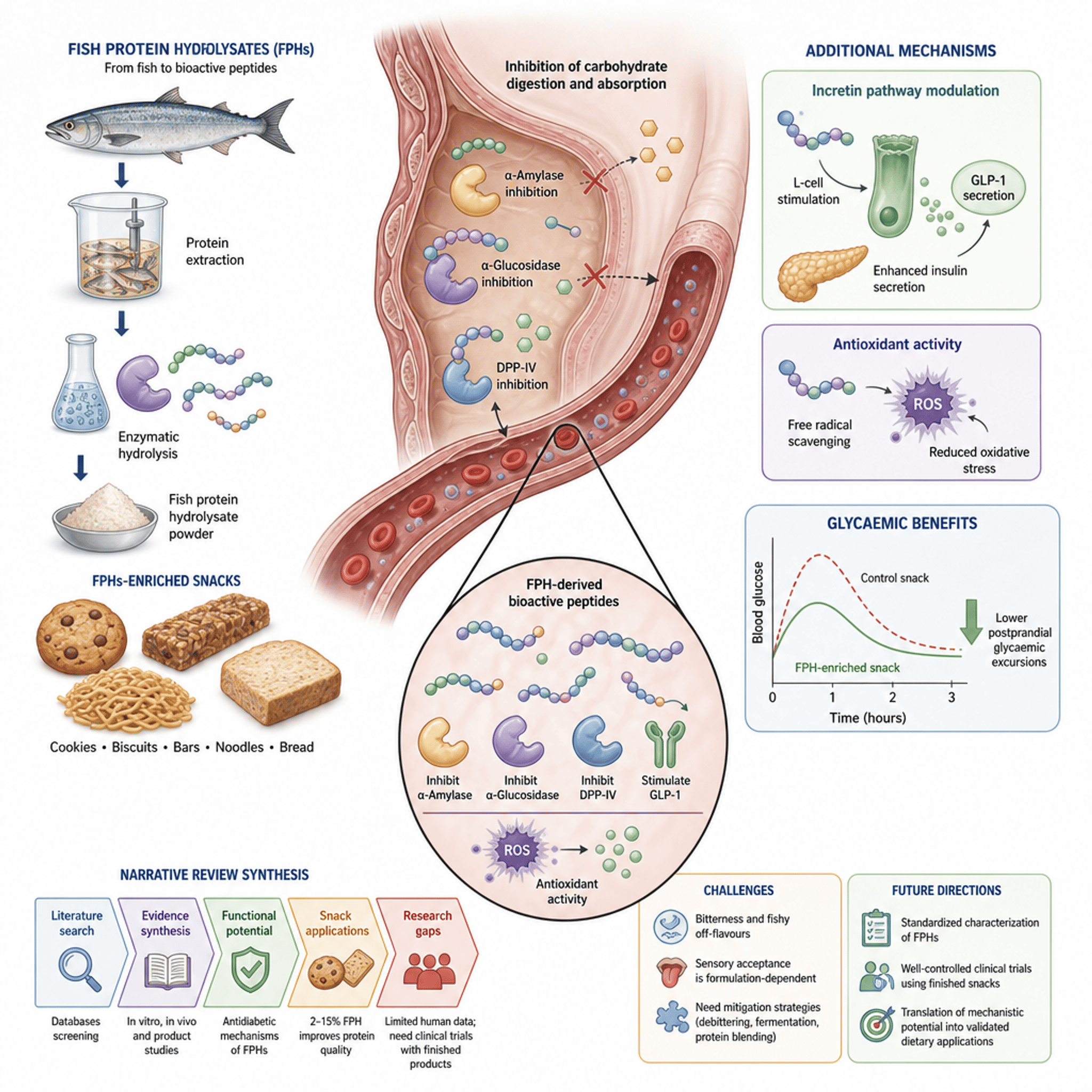
The rising prevalence of diabetes mellitus highlights the need for food-based strategies that reduce postprandial glycaemic excursions. Snacks are a critical dietary target due to their frequent consumption, yet most commercial options are rich in rapidly digestible carbohydrates. Fish protein hydrolysates (FPHs) offer peptide-mediated bioactivity beyond simple macronutrient substitution, but their application in antidiabetic snack development remains limited. This review evaluates the potential of FPHs as functional ingredients in antidiabetic snack formulations. A narrative synthesis of literature from major scientific databases was performed, focusing on antidiabetic mechanisms of FPH-derived peptides and their incorporation into finished snack products. Evidence suggests that FPHs may support glycaemic regulation through inhibition of α-amylase, α-glucosidase, and DPP-IV, modulation of incretin pathways including GLP-1, and antioxidant activity, mainly demonstrated in in vitro and in vivo models. Product studies indicate that FPH incorporation at optimal levels of approximately 2–15% improves protein density and digestibility in snack matrices such as cookies, biscuits, bars, noodles, and bread. However, sensory acceptance is formulation-dependent, and bitterness or fishy off-flavours may require mitigation strategies such as enzymatic debittering or fermentation. Despite promising functional properties, human evidence confirming glycaemic benefits of FPH-enriched snacks remains limited. Standardized characterization and well-controlled clinical trials using finished products are essential to translate mechanistic potential into validated dietary applications.
Downloads
References
Magliano DJ, Boyko EJ. IDF diabetes atlas. 2021.
Ong KL, Stafford LK, McLaughlin SA, Boyko EJ, Vollset SE, Smith AE, et al. Global, regional, and national burden of diabetes from 1990 to 2021, with projections of prevalence to 2050: a systematic analysis for the Global Burden of Disease Study 2021. The Lancet. 2023;402(10397):203-34.
Kesehatan BKP. Survei Kesehatan Indonesia 2023: Dalam Angka. Jakarta: Badan Kebijakan Pembangunan Kesehatan, Kementerian Kesehatan Republik Indonesia; 2023.
Rau MJ, Nurjannah N, Syahadat DS, Hasanah H. Determinants of Risk for Type 2 Diabetes Mellitus Among the Community at The Birobuli Community Health Center. Journal of Health and Nutrition Research. 2024;3(1):83-90.
Peres M, Costa HS, Silva MA, Albuquerque TG. The health effects of low glycemic index and low glycemic load interventions on prediabetes and type 2 diabetes mellitus: a literature review of RCTs. Nutrients. 2023;15(24):5060.
Indonesia PE. Pengelolaan dan pencegahan diabetes melitus tipe 2 di Indonesia. Pb Perkeni. 2021;6.
Hashem AM, Sakhare SD, Kudre TG. Effect of Piaractus brachypomus fish protein hydrolysate on physicochemical, sensory, and storage properties of cookies. Biocatalysis and Agricultural Biotechnology. 2023;51:102761.
Heitman K, Thomas SE, Kelly O, Fanelli SM, Krok-Schoen JL, Luo M, et al. Snacks contribute considerably to total dietary intakes among adults stratified by glycemia in the United States. PLOS Global Public Health. 2023;3(10):e0000802.
Riyadi PH, Susanto E, Agustini TW, Atho’illah MF, Arifah SN, Rifa’i M. Immunomodulatory potential of protein hydrolysate by-products derived from skipjack (Katsuwonus pelamis (Linnaeus, 1758)) against nicotinamide-streptozotocin induced diabetic rat. Veterinary Integrative Sciences. 2025;24(1):e2026006.
Cagabhion III AT, Ko W-L, Chuang T-J, Aluko RE, Chang Y-W. Identification and In Vitro Evaluation of Milkfish (Chanos chanos) Frame Proteins and Hydrolysates with DPP-IV Inhibitory and Antioxidant Activities. Foods. 2025;14(20):3456.
Wang D, Huang X, Marnila P, Hiidenhovi J, Välimaa A-L, Granato D, et al. Baltic herring hydrolysates: Identification of peptides, in silico DPP-4 prediction, and their effects on an in vivo mice model of obesity. Food Research International. 2024;191:114696.
Shekoohi N, Carson BP, Fitzgerald RJ. Antioxidative, glucose management, and muscle protein synthesis properties of fish protein hydrolysates and peptides. Journal of Agricultural and Food Chemistry. 2024;72(39):21301-17.
Akbarian M, Khani A, Eghbalpour S, Uversky VN. Bioactive peptides: Synthesis, sources, applications, and proposed mechanisms of action. International journal of molecular sciences. 2022;23(3):1445.
Daskalaki MG, Axarlis K, Tsoureki A, Michailidou S, Efraimoglou C, Lapi I, et al. Fish-derived protein hydrolysates increase insulin sensitivity and alter intestinal microbiome in high-fat-induced obese mice. Marine Drugs. 2023;21(6):343.
Wan P, Cai B, Chen H, Chen D, Zhao X, Yuan H, et al. Antidiabetic effects of protein hydrolysates from Trachinotus ovatus and identification and screening of peptides with α-amylase and DPP-IV inhibitory activities. Current Research in Food Science. 2023;6:100446.
Prasetyo DYB, Agustini TW, Anjani G, Riyadi PH. Evaluation of Immunomodulatory Properties of Fish-Protein Hydrolysate from Skipjack Tuna by-Products (Katsuwonus pelamis, Linnaeus 1758) in Streptozotocin-Nicotinamide-Induced Diabetic Rats. World’s Vet J. 2025;15:117-25.
Heffernan S, Nunn L, Harnedy-Rothwell PA, Gite S, Whooley J, Giblin L, et al. Blue Whiting (Micromesistius poutassou) protein hydrolysates increase GLP-1 secretion and proglucagon production in STC-1 cells whilst maintaining Caco-2/HT29-MTX co-culture integrity. Marine drugs. 2022;20(2):112.
Cassol GZ, Almeida FLC, de Castro RJS, Sato HH. Unlocking the potential of fish protein hydrolysates: Bioactive and technofunctional properties, applications, challenges, and future perspectives. Food Research International. 2025:116609.
Zhao X, Wan P, Chen D, Cai B, Chen H, Li J, et al. Anti-diabetic properties of yellowfin tuna protein hydrolysates and identification and screening of novel anti-diabetic peptides against α-amylase and DPP-IV. Food Chemistry. 2025:147497.
Wang Y, Nair S, Gagnon J. Herring milt and herring milt protein hydrolysate are equally effective in improving insulin sensitivity and pancreatic beta-cell function in diet-induced obese-and insulin-resistant mice. Marine drugs. 2020;18(12):635.
Harnedy-Rothwell PA, Khatib N, Sharkey S, Lafferty RA, Gite S, Whooley J, et al. Physicochemical, nutritional and in vitro antidiabetic characterisation of blue whiting (Micromesistius poutassou) protein hydrolysates. Marine drugs. 2021;19(7):383.
Sharkey SJ, Lafferty RA, Harnedy-Rothwell PA, Gite S, Whooley J, Allsopp PJ, et al. Blue Whiting (Micromesistius poutassou) Protein Hydrolysates Elicit Hydrolytic Enzyme-Dependent Improvements in Acute Postprandial Blood Glucose and Pancreatic Islet Health in a High-Fat Fed Diet-Induced Obese Mouse Model. ACS Food Science & Technology. 2025.
Naik AS, Whitaker RD, Albrektsen S, Solstad RG, Thoresen L, Hayes M. Mesopelagic fish protein hydrolysates and extracts: a source of novel anti-hypertensive and anti-diabetic peptides. Frontiers in Marine Science. 2021;8:719608.
Parthsarathy V, McLaughlin C, Sharkey S, Harnedy‐Rothwell PA, Lafferty R, Allsopp PJ, et al. Protein hydrolysates from boarfish (Capros aper) and Atlantic salmon (Salmo salar) skin gelatin improve metabolic control in genetically obese diabetic (ob/ob) mice. Journal of Food Bioactives. 2021;16:48-57.
Dale HF, Jensen C, Hausken T, Lied E, Hatlebakk JG, Brønstad I, et al. Effect of a cod protein hydrolysate on postprandial glucose metabolism in healthy subjects: A double-blind cross-over trial. Journal of nutritional science. 2018;7:e33.
Jensen C, Dale HF, Hausken T, Hatlebakk JG, Brønstad I, Lied GA, et al. The effect of supplementation with low doses of a cod protein hydrolysate on satiety hormones and inflammatory biomarkers in adults with metabolic syndrome: A randomized, double-blind study. Nutrients. 2020;12(11):3421.
Honrado A, Ardila P, Leciñena P, Beltrán JA, Calanche JB. Transforming ‘Bonito Del Norte’Tuna By-Products into functional ingredients for nutritional enhancement of cereal-based foods. Foods. 2023;12(24):4437.
Khodaei D, Noci F, Ryan L. Optimizing Protein Bars With Whey Protein Isolate, Pea Protein Isolate, and Blue Whiting (Micromesistius poutassou) Fish Protein Hydrolysate: A Simplex‐Centroid Mixture Design Study. Food Science & Nutrition. 2025;13(1):e4701.
Sharma K, Prashanthkumar MC, Patil U, Ma L, Benjakul S. Characteristics and nutritional value of cookies fortified with debittered salmon (Salmo salar) frame protein hydrolysate. Journal of Agriculture and Food Research. 2025;19:101732.
Oprea OB, Sannan S, Tolstorebrov I, Claussen IC, Gaceu L. Effects of fish protein hydrolysate on the nutritional, rheological, sensorial, and textural characteristics of bread. Foods. 2024;13(5):698.
Asharaf F, Blossom K, Safeena M, Xavier KM, Abdullah S. Debittered tilapia protein hydrolysate incorporated functionalized nutrition bar: Application of fuzzy modeling for sensory analysis. Food and Humanity. 2025;4:100568.
Honrado A, Ardila P, Lecinena P, Beltrán JA, Calanche J. Nutritional enrichment of cereal foods: feasibility study and characterisation of biscuits fortified with seabass by-products. International Journal of Food Science and Technology. 2024;59(8):5376-88.
Uivărășan AM, Gite S, Peter A, Cozmuța LM, Nicula C, Cozmuța AM. Energy bars enhanced with fish hydrolysate and their effects on consumers' sensory perception. Journal of Agroalimentary Processes & Technologies. 2024;30(4).
Resti N, Ayustaningwarno F, Anjani G, Syauqy A, Nuryanto N, Chasanah E, et al. Organoleptic quality and shelf-life of dry noodle from maize flour and fish hydrolysate protein (Mizepi) for emergency food. Canrea Journal: Food Technology, Nutritions, and Culinary Journal. 2025:154-69.
Resti N, Ayustaningwarno F, Nuryanto N, Chasanah E, Purwani EY, Zhu F, et al. Physicochemical quality of dry noodles from maize flour and fish protein hydrolyzate (Mizepi) as a potential emergency food. Food Production, Processing and Nutrition. 2024;6(1):92.
Lu LW, Silvestre MP, Sequeira IR, Plank LD, Foster M, Middleditch N, et al. A higher-protein nut-based snack product suppresses glycaemia and decreases glycaemic response to co-ingested carbohydrate in an overweight prediabetic Asian Chinese cohort: the Tū Ora postprandial RCT. Journal of nutritional science. 2021;10:e30.
Septiyanti S, Patimah S, Bur N. Penja Fish Flour Cookies: Nutritional Composition and Sensory Acceptability as a Local Food-Based Intervention for Child Undernutrition. Journal of Health and Nutrition Research. 2025;4(3):950-9.
Hassan T, Mata IBM. Effect of Sorghum Flour and Anchovy Meal Substitution on Organoleptic Properties of Biscuits. Journal of Health and Nutrition Research. 2024;3(3):185-91.
Honrado A, Miguel M, Ardila P, Beltrán JA, Calanche JB. From waste to value: fish protein hydrolysates as a technological and functional ingredient in human nutrition. Foods. 2024;13(19):3120.
Idowu AT, Benjakul S. Bitterness of fish protein hydrolysate and its debittering prospects. Journal of Food Biochemistry. 2019;43(9):e12978.
de Carvalho NC, Pessato TB, Negrao F, Eberlin MN, Behrens JH, de Lima Zollner R, et al. Physicochemical changes and bitterness of whey protein hydrolysates after transglutaminase cross-linking. LWT. 2019;113:108291.
Jensen C, Fjeldheim Dale H, Hausken T, Hatlebakk JG, Brønstad I, Lied GA, et al. Supplementation with low doses of a cod protein hydrolysate on glucose regulation and lipid metabolism in adults with metabolic syndrome: A randomized, double-blind study. Nutrients. 2020;12(7):1991.
Published
How to Cite
Issue
Section
Copyright (c) 2026 Rahma Agniya Nugraha, Ahmad Syauqy, Diana Nur Afifah

This work is licensed under a Creative Commons Attribution-NonCommercial-ShareAlike 4.0 International License.
Most read articles by the same author(s)
- Ade Chairina, Munifa Majdiyyah, Diana Nur Afifah, Ahmad Syauqy, Jeruju (Acanthus ilicifolius) Leaf Infusion Modulates Superoxide Dismutase (SOD) and Glutathione Peroxidase (GPx) Enzyme Activity in Streptozotocin-Nicotinamide (STZ-NA) Induced Diabetic Rats (Rattus norvegicus) , Journal of Health and Nutrition Research: Vol. 4 No. 2 (2025)
- Luti Bilqisthi Putri, Adriyan Pramono, Siti Fatimah Muis, Endang Mahati, Diana Nur Afifah, The Effect of Moringa Leaf Powder and Egg Supplementation on Nutritional Status and Appetite: A Quasi-Experimental Study in Undernourished Children , Journal of Health and Nutrition Research: Vol. 5 No. 1 (2026)
- Salsabila Mega Kencono Ganggi, Ahmad Syauqy, Gemala Anjani, Fitriyono Ayustaningwarno, Widya Rusyanto, Diana Nur Afifah, A Systematic Review of Fish Protein Hydrolysates in Functional Foods: Balancing Nutritional Fortification with Sensory Acceptance , Journal of Health and Nutrition Research: Vol. 5 No. 2 (2026)
- Dwi Yuniar Intan Sari, Dila Lintang Harmanto Putri, Lilis Wijayanti, Suyatno Suyatno, Ahmad Syauqy, The Coastal Iodine Paradox: A Narrative Review of Food Security and Dietary Patterns as Determinants of Iodine Status , Journal of Health and Nutrition Research: Vol. 5 No. 2 (2026)
- Fenny Anggreany Nasution, Ninik Rustanti, Ahmad Syauqy, Association Between Dietary Inflammatory Index Scores and Hemoglobin Levels Among Pregnant Women in Asahan Regency: A Cross-Sectional Study , Journal of Health and Nutrition Research: Vol. 5 No. 2 (2026)