Risk factors of stunting incidence among children aged 6-23 months in fishing families in Brebes Regency
Keywords:
Case control, Children aged 6-23 months, Risk Factor, Stunting, Fishing familiesAbstract
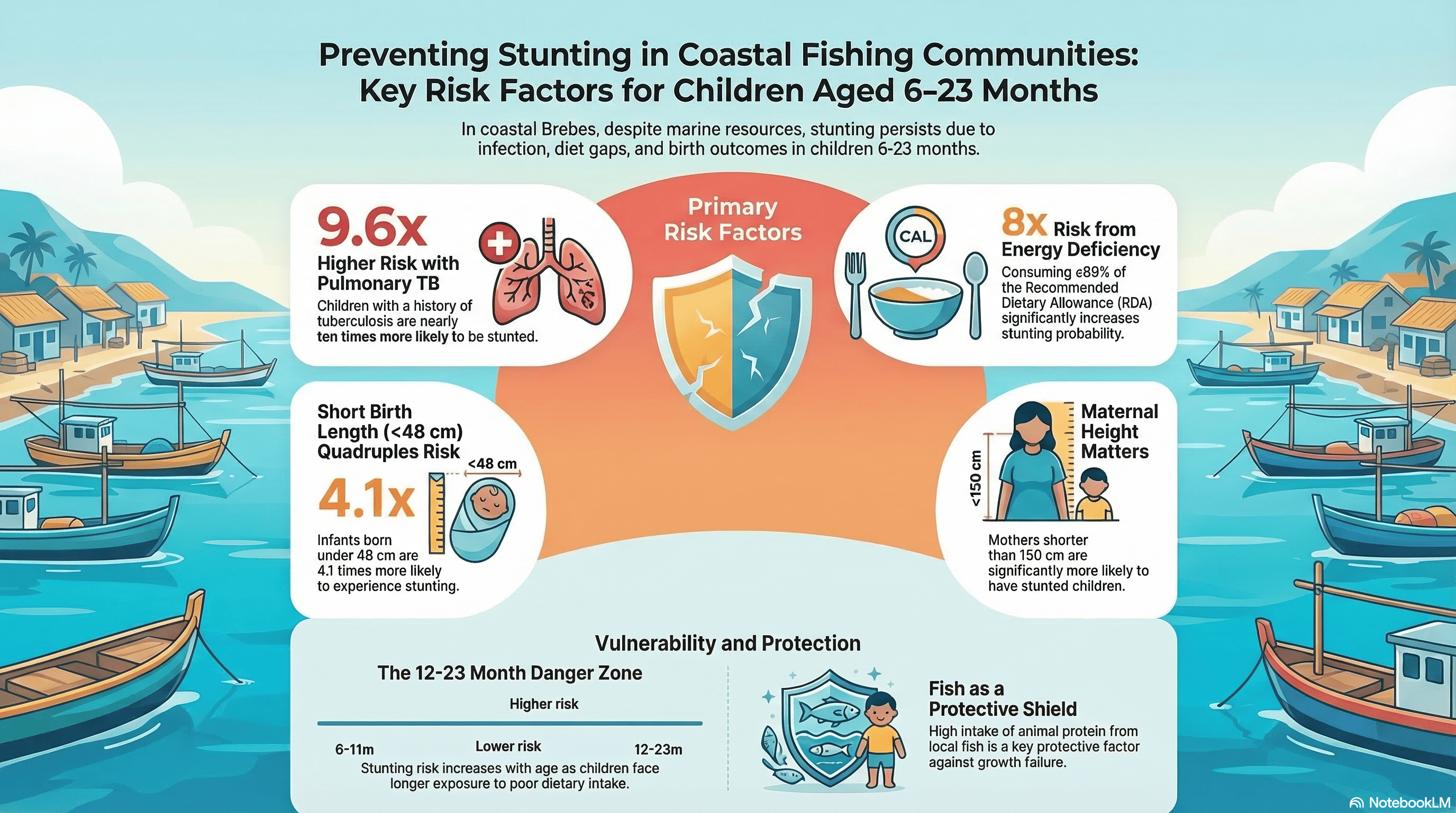
Stunting remains a major public health problem, particularly in coastal communities where poverty and limited dietary diversity are prevalent. Children in fishing families are vulnerable due to low household income, inadequate food intake, and exposure to infections. This study aimed to identify and analyze the risk factors associated with stunting among children aged 6–23 months in fishing families in Brebes Regency, Central Java. A matched case-control study was conducted from April to May 2025 in three coastal villages (Kluwut, Grinting, and Pulogading), Bulakamba Subdistrict, Brebes. A total of 132 subjects were enrolled, consisting of 44 stunting cases and 88 controls matched by age. Data were collected on child, maternal, and household characteristics, dietary intake, and health status. Statistical analyses included Chi-square test and Binary Logistic Regression to determine significant risk factors (p<0.05). The results showed that children with a history of pulmonary TB had an 9.622 times higher risk of being stunted (OR = 8.120; 95% CI: 1.009–91.735; p = 0.049). Inadequate energy intake (≤89% RDA) had an 8.12 times higher risk of stunting (OR = 8.120; 95% CI: 2.552–25.839; p = 0.001). Birth length <48 cm increased the risk of stunting by 4.105 times ((OR = 4.105; 95% CI: 1.593-10.575; p = 0.003). Meanwhile, age 6-11 months showed a protective effect (OR=0.343; 95% CI: 0.135-0.869; p=0.024).
Downloads
References
Anggraini F, Nurjihadi M. Strategi nafkah rumah tangga dalam menghadapi kemiskinan masyarakat daerah pesisir Desa Labuhan Ijuk. Nusant J Econ. 2020;2(1):1–6.
Shan CH, Ali A, Zakaria NS, Yusof HM. Assessment of diet quality and its association with nutritional status among fishermen’s children in Terengganu. Malaysian Appl Biol. 2018;47(6):137–44.
Al Rahmad AH, Miko A, Labatjo R, Fajriansyah, Fitri Y, Suryana. Malnutrition prevalence among toddlers based on family characteristics: A cross-sectional study in the rural and urban areas of Aceh, Indonesia. Sri Lanka J Child Heal. 2020;49(3):263–8.
Sumarmi S, Mahmudiono T, Melaniani S. Household food insecurity and undernutrition in children below 5 years living in different geographical areas in East Java, Indonesia. Malays J Nutr. 2018;24(4):529–38.
Saputra W, Nurrizka RH. Faktor Demografi dan Risiko Gizi Buruk dan Gizi Kurang. Makara. 2012;16(2):95–101.
Satriani, Cahyati WH, Yuniastuti A. Disparity of Risk Factors Stunting on Toddlers in the Coast and the Mountain Areas of Sinjai, South Sulawesi. Public Heal Perspect J [Internet]. 2019;4(3):196–205. Tersedia pada: http://journal.unnes.ac.id/sju/index.php/phpj
Islamiah WE, Nadhiroh SR, Putri EBP, Farapti, Apris C, Christiwan, et al. The Correlation between Food Security with Stunting Toodler from Fisherman Family. Media Gizi Indones. 2022;17(1SP):83–9.
Nurrizka RH, Ammar MI, Buntara A, Makkiyah FA. Indonesian Under Five Years of Age Children’s Malnutrition: A Case Study of Fisherman Community in Jakarta Bay. In: International Conference of Health Development. 2020. hal. 202–8.
Owino V, Ahmed T, Freemark M, Kelly P, Loy A, Manary M, et al. Environmental enteric dysfunction and growth failure/stunting in global child health. Pediatrics. 2016;138(6).
World Health Organization. Improving early childhood development: WHO guideline [Internet]. World Health Organization; 2020. Tersedia pada: https://www.who.int/publications/i/item/97892400020986
Svefors P, Sysoev O, Ekstrom EC, Persson LA, Arifeen SE, Naved RT, et al. Relative importance of prenatal and postnatal determinants of stunting: Data mining approaches to the MINIMat cohort, Bangladesh. BMJ Open. 2019;9(8):1–12.
Habimana S, Biracyaza E. Risk Factors for Stunting Among Children Under Five Years of Age in the Eastern and Western Provinces of Rwanda: Analysis of Rwanda Demographic and Health Survey 2014/2015. Pediatr Heal Med Ther. 2019;(10):115–30.
Hadi H, Fatimatasari F, Irwanti W, Kusuma C, Alfiana RD, Asshiddiqi MIN, et al. Exclusive Breastfeeding Protects Young Children from Stunting in a Low-Income Population: A Study from Eastern Indonesia. Nutrients. November 2021;13(12).
Huriah T, Nurjannah N. Risk Factors of Stunting in Developing Countries: A Scoping Review. Open Access Maced J Med Sci. 2020;8(F):155–60.
Manggala AK, Wiswa K, Kenwa M, Me M, Kenwa L, Agung A, et al. Risk Factor of Stunting. Paediatr Indones. 2018;58(5):205–12.
Agussalim, Zulkifli A, Nasry Noor N, Ansariadi, Stang, Riskiyani S. Risk Factor Analysis of Stunting in Children Aged 6-23 Months in Tanralili District, Maros Regency, Indonesia. Natl J Community Med. 2024;15(7):559–65.
Dinas Kesehatan Provinsi Jawa Tengah. Rencana Strategis Dinas Kesehatan Provinsi Jawa Tengah 2024-2026 [Internet]. Semarang; 2023. Tersedia pada: https://ppid.rsjd-sujarwadi.jatengprov.go.id/view-document/berkala/29
Badan Kebijakan Pembangunan Kesehatan. Survei Kesehatan Indonesia (SKI) dalam Angka [Internet]. Jakarta; 2024. Tersedia pada: https://repository.badankebijakan.kemkes.go.id/id/eprint/5539
BPS Kabupaten Brebes. Kabupaten Brebes Dalam Angka 2024 [Internet]. Brebes: BPS Kabupaten Brebes; 2024. Tersedia pada: https://brebeskab.bps.go.id/id/publication/2024/02/28/f05607ef4dd41d9512bce354/kabupaten-brebes-dalam-angka-2024.html
Yuliantini E, Sukiyono K, Yuliarso MZ, Sulistyo B. Food Security and Stunting Incidences in the Coastal Areas of Indonesia. Open Access Maced J Med Sci. 2022;10(F):454–61.
Charan J, Biswas T. How to Calculate Sample Size for Different Study Designs in Medical Research? Indian J Psychol Med. 2013;35(2):121–6.
Pemerintah Provinsi Jawa Tengah. Keputusan Gubernur Jawa Tengah Nomor 561/57 Tahun 2023 tentang Upah Minimum Kabupaten/Kota [Internet]. Tersedia pada: https://jdih.jatengprov.go.id/inventarisasi-hukum/download/kepgub_561-57_th_2023
Badan Pusat Statistik. Penyempurnaan Penyusunan Indeks Pembangunan Regional [Internet]. Jakarta: BPS 2013. Tersedia pada: https://www.bps.go.id/id/publication/2010/12/20/c4fe2337c19f6fb53a75b165/penyempurnaan-penyusunan-indeks-pembangunan-regional.html
Ibrahim NIF. Faktor Risiko Stunting Pada Anak Usia 6-24 Bulan di Wilayah Pesisir Kabupaten Nabire [Internet]. IPB University; 2023. Tersedia pada: http://repository.ipb.ac.id/handle/123456789/124668
Dalimunthe SM. Gambaran Faktor-Faktor Kejadian Stunting Pada Balita Usia 24-59 Bulan di Provinsi Nusa Tenggara Barat Tahun 2010 (Analisis Data Sekunder Riskesdas 2010) [Internet]. UIN Syarif Hidayatullah; 2015. Tersedia pada: http://repository.uinjkt.ac.id/dspace/handle/123456789/37993
Tanziha I, Khomsan A, Sumarti T, Dina RA, Diana R, Rohmaeni Y. Children’s Food Habits and Food Security among Households in Low and High Gender Equality in Indonesia: Kebiasaan Makan Balita dan Ketahanan Pangan Rumah Tangga di Daerah Kesetaraan Gender Rendah dan Tinggi di Indonesia. Amerta Nutrition. 2023;7(3):365–376.
Abri N, Thaha AR, Jafar N. Relationship Between Economic Status, Infectious Diseases and Urinary Iodine Excretion with Stunting Incidence of Elementary School Children in IDD Endemic Areas, Enrekang Regency. J Heal Nutr Res. 2022;1(3):133–9.
Batiro B, Demissie T, Halala Y, Anjulo AA. Determinants of stunting among children aged 6-59 months at Kindo Didaye woreda, Wolaita Zone, Southern Ethiopia: Unmatched case control study. PLoS One. 2017;12(12):1–15.
Amsalu ET, Akalu TY, Gelaye KA. Spatial distribution and determinants of acute respiratory infection among under-five children in Ethiopia: Ethiopian demographic Health Survey 2016. PLoS One. 2019;14(4):1–14.
Sarfraz A, Jamil Z, Ahmed S, Umrani F, Qureshi AK, Jakhro S, et al. Impact of diarrhoea and acute respiratory infection on environmental enteric dysfunction and growth of malnourished children in Pakistan: a longitudinal cohort study. Lancet Reg Heal Southeast Asia. 2023;15.
Moschovis PP, Addo-Yobo EO., Banajeh S, Chisaka N, Christiani DC, Hayden D, et al. Stunting is associated with poor outcomes in childhood pneumonia. Trop Med Int Heal. 2015;20(10):1320–8.
Nataprawira HM, Cesilia C, Tirtosudiro MA, Rinawan FR, Wulandari DA, Sudarwati S, et al. Tuberculosis (TB) Status in Under-Five Children with Stunting in Bandung. Glob Pediatr Heal. 2024;11(38).
Bogler L, Jantos N, Bärnighausen T, Vollmer S. Estimating the effect of measles vaccination on child growth using 191 DHS from 65 low- and middle-income countries. Vaccine. 2019;37:5073–88.
Sato R. Association between uptake of selected vaccines and undernutrition among Nigerian children. Hum Vaccines Immunother. 2021;17(8):2630–8.
Moshi CC, Sebastian PJ, Azizi KA, Killel E, Mushumbusi DG, Meghji WP, et al. Effect of Deworming on Health Outcomes among Children Aged 12-59 Months in Tanzania: A Multilevel Mixed Effects Analysis. J Nutr Metab. 2023;
Adrizain R, Faridah L, Fauziah N, Berbudi A, Afifah DN, Setiabudi D, et al. Factors influencing stunted growth in children: A study in Bandung regency focusing on a deworming program. Parasite Epidemiol Control. 2024;26.
Punuh MI, Akili RH, Mandagi C. Energy intake, household food security and stunting in toddlers at the health center of Molibagu, South Bolaang Mongondow Regency. Int J Community Med Public Heal. 2025;12(6):2460–4.
Hardinsyah, Supariasa IDN. Ilmu Gizi: Teori & Aplikasi. Jakarta: EGC; 2017.
Trisasmita L, Randabunga AEL. Protein Intake, Dietary Diversity, and Length-for-Age Nutritional Status Among Children Aged 6-23 Months: A Comprehensive Overview Study. Journal of Global Nutrition. 2025;5(1):443–453.
Ramadhani FN, Kandarina BI, Gunawan IMA. Pola asuh dan pola makan sebagai faktor risiko stunting balita usia 6-24 bulan suku Papua dan non Papua. Ber Kedokt Masy. 2019;35(5):175–83.
van Stuijvenberg ME, Nel J, Schoeman SE, Lombard CJ, du Plessis LM, Dhansay MA. Low intake of calcium and vitamin D, but not zinc, iron or vitamin A, is associated with stunting in 2- to 5-year-old children. Nutrition. 2015;31(6):841–6.
Asfiyatus S, Dewi RK. The Role of Animal Protein in Preventing Stunting in Toddlers. J Ris Sains dan Teknol. 2022;6(1):95–100.
Headey D, Hirvonen K, Hoddinott J. Animal Sourced Foods and Child Stunting. Am J Agric Econ. Juli 2018;100(5):1302–19.
Kaimila Y, Divala O, Agapova SE, Stephenson KB, Thakwalakwa C, Trehan I, et al. Consumption of Animal-Source Protein is Associated with Improved Height-for-Age Z Scores in Rural Malawian Children Aged 12–36 Months. Nutrients. 2019;11(2):1–21.
Nabilah K, Muhdar IN, Lestari WA, Sariman S. The Relationship Between Macro-Nutrient Intake, Food Security, and Nutrition-Related Knowledge with The Incidence of Stunting in Toddlers. J Heal Nutr Res. 2024;3(2):164–71.
Widyawardani N, Bustamam N, Aprilia CA, Hardini N, Prasetio PO, Yusuf KN, et al. Analysis of macronutrient and micronutrient intake with the incidence of stunting and wasting in toddlers 0-59 months of age at public health center Bojong, Bogor regency. World Nutr J. 2024;7(i2):78–89.
Ross AC, Caballero BH, Cousins RJ, Tucker KL, Ziegler TR. Modern nutrition in health and disease. 11th ed. Wolters Kluwer Health Adis; 2012.
Saptarini I, Rizkianti A, Arfines PP. Dampak Depresi Parental Terhadap Kejadian Stunting di Indonesia. Bul Penelit Kesehat. 2020;48(1):1–10.
Qurani RM, Karuniawaty TP, John RE, Wangiyana NKAS, Setiadi QH, Tengkawan J, et al. Correlation Between Maternal Factor and Stunting Among Children of 6-12 Months Old in Central Lombok. J Public Heal Res Community Heal Dev. 2022;5(2):107–16.
Addo OY, Stein AD, Fall CH, Gigante DP, Guntupalli AM, Horta BL, et al. Maternal height and chil groiwth patterns. J Pediatr. 2013;163(2):549-554.
Pusparini, Ernawati F, Hardinsyah, Briawan D. Indeks Massa Tubuh Rendah pada Awal Kehamilan dan Defisiensi Vitamin A pada Trimester Kedua Sebagai Faktor Risiko Gangguan Pertumbuhan Linier pada Bayi Lahir. J Gizi Pangan [Internet]. 2016;11(3):191–200. Tersedia pada: https://journal.ipb.ac.id/jgizipangan/article/view/16454/12073
Dewi R, Evrianasari N, Yuviska IA. Kadar Hb,Lila dan Berat Badan Ibu Saat Hamil Berisiko Terhadap Kejadian Stunting Pada Anak Usia 1-3 Tahun. J Kebidanan Malahayati. 2020;6(1):57–64.
Tawari RH., Hastari P, Haruna. Persepsi Penerapan Kebijakan Kuota dan Dampaknya Bagi Nelayan Lokal dalam Skema Penangkapan Ikan Terukur di Kepulau Banda. Amanisal J Teknol dan Manaj Perikan Tangkap. 2025;14(1):59–70.
Rahmawati D, Agustin L. Hubungan Tingkat Pendidikan Ibu dan Pemberian Informasi Tentang Stunting dengan Kejadian Stunting. J Ilmu Kesehat. 2020;9(1):80–5.
Perdana P, Latief S, Darma S, Darussalam AHE, Samosir ADP. Narrative Review: Hubungan Faktor Sosial Demografi terhadap Kejadian Stunting. Fakumi Med J J Mhs Kedokt. 2025;5(2):76–84.
Husna A, Willis R, Rahmi N, Fahkrina D. Hubungan Pendapatan Keluarga dan Pemberian ASI Eksklusif dengan Kejadian Stunting pada Balita Usia 24-36 Bulan di Wilayah Kerja Puskesmas Sukajaya Kota Sabang. J Healthc Technol Med. 2023;9(1):2615–109.
Purwanti R, Ginting IAB, Aulia NP, Dieny FF. Karakteristik Keluarga, Ketahanan Pangan, Pengeluaran Pangan, dan Keanekaragaman Pangan Keluarga dengan dan Tanpa WaSt (Wasting-Stunting) pada Anak di Kota Semarang. Amerta Nutr. 2024;8(3):228–39.
Veronika S, Dolorosa E, Imelda I. Determinan Ketahanan Pangan Rumah Tangga Nelayan di Desa Sungai Kakap, Kecamatan Sungai Kakap. Bul Ilm Mar Sos Ekon Kelaut dan Perikan. 2025;11(1):73–84.
Wado LAL, Sumargo T, Armawi W. Sosio Demografi Ketahanan Pangan Keluarga Dalam Hubungannya Dengan Kejadian Stunting Pada Anak Usia 1 – 5 Tahun (Studi Di Wilayah Kerja Puskesmas Bandarharjo Kelurahan Tanjung Mas, Kecamatan Semarang Utara, Kotamadya Semarang, Provinsi Jawa Tengah). Jurnal Ketahanan Nasional. 2019;25(2):178.
Jahiroh N, Prihartono N. Hubungan Stunting dengan Kejadian Tuberkulosis pada Balita. The Indonesian Journal of Infectious Diseases. 2017;1(2):6–13.
Ikhtiarti W, Rahfiludin MZ, Nughraheni SA. Faktor Determinan yang Berhubungan dengan Kejadian Stunting Pada Balita Usia 1–3 Tahun di Wilayah Pesisir Kabupaten Brebes. Jurnal Ilmiah Mahasiswa, 2020;10(2):51-56.
Silva ID, Sumarto S. Child malnutrition in Indonesia: Can education, sanitation and healthcare augment the role income?. Journal of International Development. 2018;30(5).
Sidiq R, Dewata I, Heldi H, Syah N, Handayuni L. The Spread of Tuberculosis Cases in the Highlands and Coastal Areas of Padang. Kesmas: Jurnal Kesehatan Masyarakat Nasional. 2025;20(1).
Yuliantini E, Kamsiah K, Maigoda T, Ahmad A. Asupan makanan dengan kejadian stunting pada keluarga nelayan di Kota Bengkulu. AcTion: Aceh Nutrition Journal. 2022;7(1):79-88.
Wati L, Atrie UY, Pujiati W, Widiastuti L, Siagian Y, Indaryani. Faktor-Faktor yang Berhubungan dengan Status Gizi pada Balita di Wilayah Pesisir Kelurahan Kampung Bugis. Jurnal Riset Media Keperawatan. 2024;7(2):20–30.
Sudikno, Eko S, Irawan IR, Aditianti, Widodo Y, Nurhidayati N, et al. Faktor Risiko Stunting Balita 0-23 Bulan di Indonesia. Penel Gizi Makan. 2022;45(2):101–10.
Rahayu HK, Muhlis ANA, Bakhtiar R, Wijaya RH, Akbar MF, Dzakwan SA, et al. Association Between Birth Weight, Birth Length, and Stunting: A Case Analysis at Lempake Public Health Center, East Kalimantan, Indonesia. J Community Med Public Heal Res. 2025;6(1):50–9.
Swathma D, Lestari H, Teguh R. Riwayat Imunisasi Dasar Terhadap Kejadian Stunting Pada Balita Usia 12-36 Bulan di Wilayah Kerja Puskesmas Kandai Kota Kendari Tahun 2016. JIMKesmas. 2016;1(3):1–10.
Abdillah S. The Effect of Maternal and Child Factors on Stunting in Children Under Five Years in Rural Indonesia. KnE Life Sci. 2022;813–22.
Andini V, Maryanto S, Mulyasari I. The Correlation Between Birth Length, Birth Weight and Exclusive Breastfeeding with the Incidence of Stunting in Children Age Group 7-24 Months in Wonorejo Village, Pringapus District, Semarang Regency. J Gizi dan Kesehat. 2020;12(1):49–58.
Karlsson O, Kim R, Moloney GM, Hasman A, Subramanian S. Patterns in child stunting by age: A cross-sectional study of 94 low- and middle-income countries. Matern Child Nutr. Oktober 2023;19(4).
Published
How to Cite
Issue
Section
Copyright (c) 2026 Hanin Maulida Fasya, Dodik Briawan, Ali Khomsan

This work is licensed under a Creative Commons Attribution-NonCommercial-ShareAlike 4.0 International License.
Most read articles by the same author(s)
- Nur Laily Ramdhani, Cesilia Meti Dwiriani, Ali Khomsan , Determinants of Iron Supplementation Compliance Among Adolescent Girls in Kuningan Regency, Indonesia , Journal of Health and Nutrition Research: Vol. 4 No. 3 (2025)
- Rina Oktasari, Hadi Riyadi, Ali Khomsan, Katrin Roosita, Yulin Lestari, Parity, Interpregnancy Interval, and Socioeconomic Status in Relation to Low Birth Weight: A Prospective Cohort in Yogyakarta , Journal of Health and Nutrition Research: Vol. 5 No. 1 (2026)
- Besti Verawati, Hadi Riyadi, Ali Khomsan, Ikeu Ekayanti, Lifestyle Behaviors and Risk of Metabolic Syndrome: A Case-Control Study among Fishermen and Oil Palm Farmers , Journal of Health and Nutrition Research: Vol. 4 No. 3 (2025)
- Sofyan Musyabiq Wijaya, Sri Anna Marliyati, Dodik Briawan, Eny Palupi, Bioavailability of Iron in Chicken Nuggets with the Addition of Chicken Liver and Moringa Leaves , Journal of Health and Nutrition Research: Vol. 5 No. 1 (2026)
- Rahmauldianti Safitri, Cesilia Meti Dwiriani, Dodik Briawan, Diet Quality, Nutrient Intake, and Estimated Iron and Zinc Bioavailability in Stunted and Normal Toddlers in Bogor Regency, Indonesia: A Comparative Study , Journal of Health and Nutrition Research: Vol. 5 No. 2 (2026)