Parity, Interpregnancy Interval, and Socioeconomic Status in Relation to Low Birth Weight: A Prospective Cohort in Yogyakarta
Keywords:
Low Birth Weight, Parity, Interpregnancy Interval, Socioeconomic Factors, Prospective StudiesAbstract
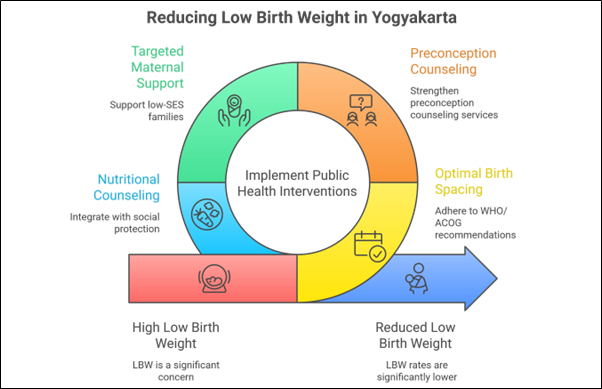
Low birth weight (LBW, <2,500 g) remains a critical public health problem, contributing to neonatal mortality and long-term risk of non-communicable diseases, and national estimates in Indonesia indicate a prevalence ranging from approximately 6.2% to 11.7%. Parity and interpregnancy interval (IPI) are important reproductive determinants of perinatal outcomes, and their effects may be modified by socioeconomic status (SES). This study aimed to investigate the association between parity and IPI with LBW and to assess whether SES modifies these associations in a prospective cohort of pregnant women in Yogyakarta, Indonesia. A total of 120 women (poor households n=48; non-poor households n=72) were recruited purposively from community health centers and a maternity hospital/clinic. Inclusion criteria were gestational age 26–35 weeks, maternal age 20–35 years, parity 1–2, non-smoker, and provision of informed consent. Pre-pregnancy BMI was obtained through maternal recall of the last measured height and weight before conception. Data were analyzed using Pearson’s χ² tests for baseline comparisons and stratified logistic regression models to estimate adjusted odds ratios (aORs) with 95% confidence intervals. The prevalence of LBW was higher among women with non-optimal IPI (<24 or >60 months and primigravida) compared to those with optimal IPI (24–60 months). Multiparity showed a protective tendency against LBW, particularly among non-poor women. SES significantly modified the association between IPI and LBW (p for interaction <0.05). These findings suggest that multiparity may reduce LBW risk, whereas non-optimal IPI increases it, with SES acting as an effect modifier. Strengthening preconception counseling on birth spacing and targeted support for low-SES families are warranted
Downloads
References
Okwaraji YB, Krasevec J, Bradley E, Conkle J, Stevens GA, Gatica‑Domínguez G, et al. National, regional, and global estimates of low birthweight in 2020, with trends from 2000: a systematic analysis. Lancet. 2024;403(10432):ePub ahead of print. doi:10.1016/S0140‑6736(23)01198‑4.
UNICEF. Low birthweight. New York: UNICEF Data; 2023. Available from: https://data.unicef.org/topic/nutrition/low-birthweight/
World Health Organization. Joint low birthweight estimates. Geneva: WHO; 2023. Available from: https://www.who.int/teams/nutrition-and-food-safety/monitoring-nutritional-status-and-food-safety-and-events/joint-low-birthweight-estimates
Shah PS; Knowledge Synthesis Group on Determinants of LBW/PT Births. Parity and low birth weight and preterm birth: a systematic review and meta-analyses. Acta Obstet Gynecol Scand. 2010 Jul;89(7):862-875. doi:10.3109/00016349.2010.486827.
Mgaya AH, Massawe SN, Kidanto HL, Mgaya HN. Grand multiparity: is it still a risk in pregnancy? BMC Pregnancy Childbirth. 2013;13:241. doi:10.1186/1471-2393-13-241.
Ministry of Health Republic of Indonesia. National Report: Riset Kesehatan Dasar (Riskesdas) 2018. Jakarta: National Institute of Health Research and Development; 2019.
World Health Organization. Report of a WHO Technical Consultation on Birth Spacing. Geneva: WHO; 2007. Available from: https://apps.who.int/iris/handle/10665/69855
American College of Obstetricians and Gynecologists. Interpregnancy Care. Obstet Care Consensus. 2019;OC 8. Available from: https://www.acog.org/clinical/clinical-guidance/obstetric-care-consensus/articles/2019/01/interpregnancy-care
Ni W, Gao X, Su X, Cai J, Zhang S, Zheng L, Liu J, Feng Y, Chen S, Ma J, Cao W, Zeng F. Birth spacing and risk of adverse pregnancy and birth outcomes: a systematic review and dose–response meta-analysis. Acta Obstet Gynecol Scand. 2023;102(12):1377-1393. doi:10.1111/aogs.14648.
Beyene FY, Wudineh KG, Bantie SA, Tesfu AA. Effect of short inter-pregnancy interval on perinatal and maternal outcomes among pregnant women in sub-Saharan Africa: a systematic review and meta-analysis. PLoS One. 2025 Jan 7;18(1):e0294747. doi:10.1371/journal.pone.0294747.
Wen X, Liang W, Zhai J, Wang Y, Zheng P, Wang S. The association between interpregnancy intervals and preterm birth: a systematic review and meta-analysis. BMC Pregnancy Childbirth. 2025;25:226. doi:10.1186/s12884-025-07259-y.
Li S, Li J, Du L, Wang X, Zhang Y, Xiao Y, Pan C, Huo Y. Association between parity and adverse maternal and neonatal outcomes: a population-based cross-sectional study. Front Med. 2025;12:1697655. doi:10.3389/fmed.2025.1697655.
Muniro Z, Tarimo CS, Mahande MJ, Maro E, Mchome B. Grand multiparity as a predictor of adverse pregnancy outcome among women who delivered at a tertiary hospital in Northern Tanzania. BMC Pregnancy Childbirth. 2019;19:222. doi:10.1186/s12884-019-2377-5.
Wulandari F, Mahmudiono T, Rifqi MA, Helmyati S, Dewi M, Yuniar CT. Maternal characteristics and socio-economic factors as determinants of low birth weight in Indonesia: analysis of the 2017 Indonesian Demographic and Health Survey (IDHS). Int J Environ Res Public Health. 2022 Oct 26;19(21):13892. doi:10.3390/ijerph192113892.
Ekoriano M, Widiyanto A, Muthmainnah M, Devi YP, Cahyono BE, Nafsi I, Widodo T. Profile and factors associated with low birth weight in Indonesia: a national data survey. Rural Remote Health. 2025 Feb;25(1):9170. doi:10.22605/RRH9170.
von Elm E, Altman DG, Egger M, Pocock SJ, Gøtzsche PC, Vandenbroucke JP; STROBE Initiative. The Strengthening the Reporting of Observational Studies in Epidemiology (STROBE) statement: guidelines for reporting observational studies. J Clin Epidemiol. 2008 Apr;61(4):344–349. doi:10.1016/j.jclinepi.2007.11.008..
Lachat C, Hawwash D, Ocké MC, Berg C, Forsum E, Hörnell A, Larsson C, Sonestedt E, Wirfält E, Åkesson A, et al. Strengthening the Reporting of Observational Studies in Epidemiology—Nutritional Epidemiology (STROBE-nut): an extension of the STROBE statement. PLoS Med. 2016 Jun 7;13(6):e1002036. doi:10.1371/journal.pmed.1002036.
Victora CG, Christian P, Vidaletti LP, Gatica-Domínguez G, Menon P, Black RE. Revisiting maternal and child undernutrition in low-income and middle-income countries: variable progress towards an unfinished agenda. Lancet. 2021;397(10290):1388-1399. doi:10.1016/S0140-6736(21)00394-9.
Yanti FD, Ginting RMS, Susanti E. The effect of chronic energy deficiency, anemia, and compliance with iron supplement consumption in pregnant women on low birth weight. J Health Nutr Res. 2024;3(1):68–73. doi: 10.56303/jhnresearch.v3i1.201.
Suriati I, Juliani R. Impact of maternal nutritional status on morning sickness severity and fetal health: a correlational study. J Health Nutr Res. 2025;4(2):435–443. doi: 10.56303/jhnresearch.v4i2.396.
Lin L, Lu C, Chen W, Li C, Guo VY, et al. Parity and the risks of adverse birth outcomes: a retrospective study among Chinese. BMC Pregnancy Childbirth. 2021;21:257. doi:10.1186/s12884-021-03718-4.
Sutan R, Mohtar M, Mahat AN, Tamil AM. Determinant of low birth weight infants: a matched case-control study. Open J Prev Med. 2014;4(3):91–99. doi:10.4236/ojpm.2014.43013.
Muniro Z, Tarimo CS, Mahande MJ, Maro E, Mchome B. Grand multiparity as a predictor of adverse pregnancy outcome among women who delivered at a tertiary hospital in Northern Tanzania. BMC Pregnancy Childbirth. 2019;19:222. doi:10.1186/s12884-019-2377-5.
Titaley CR, Mu’asyaroh A, Que BJ, Tjandrarini DH, Ariawan I. Determinants of early neonatal mortality: secondary analysis of the 2012 and 2017 Indonesia Demographic and Health Survey. Front Pediatr. 2024 Jan 18;12:1288260. doi:10.3389/fped.2024.1288260.
Titaley CR, Tjandrarini DH, Malakauseya MLV, Ariawan I, Iwan RF, Istia SS, et al. Determinants of non-use of antenatal care services in eastern Indonesia: analysis of the 2023 Indonesia Health Survey. Front Glob Womens Health. 2025 Aug 18;6:1649276. doi:10.3389/fgwh.2025.1649276.
Blumenshine P, Egerter S, Barclay CJ, Cubbin C, Braveman PA. Socioeconomic disparities in adverse birth outcomes: a systematic review. Am J Prev Med. 2010;39(3):263-272. doi:10.1016/j.amepre.2010.05.012.
Ospina MB, Voaklander D, Senthilselvan A, Osornio-Vargas A, Mganga E. Socioeconomic gradients of adverse birth outcomes and related maternal factors in Alberta, Canada: a retrospective cohort study. BMJ Open. 2020;10(6):e033296. doi:10.1136/bmjopen-2019-033296.
Sow M, Gonçalves AN, Corman J. Associations between socioeconomic status and adverse pregnancy outcomes in Brussels and Montreal: a cross-sectional analysis. BMC Public Health. 2022;22:910. doi:10.1186/s12889-022-13165-1
Kozuki N, Lee ACC, Silveira MF, Victora CG, Adair L, Humphrey J, et al.; Child Health Epidemiology Reference Group Small-for-Gestational-Age-Preterm Birth Working Group. The associations of birth intervals with small-for-gestational-age, preterm, and neonatal and infant mortality: a meta-analysis. BMC Public Health. 2013;13(Suppl 3):S3. doi:10.1186/1471-2458-13-S3-S3.
Owusu-Addo E, Renzaho AMN. The impact of cash transfers on social determinants of health and health inequalities in Sub-Saharan Africa: a systematic review. Health Policy Plan. 2018;33(5):675–696. doi: 10.1093/heapol/czy020.
Neupane S, Scott S, Piwoz E, Kim SS, Menon P, Nguyen PH. More is not enough: High quantity and high quality antenatal care are both needed to prevent low birthweight in South Asia. PLOS Glob Public Health. 2023;3(6):e0001991. doi:10.1371/journal.pgph.0001991
Published
How to Cite
Issue
Section
Copyright (c) 2026 Rina Oktasari, Hadi Riyadi, Ali Khomsan, Katrin Roosita, Yulin Lestari

This work is licensed under a Creative Commons Attribution-NonCommercial-ShareAlike 4.0 International License.
Most read articles by the same author(s)
- Nur Laily Ramdhani, Cesilia Meti Dwiriani, Ali Khomsan , Determinants of Iron Supplementation Compliance Among Adolescent Girls in Kuningan Regency, Indonesia , Journal of Health and Nutrition Research: Vol. 4 No. 3 (2025)
- Besti Verawati, Hadi Riyadi, Ali Khomsan, Ikeu Ekayanti, Lifestyle Behaviors and Risk of Metabolic Syndrome: A Case-Control Study among Fishermen and Oil Palm Farmers , Journal of Health and Nutrition Research: Vol. 4 No. 3 (2025)
- Novi Puspita Sari, Lilik Kustiyah, Hadi Riyadi, The Correlations of Body Image, Eating Behavior Types, and Energy and Nutrient Adequacy Level with Anemia Status in Adolescent Girls at SMAN 1 Dramaga, Bogor Regency , Journal of Health and Nutrition Research: Vol. 5 No. 1 (2026)
- Hanin Maulida Fasya, Dodik Briawan, Ali Khomsan, Risk factors of stunting incidence among children aged 6-23 months in fishing families in Brebes Regency , Journal of Health and Nutrition Research: Vol. 5 No. 1 (2026)
- Besti Verawati, Rina Oktasari, Ai Kustiani, Nuryani Nuryani, Food Diversity and Diet Quality as Determinants of Metabolic Syndrome in Fishermen Communities , Journal of Health and Nutrition Research: Vol. 5 No. 2 (2026)
- Hafika Yunisari Pradina, Katrin Roosita, Ahmad Sulaeman, Hardinsyah Hardinsyah, Stefanus Indrayana, Association of Contribution and Adequacy Levels of Energy and Nutrients from Supplementary Foods with Perceived Breast Milk Sufficiency among Lactating Mothers in a Stunting Prevention Program , Journal of Health and Nutrition Research: Vol. 5 No. 1 (2026)
- Fathimah Fathimah, Katrin Roosita, Budi Setiawan, Zuraidah Nasution, Mohamad Rafi, Global Knowledge Structure and Research Fronts of Kaempferol in Antidiabetic Studies: A Bibliometric and Science Mapping Analysis , Journal of Health and Nutrition Research: Vol. 5 No. 2 (2026)