Effect of nutritious snacks provision on breakfast adequacy and nutritional status of elementary school students
Keywords:
Breakfast Adequacy, GENIUS Program, Nutritional Status, School-aged Children, Snack ProvisionAbstract
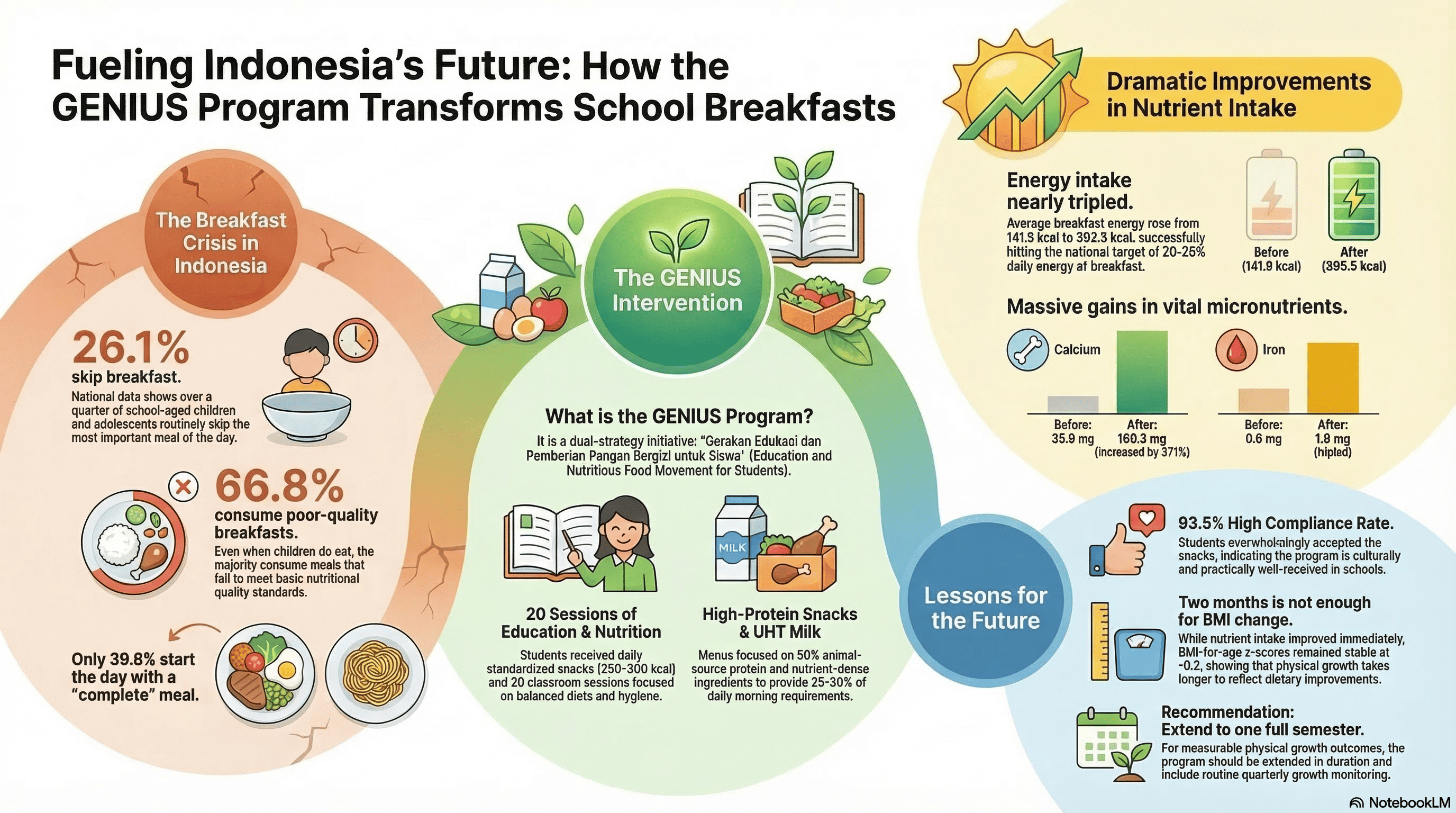
Inadequate breakfast intake and malnutrition remain significant public health concerns among school-aged children in Indonesia, particularly in regions with a high Prevalence of Undernourishment (PoU). To address this, the National Food Agency (BAPANAS) implemented the GENIUS program (Gerakan Edukasi dan Pemberian Pangan Bergizi untuk Siswa), which integrates nutrition education with the provision of standardized nutritious snacks. This study aims to analyze the impact of the GENIUS program on breakfast adequacy and nutritional status among elementary school students in ten Indonesian provinces with PoU exceeding 5%. A pre-experimental pre–post study design was employed, involving 4,953 students in grades 4-6. The intervention consisted of 20 nutrition education sessions and the daily provision of standardized snacks (250–300 kcal per serving) and UHT milk over a two-month period. Breakfast adequacy was assessed using 24-hour breakfast recalls. Snack compliance was also monitored daily. The intervention led to significant improvements in breakfast nutrient intake (p < 0.05). Mean energy intake increased from 141.9 kcal to 393.5 kcal, protein from 4.0 g to 11.5 g, fat from 5.6 g to 14.9 g, and carbohydrates from 17.7 g to 48.9 g. Substantial gains were also observed for key micronutrients, including calcium, phosphorus, and iron . Despite these dietary improvements, BMI-for-age z-scores showed no meaningful change (-0.2 ± 1.4 at baseline vs. -0.2 ± 1.5 at endline), consistent with the short duration of the intervention. Snack compliance was notably high, with 93.5% of students achieving high adherence (≥70%). The GENIUS program effectively enhanced the quality and adequacy of breakfast among students in food-insecure regions. While the two-month duration was sufficient to improve nutrient intake, it was inadequate to produce measurable changes in nutritional status. Future programs should consider longer implementation periods and strengthened school-family engagement to support sustained improvements in growth outcomes
Downloads
References
Kebijakan Pembangunan B, Kementerian K, Ri K. Survei Kesehatan Indonesia (SKI) dalam Angka. 2023.
Harahap H, Widodo Y, Sandjaja S, Khouw I, Deurenberg P. Quantity And Quality Of Breakfast Of Children Aged 2.0 To 12.9 Years In Indonesia. Gizi Indonesia [Internet]. 2 Juli 2019;42(1):31. Tersedia pada: https://persagi.org/ejournal/index.php/Gizi_Indon/article/view/355
Kemenkes. Riskesdas 2018 dalam angka, Indonesia [Internet]. 2018 [dikutip 13 Juli 2024]. Tersedia pada: chrome-extension://efaidnbmnnnibpcajpcglclefindmkaj/https://dinkes.babelprov.go.id/sites/default/files/dokumen/bank_data/20181228%20-%20Laporan%20Riskesdas%202018%20Nasional-1.pdf
Badan Pangan Nasional. Siapkan Generasi Emas 2045, NFA Dorong Budaya Sarapan Bergizi Sejak Usia Dini. 2023.
Indriasari R, Nadjamuddin U, Arsyad DS, Iswarawanti DN. School-based nutrition education improves breakfast-related personal influences and behavior of indonesian adolescents: A cluster randomized controlled study. Nutr Res Pract. 1 Oktober 2021;15(5):639–54.
BAPPENAS. Laporan Pelaksanaan Pencapaian Tujuan Pembangunan Berkelanjutan/ Sustainable Development Goals (TPB/SDGs) Tahun 2023 [Internet]. Jakarta; 2023. Tersedia pada: https://sdgs.bappenas.go.id/website/wp-content/uploads/2023/11/Laporan-tahunan-SDGs-2023.pdf
Royer MF, Guerithault N, Braden BB, Laska MN, Bruening M. Food Insecurity Is Associated with Cognitive Function: A Systematic Review of Findings across the Life Course. International Journal of Translational Medicine. 9 November 2021;1(3):205–22.
Zenebe M, Gebremedhin S, Henry CJ, Regassa N. School feeding program has resulted in improved dietary diversity, nutritional status and class attendance of school children. Ital J Pediatr [Internet]. 23 Desember 2018;44(1):16. Tersedia pada: https://ijponline.biomedcentral.com/articles/10.1186/s13052-018-0449-1
Andueza N, Navas-Carretero S, Cuervo M. Effectiveness of Nutritional Strategies on Improving the Quality of Diet of Children from 6 to 12 Years Old: A Systematic Review. Vol. 14, Nutrients. MDPI; 2022.
Dykstra H, Davey A, Fisher JO, Polonsky H, Sherman S, Abel ML, dkk. Breakfast-skipping and selecting low-nutritional-quality foods for breakfast are common among low-income urban children, regardless of food security status. Journal of Nutrition. 2016;146(3):630–6.
Hardinsyah, Aries M. Jenis Pangan Sarapan Dan Perannya Dalam Asupan Gizi Harian Anak Usia 6-12 Tahun Di Indonesia (Type of food for breakfast and its roles in daily nutrient intakes of school age children 6-12 years in Indonesia). Juli 2012;2(7).
Perdana F, Hardinsyah H. Analisis Jenis, Jumlah, Dan Mutu Gizi Konsumsi Sarapan Anak Indonesia. Jurnal Gizi dan Pangan [Internet]. 29 November 2013;8(1):39. Tersedia pada: http://journal.ipb.ac.id/index.php/jgizipangan/article/view/7251
Jiang Z, Song C, Shi M, Chen R, Hong Y, Zhang C, dkk. Effect of Customized Nutritious Breakfast and Nutrition Education on Nutritional Status of Preschool Children in Economically Underdeveloped Multi-Ethnic Areas: A Cluster Randomized Clinical Trial in Linxia, China. Nutrients. 1 Juli 2024;16(14).
Ong RT, Lao S, Seow SK, Dav VS, Ling MH. Systematic Review of PubMed Articles Prior to 2023 on Effects of Breakfast on School Performance. Medicon Medical Sciences [Internet]. 26 Desember 2023; Tersedia pada: https://themedicon.com/pdf/medicalsciences/MCMS-06-183.pdf
Liao SF, Tseng HM, Chen JD, Chen CM, Li SC. A Pilot Evaluation of a School-Based Nutrition Education Program with Provision of Fruits and Vegetables to Improve Consumption Among School-Age Children in Palau. Nutrients . 1 Maret 2025;17(6).
Nally S, Carlin A, Blackburn NE, Baird JS, Salmon J, Murphy MH, dkk. The effectiveness of school-based interventions on obesity-related behaviours in primary school children: A systematic review and meta-analysis of randomised controlled trials. Children. 1 Juni 2021;8(6).
Millward DJ. Nutrition, infection and stunting: the roles of deficiencies of individual nutrients and foods, and of inflammation, as determinants of reduced linear growth of children. Nutr Res Rev [Internet]. 23 Juni 2017;30(1):50–72. Tersedia pada: https://www.cambridge.org/core/product/identifier/S0954422416000238/type/journal_article
Schultz L, Ruel-Bergeron J. Considerations for Monitoring School Health and Nutrition Programs. Front Public Health. 16 Juli 2021;9.
Karpouzis F, Anastasiou K, Lindberg R, Walsh A, Shah S, Ball K. Effectiveness of School-based Nutrition Education Programs that Include Environmental Sustainability Components, on Fruit and Vegetable Consumption of 5–12YearOld Children: A Systematic Review. J Nutr Educ Behav. 1 Juli 2025;57(7):627–42.
Barnes C, Mccrabb S, Stacey F, Nathan N, Yoong SL, Grady A, dkk. Improving implementation of school-based healthy eating and physical activity policies, practices, and programs: a systematic review. Vol. 11, Translational Behavioral Medicine. Oxford University Press; 2021. hlm. 1365–410.
Cotton W, Dudley D, Peralta L, Werkhoven T. The effect of teacher-delivered nutrition education programs on elementary-aged students: An updated systematic review and meta-analysis. Prev Med Rep. 1 Desember 2020;20.
Devine LD, Gallagher AM, Briggs S, Hill AJ. Factors that influence food choices in secondary school canteens: a qualitative study of pupil and staff perspectives. Front Public Health. 2023;11.
Bila S, Rahma C. The Relationship Between Snacks Consumption Patterns And Nutritional Status In Paya Peunaga Elementary School Children In Meureubo Sub-District. 2024;25–6.
Erda R, Hamidi D, Desmawati D, Rasyid R, Sarfika R. Evaluating socio-demographic, behavioral, and maternal factors in the dual burden of malnutrition among school-aged children in Batam, Indonesia. Narra J [Internet]. 21 Februari 2025;5(1):e2049. Tersedia pada: https://narraj.org/main/article/view/2049
Katsagoni CN, Psarra G, Georgoulis M, Tambalis K, Panagiotakos DB, Sidossis LS. High and moderate adherence to Mediterranean lifestyle is inversely associated with overweight, general and abdominal obesity in children and adolescents: The MediLIFE-index. Nutrition Research [Internet]. Januari 2020;73:38–47. Tersedia pada: https://linkinghub.elsevier.com/retrieve/pii/S0271531719305135
Mohammed B, Belachew T, Kedir S, Abate KH. Effect of school feeding program on body mass index of primary school adolescents in Addis Ababa, Ethiopia: A prospective cohort study. Front Nutr [Internet]. 9 Januari 2023;9. Tersedia pada: https://www.frontiersin.org/articles/10.3389/fnut.2022.1026436/full
Published
How to Cite
Issue
Section
Copyright (c) 2026 Salwa Inayah Huda MA Parewasi, Hardinsyah Hardinsyah, Ikeu Ekayanti

This work is licensed under a Creative Commons Attribution-NonCommercial-ShareAlike 4.0 International License.
Most read articles by the same author(s)
- Arfah Husna, Hardinsyah Hardinsyah, Cesilia Meti Dwiriani, Lilik Kustiyah, The Association of Breakfast Consumption with Blood Glucose Levels and Short-Term Memory in Primary School Children: A Cross-Sectional Study , Journal of Health and Nutrition Research: Vol. 5 No. 1 (2026)
- Maya Klementina Dasmasela, Hardinsyah Hardinsyah, Mira Dewi, Ikeu Ekayanti, Indrayana Indrayana, Local Food-Based Supplementation and Behavior Change Communication Improve Mid-Upper Arm Circumference (MUAC) in Pregnant Women: A Community-Based Intervention Study , Journal of Health and Nutrition Research: Vol. 4 No. 3 (2025)
- Besti Verawati, Hadi Riyadi, Ali Khomsan, Ikeu Ekayanti, Lifestyle Behaviors and Risk of Metabolic Syndrome: A Case-Control Study among Fishermen and Oil Palm Farmers , Journal of Health and Nutrition Research: Vol. 4 No. 3 (2025)
- Hafika Yunisari Pradina, Katrin Roosita, Ahmad Sulaeman, Hardinsyah Hardinsyah, Stefanus Indrayana, Association of Contribution and Adequacy Levels of Energy and Nutrients from Supplementary Foods with Perceived Breast Milk Sufficiency among Lactating Mothers in a Stunting Prevention Program , Journal of Health and Nutrition Research: Vol. 5 No. 1 (2026)