The Association of Breakfast Consumption with Blood Glucose Levels and Short-Term Memory in Primary School Children: A Cross-Sectional Study
Keywords:
breakfast, blood glucose, short-term memory, Primary School StudentAbstract
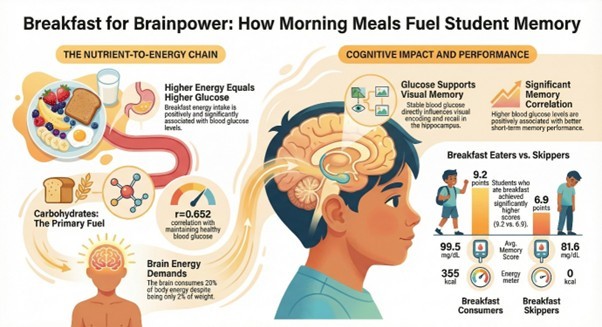
Breakfast is an essential component of a healthy diet for school-aged children, yet it is often neglected. This study aimed to analyze the association between breakfast intake, blood glucose levels, and short-term memory among elementary school students in Nagan Raya Regency. This study employed a cross-sectional design involving 150 students from grades IV, V, and VI across three primary schools in Nagan Raya District with a purposive sampling technique. Short-term memory was assessed at 08:30 a.m. using a picture recognition memory test, and blood glucose levels were measured at 09:00 a.m. using the finger-prick method. Breakfast intake was measured using the recall method. Data on student characteristics (gender, daily allowance, and mother’s education) and nutritional status were sourced from the 2023 GENIUS program (Nutrition education and snacks program for school children). The statistical tests used were the Mann–Whitney U test and the Spearman rank correlation test. The results showed that breakfast energy intake was positively and significantly associated with blood glucose levels, and blood glucose levels were positively and significantly associated with short-term memory. Consuming a complete breakfast plays an important role in maintaining stable blood glucose levels and supporting of short-term memory among primary school students.
Downloads
References
Kustiyah L, Kusprasetia M. Children with Better Breakfast Habit and Family Socioeconomic Status Tended to Have Better Academic Achievment. Int J Med Heal Sci. 2018;03(02):14–21.
Baddeley A. The episodic buffer: a new component of working memory? Trends Cogn Sci. 2000 Nov;4(11):417–23.
Monzani A, Ricotti R, Caputo M, Solito A, Archero F, Bellone S, et al. A Systematic Review of the Association of Skipping Breakfast with Weight and Cardiometabolic Risk Factors in Children and Adolescents. What Should We Better Investigate in the Future? Nutrients. 2019 Feb;11(2).
Kemenkes RI. Laporan Nasional Riskesdas 2018. Lembaga Penerbit Badan Penelitian dan Pengembangan Kesehatan; 2018.
Putri SK. Hubungan Kebiasaan Sarapan Pagi dengan Konsentrasi Belajar pada Anak Sekolah Dasar : Literature Review: The Relationship Between Habits and Learning Concentration in Elementary School : Literature Review. Media Publ Promosi Kesehat Indones. 2023 Aug 2;6(8 SE-Review Article):1538–44.
Godin KM, Patte KA, Leatherdale ST. Examining Predictors of Breakfast Skipping and Breakfast Program Use Among Secondary School Students in the COMPASS Study. J Sch Health. 2018 Feb;88(2):150–8.
Kawabata M, Lee K, Choo H cheng, Burns SF. Breakfast and Exercise Improve Academic and Cognitive Performance in Adolescents. 2021;
Gillespie KM, White MJ, Kemps E, Moore H, Dymond A, Bartlett SE. The Impact of Free and Added Sugars on Cognitive Function : A Systematic Review and Meta-Analysis. 2024;1–31.
Chen Y, Joo J, Man J, Chu T, Chuen R, Chang C, et al. Downregulation of the glucose transporter GLUT 1 in the cerebral microvasculature contributes to postoperative neurocognitive disorders in aged mice. J Neuroinflammation. 2023;1–18.
Raut S, KC D, Singh DR, Dhungana RR, Pradhan PMS, Sunuwar DR. Effect of nutrition education intervention on nutrition knowledge, attitude, and diet quality among school-going adolescents: a quasi-experimental study. BMC Nutr. 2024;10(1).
Gibson-Moore H, Spiro A, Stanner S. No food for thought–How important is breakfast to the health, educational attainment and wellbeing of school-aged children and young people? Nutr Bull. 2023;48(4):458–81.
Rani R, Dharaiya CN, Singh B. Importance of not skipping breakfast: a review. Int J Food Sci Technol. 2021;56(1):28–38.
Elkhatir M, Ghaffouli C, Louasté B, Loukili A, Aboussaleh Y. Dietary habits and cognitive performance in primary school students : a cross-sectional study in Khemisset region in Morocco. 2025;(October):1–11.
Alshdifat E, Alkhawaldeh A, Albashtawy M, Ta’an W, Mohammad K, Al-Rawashdeh S, et al. Breakfast Skipping and Associated Factors Among Jordanian University Students. Iran J Nurs Midwifery Res. 2024;29(1).
Hovdenak IM, Helleve A, Wolden IE, Bere E. Socioeconomic inequality in breakfast skipping among Norwegian adolescents. Nutr J. 2024;23(1):94.
Kawalec A, Pawlas K. Breakfast Frequency and Composition in a Group of Polish Children Aged 7–10 Years. 2021;
Luque V, Mucarzel F, Hertogs A, Seed PT, Flynn AC, Poston L, et al. Associations between maternal diet, family eating habits and preschool children’s dietary patterns: insights from the UPBEAT trial. Nutr J. 2024;23(1):115.
Rosyidah Z, Andrias DR. Jumlah Uang Saku dan Kebiasaan Melewatkan Sarapan Berhubungan dengan Status Gizi Lebih Anak UsiaSekolah Dasar. Media Gizi Indones. 2015 May 20;10(1):1–6.
Kemenkes RI. Angka Kecukupan Gizi. 2019;(956).
Hardinsyah H, Aries M. Jenis Pangan Sarapan dan Perannya dalam Asupan Gizi Harian Anak Usia 6-12 Tahun dI Indonesia. J Gizi dan Pangan. 2016;7:89.
Álvarez-Bueno C, Martínez-Vizcaíno V, López EJ, Visier-Alfonso ME, Redondo-Tébar A, Cavero-Redondo I. Comparative Effect of Low-Glycemic Index versus High-Glycemic Index Breakfasts on Cognitive Function: A Systematic Review and Meta-Analysis. Nutrients. 2019 Jul;11(8).
Mergenthaler P, Lindauer U, Dienel GA, Meisel A. Sugar for the brain: the role of glucose in physiological and pathological brain function. Trends Neurosci. 2013 Oct;36(10):587–97.
Nagao K. Cognition and nutrition: the role of dietary protein and amino acids in cognitive health. Curr Opin Clin Nutr Metab Care. 2024 Jan;27(1):40–6.
Nurul-Fadhilah A, Teo PS, Huybrechts I, Foo LH. Infrequent breakfast consumption is associated with higher body adiposity and abdominal obesity in Malaysian school-aged adolescents. PLoS One. 2013;8(3):e59297.
Kustiya L, Carissa C, Anwar F. Relationship between Breakfast Types and Blood Glucose Level and Short-Term Memory of Elementary School Children in Bogor, Indonesia. Malaysian J Med Heal Sci. 2020;16(13).
Wylie GR, Genova HM, Yao B, Chiaravalloti N, Román CAF, Sandroff BM, et al. Evaluating the effects of brain injury, disease and tasks on cognitive fatigue. Sci Rep. 2023 Jun 20;13(1):20166.
Adolphus K, Hoyland A, Walton J, Quadt F, Lawton CL, Dye L. Ready-to-eat cereal and milk for breakfast compared with no breakfast has a positive acute effect on cognitive function and subjective state in 11–13-year-olds: a school-based, randomised, controlled, parallel groups trial. Eur J Nutr. 2021;60(6):3325–42.
Mahoney CR, Taylor HA, Kanarek RB, Samuel P. Effect of breakfast composition on cognitive processes in elementary school children. Physiol Behav. 2005;85(5):635–45.
Hoyland A, Dye L, Lawton CL. A systematic review of the effect of breakfast on the cognitive performance of children and adolescents. Nutr Res Rev. 2009 Dec;22(2):220–43.
Holesh JE, Aslam S, Martin A. Physiology, Carbohydrates. Treasure Island (FL): StatPearls Publishing; 2023.
Hall, E. J. Guyton and Hall Textbook of Medical Physiology. 14th ed. Philadelphia: Elsevier; 2021.
Gropper SS, Smith JL, Carr TP. Advanced Nutrition and Human Metabolism [Internet]. Cengage Learning; 2021. Available from: https://books.google.co.id/books?id=vggVEAAAQBAJ
Melzer TM, Manosso LM, Yau S yu, Gil-Mohapel J, Brocardo PS. In Pursuit of Healthy Aging: Effects of Nutrition on Brain Function. Vol. 22, International Journal of Molecular Sciences. 2021. p. 5026.
Ekstrand B, Scheers N, Rasmussen MK, Young JF, Ross AB, Landberg R. Brain foods - the role of diet in brain performance and health. Nutr Rev. 2021 May;79(6):693–708.
Arshad MT, Maqsood S, Altalhi R, Shamlan G, Mohamed Ahmed IA, Ikram A, et al. Role of Dietary Carbohydrates in Cognitive Function: A Review. Food Sci Nutr. 2025 Jul;13(7):e70516.
Nimgampalle M, Chakravarthy H, Devanathan V. Chapter 8 - Glucose metabolism in the brain: An update. In: Viswanath B, editor. Recent Developments in Applied Microbiology and Biochemistry. Academic Press; 2021. p. 77–88.
McNay EC, Pearson-Leary J. GluT4: A central player in hippocampal memory and brain insulin resistance. Exp Neurol. 2020 Jan;323:113076.
Published
How to Cite
Issue
Section
Copyright (c) 2026 Arfah Husna, Hardinsyah Hardinsyah, Cesilia Meti Dwiriani, Lilik Kustiyah

This work is licensed under a Creative Commons Attribution-NonCommercial-ShareAlike 4.0 International License.
Most read articles by the same author(s)
- Nur Laily Ramdhani, Cesilia Meti Dwiriani, Ali Khomsan , Determinants of Iron Supplementation Compliance Among Adolescent Girls in Kuningan Regency, Indonesia , Journal of Health and Nutrition Research: Vol. 4 No. 3 (2025)
- Fatimah Zuhra, Ikeu Tanziha, Cesilia Meti Dwiriani, Muhammad Rizki Ramadhani, Estimation of Food Waste and Nutrient Loss in The Free Nutritious Meal Program for Students in East Aceh, Indonesia , Journal of Health and Nutrition Research: Vol. 5 No. 1 (2026)
- Maya Klementina Dasmasela, Hardinsyah Hardinsyah, Mira Dewi, Ikeu Ekayanti, Indrayana Indrayana, Local Food-Based Supplementation and Behavior Change Communication Improve Mid-Upper Arm Circumference (MUAC) in Pregnant Women: A Community-Based Intervention Study , Journal of Health and Nutrition Research: Vol. 4 No. 3 (2025)
- Novi Puspita Sari, Lilik Kustiyah, Hadi Riyadi, The Correlations of Body Image, Eating Behavior Types, and Energy and Nutrient Adequacy Level with Anemia Status in Adolescent Girls at SMAN 1 Dramaga, Bogor Regency , Journal of Health and Nutrition Research: Vol. 5 No. 1 (2026)
- Salwa Inayah Huda MA Parewasi, Hardinsyah Hardinsyah, Ikeu Ekayanti, Effect of nutritious snacks provision on breakfast adequacy and nutritional status of elementary school students , Journal of Health and Nutrition Research: Vol. 5 No. 1 (2026)
- Hafika Yunisari Pradina, Katrin Roosita, Ahmad Sulaeman, Hardinsyah Hardinsyah, Stefanus Indrayana, Association of Contribution and Adequacy Levels of Energy and Nutrients from Supplementary Foods with Perceived Breast Milk Sufficiency among Lactating Mothers in a Stunting Prevention Program , Journal of Health and Nutrition Research: Vol. 5 No. 1 (2026)
- Asnawi Baso, Rimbawan Rimbawan, Lilik Kustiyah, Effect of Non-Thermal Alkaline (Lime) Soaking on Amino Acid Profile of Maize (Zea mays L.): A Modified Nixtamalization Approach , Journal of Health and Nutrition Research: Vol. 5 No. 2 (2026)