The Relationship Between Immunization, Health Insurance, Family Support, and Health Workers with Stunting Incidence
Keywords:
Stunting, Immunization, Health Insurance, Family Support, Health Workers SupportAbstract
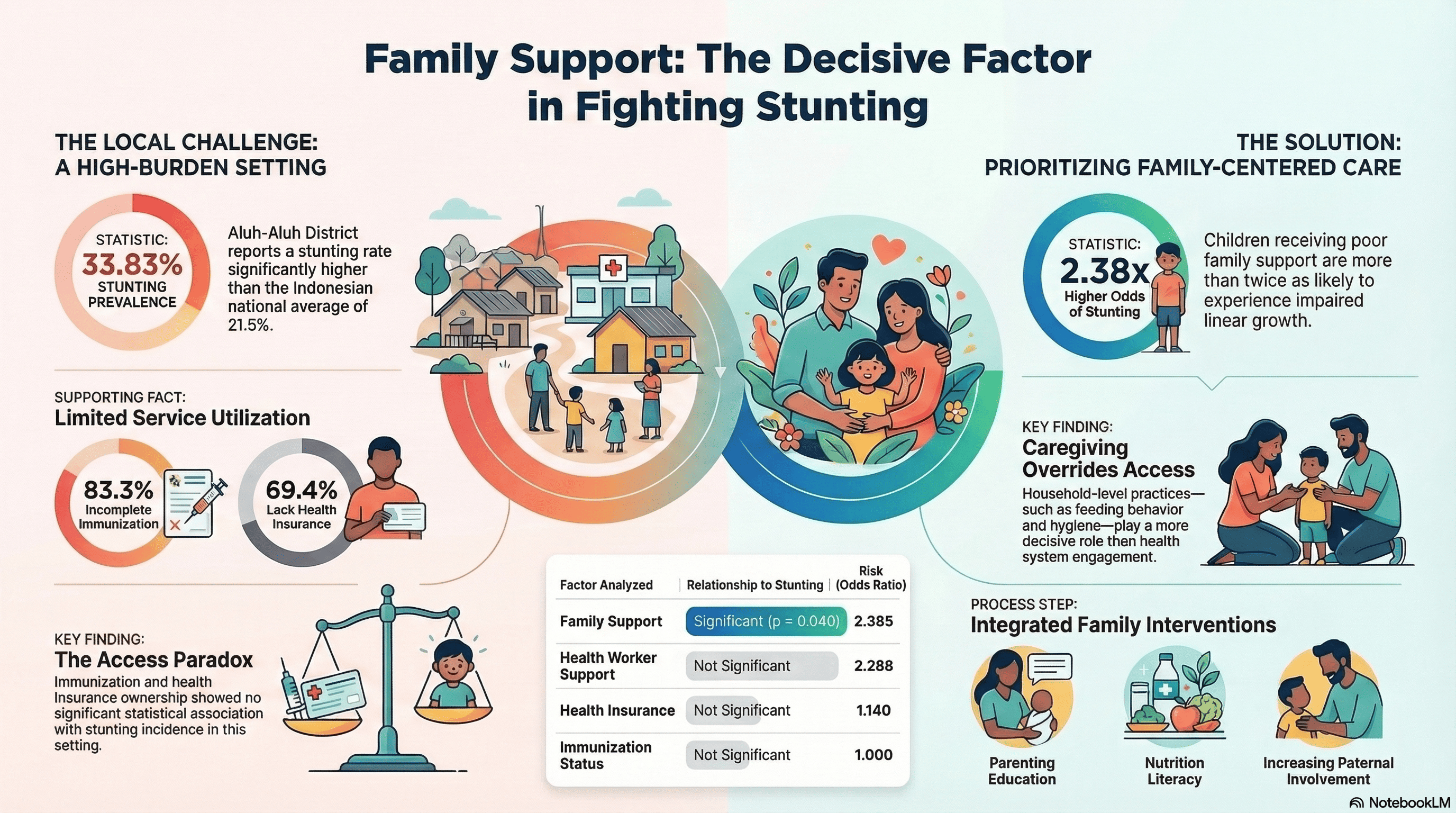
Stunting remains a critical public health concern in Indonesia, with the Banjar Regency—specifically the Aluh-Aluh Public Health Center working area—reporting a persistently high prevalence. Beyond direct nutritional factors, stunting is influenced by underlying determinants such as access to health services and the quality of household caregiving. This study aimed to analyze the associations between immunization status, health insurance ownership, family support, and health worker support with the incidence of stunting among children under five. Methods: A quantitative case-control study was conducted involving 144 children (72 stunted cases and 72 non-stunted controls). Participants were selected through a two-stage sampling process: purposive selection of high-risk villages followed by random selection of eligible children, matched by sex. Data were collected via structured questionnaires and secondary anthropometric data from the e-PPGBM system. Statistical analysis was performed using univariate and bivariate chi-square tests to determine odds ratios (OR) and 95% confidence intervals (CI). The findings indicated no significant associations between stunting and immunization status (p = 1.000), health insurance ownership (p = 0.717), or health worker support (p = 0.074). However, family support was significantly associated with stunting incidence (p = 0.040). Children receiving poor family support had 2.385 times higher odds of being stunted compared to those receiving good support (OR = 2.385; 95% CI = 1.026–5.545). While access to health services is an important framework, household-level caregiving practices—manifested through family support—play a decisive role in stunting prevention in this setting
Downloads
References
Pemerintah Republik Indonesia. Peraturan Presiden Republik Indonesia Nomor 72 Tahun 2021 Tentang Percepatan Penurunan Stunting. 2021.
UNICEF, WHO, World Bank. Level and trend in child malnutrition [Internet]. World Health Organization. New York: UNICEF and WHO; 2023. 4 p. Available from: https://www.who.int/publications/i/item/9789240073791
Kemenkes RI. Survei Kesehatan Indonesia Tahun 2023. Badan Kebijakan Pembangunan Kesehatan. Jakarta: Kemenkes RI; 2024.
Dinkes Kabupaten Banjar. Publikasi Stunting Kabupaten Banjar Tahun 2024. Martapura: Dinas Kesehatan Kabupaten Banjar; 2024.
UNICEF. UNICEF’s approach to scaling up nutrition programming for mothers and their children. New York: UNICEF; 2015.
IFPRI. From Promise to Impact Ending malnutrition by 2030. Washington DC: International Food Policy Research Institute; 2016.
Rahayu A, Yulidasari F, Anggraini L, Rahman F, Laily N, Sari AR, et al. Energy and Protein Intake-Related Risks Affected the Occurrence of Stunting Among Young Children. Advances in Health Sciences Research. 2020;22:330–6.
Mulyani I, Khairunnas K, Ayunda HM, Syafiq A, Ahmad A, Muliadi T. Exploring the Relationship Between Immunization and Stunting: Understanding the Impact of Vaccinations on Child Growth and Development. J-Kesmas: Jurnal Fakultas Kesehatan Masyarakat (The Indonesian Journal of Public Health). 2023 Apr 18;10(1):11.
Purwanti ED, Masitoh S, Ronoatmodjo S. Association Between Basic Immunization Status and Stunting in Toddlers Aged 12-59 Months in Indonesia. Journal of Preventive Medicine and Public Health. 2025 May 31;58(3):298–306.
Hafid Firdausi A, Shoim M. Incomplete Immunization and Chronic Energy Deficiency (CED) as Risk Factors for Stunting in Toddlers. Disease Prevention and Public Health Journal. 2023 Sep 13;17(2):200–5.
Theresia GN, Sudarma V. Immunization status lowers the incidence of stunting in children 1-5 years. World Nutrition Journal. 2022 Aug 26;6(1):9–15.
Nshakira-Rukundo E, Mussa EC, Gerber N, von Braun J. Impact of voluntary community-based health insurance on child stunting: Evidence from rural Uganda. Soc Sci Med. 2020 Jan;245:112738.
Kofinti RE, Koomson I, Paintsil JA, Ameyaw EK. Reducing children’s malnutrition by increasing mothers’ health insurance coverage: A focus on stunting and underweight across 32 sub-Saharan African countries. Econ Model. 2022 Dec;117:106049.
Lu C, Mejía-Guevara I, Hill K, Farmer P, Subramanian SV, Binagwaho A. Community-Based Health Financing and Child Stunting in Rural Rwanda. Am J Public Health. 2016 Jan;106(1):49–55.
Picauly I, Adi AAAM, Meiyetriani E, Mading M, Weraman P, Nashriyah SF, et al. Determinants of child stunting in the dryland area of East Nusa Tenggara Province, Indonesia: insights from a national-level survey. J Med Life. 2024 Feb;17(2):147–56.
Nugraha SY, Fatikhah N, Wahyuni ST, Saudah N. Influence Of Social Support For Families Parenting Mother In Preventing Child Stunting. International Journal Of Nursing And Midwifery Science (IJNMS). 2019 Dec 18;3(3):122–6.
Aulia Fitroningtyas E. Parenting Patterns as A Determinant of Stunting in Toddlers Under Five Years in Indonesia. KESANS : International Journal of Health and Science. 2021 Dec 20;1(3):221–9.
Mandosir YM, Irab P, Mollet G, Irmanto M, Palela D, Renyaan D, et al. The Relationship Between Mother’s Knowledge, Family Income, and Parenting Pattern with Stunting in Toddlers Aged 24-59 Months in the Working Area of Abepura Primary Health Center. International Journal of Multidisciplinary Research and Analysis. 2023 Apr 28;06(04).
Laili AN, Munawir A, Ningtyias FW. The Influence of Parenting Patterns on Stunting Incidences in Toddlers (Study in the Work Area of Sumberjambe Health Center, Kasiyan Health Center and Sumberbaru Health Center Jember Regency). Journal for Quality in Public Health. 2021 Nov 15;5(1):256–60.
Putri TF, Putri FA, Anjani D, Putri SF, Juniarly A. Psychoeducation of Stunting Prevention Through Good Parenting for Parents Who Have Children Under Five. Altifani Journal: International Journal of Community Engagement. 2023 Dec 26;4(1):88.
Syam RC, Syafar M, Maidin MA, Rachmat M, Ismita UW, Yanti IH, et al. Reinforcers and Inhibitors of Family-based Stunting Children Parenting (Case Studies in Slums Area of Makassar City). Open Access Maced J Med Sci. 2020 Sep 15;8(T2):131–5.
Rahmawati DA, Fitri Anto AH, Prihastuty R, Sulistyawati Y. Parenting Self-Efficacy, Father Involvement, dan Stunting. As-Syar’i: Jurnal Bimbingan & Konseling Keluarga. 2024 Aug 17;6(3):1747–60.
Taufiqurrahman T, Hatijah N, Intiyati A. Determinants Affecting Family Commitment and Capability in Preventing Stunting in Children Under Two Years. Amerta Nutrition. 2024 Dec 30;8(2SP):58–66.
Nordianiwati N, Gilang Fitriana N, Situmean L, Aris Tyarini I, Setyawati A. Education on the role of family in stunting prevention in toddlers. Abdimas Polsaka. 2024 Jan 28;3(1):14–9.
Siregar FA, Surdayati E, Nurmaini. Community Empowerment in The Prevention of Stunting for Children Under Five. ABDIMAS TALENTA: Jurnal Pengabdian Kepada Masyarakat. 2020 Dec 2;5(2):503–8.
Fajar NA, Zulkarnain M, Taqwa R, Sulaningsi K, Ananingsih ES, Rachmayanti RD, et al. Family Roles and Support in Preventing Stunting: A Systematic Review. Jurnal Promosi Kesehatan Indonesia. 2023 Nov 14;19(1):50–7.
Singgih Setiawan, Arditya Prayogi. Education and Cooking Demonstration of Supplementary Food for Toddlers as an Effort to Prevent Stunting in Pegiringan Village, Bantarbolang District, Pemalang Regency. Al-arkhabiil: Jurnal Pengabdian Masyarakat. 2024 Dec 31;4(4):1–9.
Umar F. Family Centered Approaches to Stunting Prevention. Journal of Health Literacy and Qualitative Research. 2021 Sep 30;1(2):84–98.
Published
How to Cite
Issue
Section
Copyright (c) 2026 Fauzie Rahman, Anggun Wulandari, Nur Laily, Muhammad Ali Faisal, Rizqi Rifani, Intan Yustikasari, Andini Octaviana Putri, Lia Anggraini, Muhamad Azmiyannoor, Muhammad Zainal Khadafi, Ahmad Navijay

This work is licensed under a Creative Commons Attribution-NonCommercial-ShareAlike 4.0 International License.
Most read articles by the same author(s)
- Nur Laily, Andini Octaviana Putri, Anggun Wulandari, Fauzie Rahman, Lia Anggraini, Nidaul Jannah, Lisa Salsa Billa, Siti Maimunah, Sri Wulandari, Nuralpisah Nuralpisah, Fitrya Hayati Alkamaliah, Analysis of Human Resources, Infrastructure, Budget, and Procedures on the Implementation Process of the PHBS Program in South Kalimantan , Journal of Health and Nutrition Research: Vol. 5 No. 1 (2026)
- Anggun Wulandari, Neka Erlyani , Fauzie Rahman, Nur Laily, Andini Octaviana Putri, Lia Anggraini, Siti Maimunah, Sri Wulandari, Nuralpisah Nuralpisah, Fitrya Hayati Alkamaliah, Evaluation of Integrated Primary Care (ILP) Implementation: A Qualitative Assessment of Input and Process Dimensions in Banjarbaru City Health Centers , Journal of Health and Nutrition Research: Vol. 5 No. 2 (2026)