Effect of Freeze-Drying on the Sensory, Physicochemical, and Microbiological Characteristics of a Dadih-Based Functional Beverage
Keywords:
Dadih, Freeze-drying, Fermented milk, Physicochemical characteristics, Lactic acid bacteriaAbstract
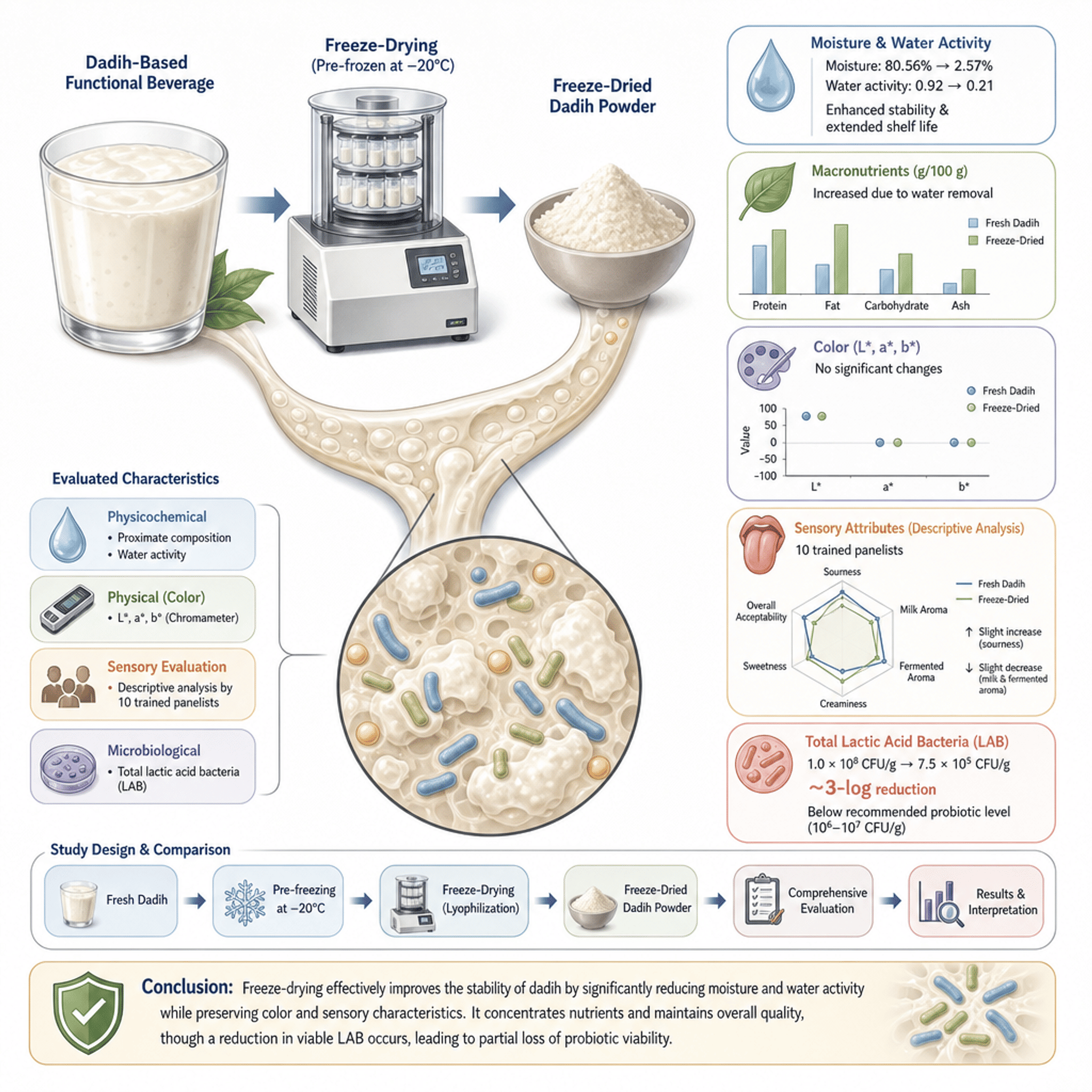
Dadih, a traditional fermented buffalo milk product from West Sumatra, Indonesia, is widely recognized for its probiotic properties and functional health benefits. This study aimed to evaluate the effect of freeze-drying on the physicochemical, physical, sensory, and microbiological characteristics of dadih. An experimental design was employed by comparing fresh dadih with freeze-dried dadih powder, in which samples were pre-frozen at −20°C prior to drying. Physicochemical properties were analyzed through proximate composition and water activity, while physical characteristics were assessed using color parameters (L*, a*, b*) measured by a chromameter. Sensory attributes were evaluated using descriptive analysis by ten trained panelists, and microbiological quality was determined based on total lactic acid bacteria (LAB). The results showed that freeze-drying significantly reduced moisture content (from 80.56% to 2.57%) and water activity (from 0.92 to 0.21), indicating enhanced product stability and extended shelf life. The relative concentrations of macronutrients increased due to water removal. No significant changes were observed in color parameters, suggesting that visual quality was preserved. Sensory evaluation revealed a slight increase in sourness and a minor decrease in milk and fermentation aroma. The total LAB decreased from 1.0 × 10⁸ CFU/g to 7.5 × 10⁵ CFU/g after freeze-drying, representing approximately a 3-log reduction. This final count is slightly below the commonly recommended minimum level (10⁶–10⁷ CFU/g) required for probiotic efficacy, indicating a partial loss of functional viability. In conclusion, freeze-drying effectively improves the stability of dadih by significantly reducing moisture and water activity while preserving color and sensory characteristics. Unlike conventional thermal drying methods, this technique maintains product quality and concentrates nutrients, although some reduction in viable LAB occurs.
Downloads
References
Surono IS. Ethnic Fermented Foods and Beverages of Indonesia BT - Ethnic Fermented Foods and Alcoholic Beverages of Asia. In: Tamang JP, editor. New Delhi: Springer India; 2016. p. 341–82. doi:10.1007/978-81-322-2800-4_14
Arnold M, Rajagukguk YV, Gramza-Michałowska A. Characterization of dadih: Traditional fermented buffalo milk of minangkabau. Beverages. 2021;7(3). doi:10.3390/beverages7030060
Habibi NA, Gusnedi G, Sartika W, Ismanilda I. Antioxidant Activity and Amino Acid Profile of “Dadih” from Various Regions in West Sumatra, Indonesia. Poltekita : Jurnal Ilmu Kesehatan. 2023;17(3):1026–33. doi:10.33860/jik.v17i3.3381
Islam MA, Roy S, Nabi A, Solaiman S, Rahman M, Huq M, et al. Microbiological quality assessment of milk at different stages of the dairy value chain in a developing country setting. International Journal of Food Microbiology. 2018;278:11–9. doi:https://doi.org/10.1016/j.ijfoodmicro.2018.04.028
Karelakis C, Zevgitis P, Galanopoulos K, Mattas K. Consumer Trends and Attitudes to Functional Foods. Journal of International Food & Agribusiness Marketing. 2020 May 26;32(3):266–94. doi:10.1080/08974438.2019.1599760
Jude J, Adu EA, Kamaldeen OS, Maiyanga IE. Freeze Drying – Application in Food Processing and Storage (Review). Badeggi Journal of Agricultural Research and Environment. 2023;5(2):21–35. doi:10.35849/bjare202302/97/003
Habibi NA, Fathia S, Utami CT. Changes in Food Characteristics in Fruit Chips by Freeze Drying Method (Review). JST (Jurnal Sains Terapan). 2019;5(2). doi:10.32487/jst.v5i2.634
Prosapio V, Lopez-Quiroga E. Freeze-Drying Technology in Foods. Foods (Basel, Switzerland). Switzerland; 2020. doi:10.3390/foods9070920 PubMed PMID: 32668649.
Ibrahim I, Ayariga JA, Xu J, Boakai RK, Ajayi OS, Owusu-Kwarteng J. A Comparative Study of Skimmed Milk and Cassava Flour on the Viability of Freeze-Dried Lactic Acid Bacteria as Starter Cultures for Yogurt Fermentation. Foods. 2023;12(6). doi:10.3390/foods12061207
Chen P, Guo C, Cheng H, Ye X, Chen J. Cross-stress adaptation enhances the survival and stability of freeze-dried lactic acid bacteria. Food Science of Animal Resources. 2026;46(1):2. doi:10.1007/s44463-025-00007-y
Nowak D, Jakubczyk E. The Freeze-Drying of Foods-The Characteristic of the Process Course and the Effect of Its Parameters on the Physical Properties of Food Materials. Foods. 2020 Oct;9. doi:10.3390/foods9101488
Hariyadi P. Freeze Drying Technology: for better quality & flavor of dried products. FoodReview Indonesia. 2013 Feb;8:52–7.
Setiarto RHB, Anshory L, Wardana AA. Nutritional and microbiological characteristics of Dadih and their application to the food industry: A review. IOP Conference Series: Earth and Environmental Science. 2023;1252(1). doi:10.1088/1755-1315/1252/1/012153
Amalia R, Pindona Z, Rusdiana N, Pratiwi D. Analysis of Calcium, Iron, Ash, Fat, and Water Content in Fresh and Processed Cow’s Milk Using Atomic Absorption Spectrophotometry Methods. Journal of Fundamental and Applied Pharmaceutical Science. 2023;4(1):8–14. doi:10.18196/jfaps.v4i1.18938
AOAC. Official Methods of Analysis. 15th ed. Washington DC: Association of Official Analytical Chemists.; 1999.
AOAC. Method of Analysis. Association of Official Analytical Chemistry. Washington DC.; 1995.
Milovanovic B, Djekic I, Miocinovic J, Djordjevic V, Lorenzo JM, Barba FJ, et al. What Is the Color of Milk and Dairy Products and How Is It Measured? Foods. 2020;9(11). doi:10.3390/foods9111629
Adawiyah DR, Hunaefi D, Nurtama B. Evaluasi Sensori Produk Pangan. Jakarta: Bumi Aksar; 2024. 224 p.
Jannah AM, Legowo AM, Pramono YB, Al-baarri AN. Total Lactic Acid Bacteria, pH, Acidity, Taste and Favorability of Yogurt Drink with Star Fruit Extract Addition. Jurnal Aplikasi Teknologi Pangan. 2014;3(2).
Shukla S. Freeze Drying Process: a Review. International journal of pharmaceutical sciences and research. 2018;2(12):3061–8.
Mathlouthi M. Water content, water activity, water structure and the stability of foodstuffs. Food Control. 2001;12(7):409–17. doi:10.1016/S0956-7135(01)00032-9
Sperber WH. Influence of Water Activity on Foodborne Bacteria — A Review. Journal of Food Protection. 1983;46(2):142–50. doi:10.4315/0362-028x-46.2.142
Meda L, Ratti C. Rehydration of Freeze-Dried Strawberries at Varrying Temperatures. Journal of Food Process Engineering. 2005 Jun 1;28(3):233–46. doi:https://doi.org/10.1111/j.1745-4530.2005.00404.x
Zhou X, Wang S. Recent developments in radio frequency drying of food and agricultural products: A review. Drying Technology. 2019;37(3):271–86.
Andrieu J, Vessot S. A review on experimental determination and optimization of physical quality factors during pharmaceuticals freeze-drying cycles. Drying Technology. 2018;36(2):129–45.
Siddiqui SA, Ucak İ, Jain S, Elsheikh W, Ali Redha A, Kurt A, et al. Impact of drying on techno-functional and nutritional properties of food proteins and carbohydrates - A comprehensive review. Drying Technology. 2024 Mar 1;42(4):592–611. doi:10.1080/07373937.2024.2303580
Yamaguchi S, Krebs de Souza C, Bertoli S, Carvalho L. Evaluation of physical-chemical and microbiological characteristics of freeze-dried and reydrated yogurt. Research, Society and Development. 2020 Apr 9;9:14962446. doi:10.33448/rsd-v9i6.2446
Hammami C, Rene F, Marin M. Process–quality optimization of the vacuum freeze‐drying of apple slices by the response surface method. International journal of food science & technology. 1999;34(2):145–60.
Morales FJ, van Boekel MAJS. A Study on Advanced Maillard Reaction in Heated Casein/Sugar Solutions: Colour Formation. International Dairy Journal. 1998;8(10):907–15. doi:https://doi.org/10.1016/S0958-6946(99)00014-X
Izadi M, Eskandari MH, Niakousari M, Shekarforoush S, Hanifpour MA, Izadi Z. Optimisation of a pilot-scale spray drying process for probiotic yoghurt, using response surface methodology. International Journal of Dairy Technology. 2014;67(2):211–9. doi:https://doi.org/10.1111/1471-0307.12108
Cheng H. Volatile flavor compounds in yogurt: A review. Critical reviews in food science and nutrition. 2010;50(10):938–50.
Tamime AY, Robinson RK. Tamime and Robinson’s yoghurt: science and technology. Elsevier; 2007.
Kesler MK, González-Orozco BD, Barringer SA, Alvarez VB. Mitigation of undesirable volatile aroma compounds in kefir by freeze drying and vacuum evaporation. Journal of Food Science. 2023 Aug 1;88(8):3216–27. doi:https://doi.org/10.1111/1750-3841.16678
Tyagi N, Gidlöf Z, Osanlóo DT, Collier ES, Kadekar S, Ringstad L, et al. The Impact of Formulation and Freeze Drying on the Properties and Performance of Freeze-Dried Limosilactobacillus reuteri R2LC. Applied Microbiology. 2023;3(4):1370–87. doi:10.3390/applmicrobiol3040092
Cui L, Niu L ying, Li D jing, Liu C quan, Liu Y ping, Liu C ju, et al. Effects of different drying methods on quality, bacterial viability and storage stability of probiotic enriched apple snacks. Journal of Integrative Agriculture. 2018;17(1):247–55. doi:10.1016/S2095-3119(17)61742-8
Fonseca F, Cenard S, Passot S. Freeze-drying of lactic acid bacteria. Methods in molecular biology (Clifton, NJ). 2015;1257:477–88. doi:10.1007/978-1-4939-2193-5_24 PubMed PMID: 25428024.
Tripathi MK, Giri SK. Probiotic functional foods: Survival of probiotics during processing and storage. Journal of Functional Foods. 2014;9:225–41. doi:https://doi.org/10.1016/j.jff.2014.04.030
Published
How to Cite
Issue
Section
Copyright (c) 2026 Nur Ahmad Habibi, Sri Darningsih, Zulkifli Zulkifli, Edmon Edmon, Citra Tristi Utami, Heri Heri, Gusnedi Gusnedi

This work is licensed under a Creative Commons Attribution-NonCommercial-ShareAlike 4.0 International License.
Most read articles by the same author(s)
- Nur Ahmad Habibi, Neza Viona Ariska, Ismanilda Ismanilda, Zulkifli Zulkifli, Marni Handayani, Citra Tristi Utami, Association of Household Food Safety Practices with Stunting in Children Under Five: A Case-Control Study in A High-Prevalence Indonesian Village , Journal of Health and Nutrition Research: Vol. 4 No. 3 (2025)
- Gusnedi Gusnedi, Nur Ahmad Habibi, Renidayati Renidayati, Irmawartini Irmawartini, Heppi Sasmita, Delima Delima, Mardiani Bebasari, Renita Afriza, Dwi Octa Amalia, Hamdani Hamdani, Citra Tristi Utami , Strengthening Nutrition Interventions through Academic Collaboration in Pasaman Barat, Indonesia , Journal of Health and Nutrition Research: Vol. 5 No. 1 (2026)