Nutritional Interventions and Wound Healing Outcomes in Patients With Diabetic Foot Ulcers: A Systematic Review
Keywords:
Diabetic foot ulcer, Nutritional interventions, Oral nutritional supplementation, Multidisciplinary care, Wound healingAbstract
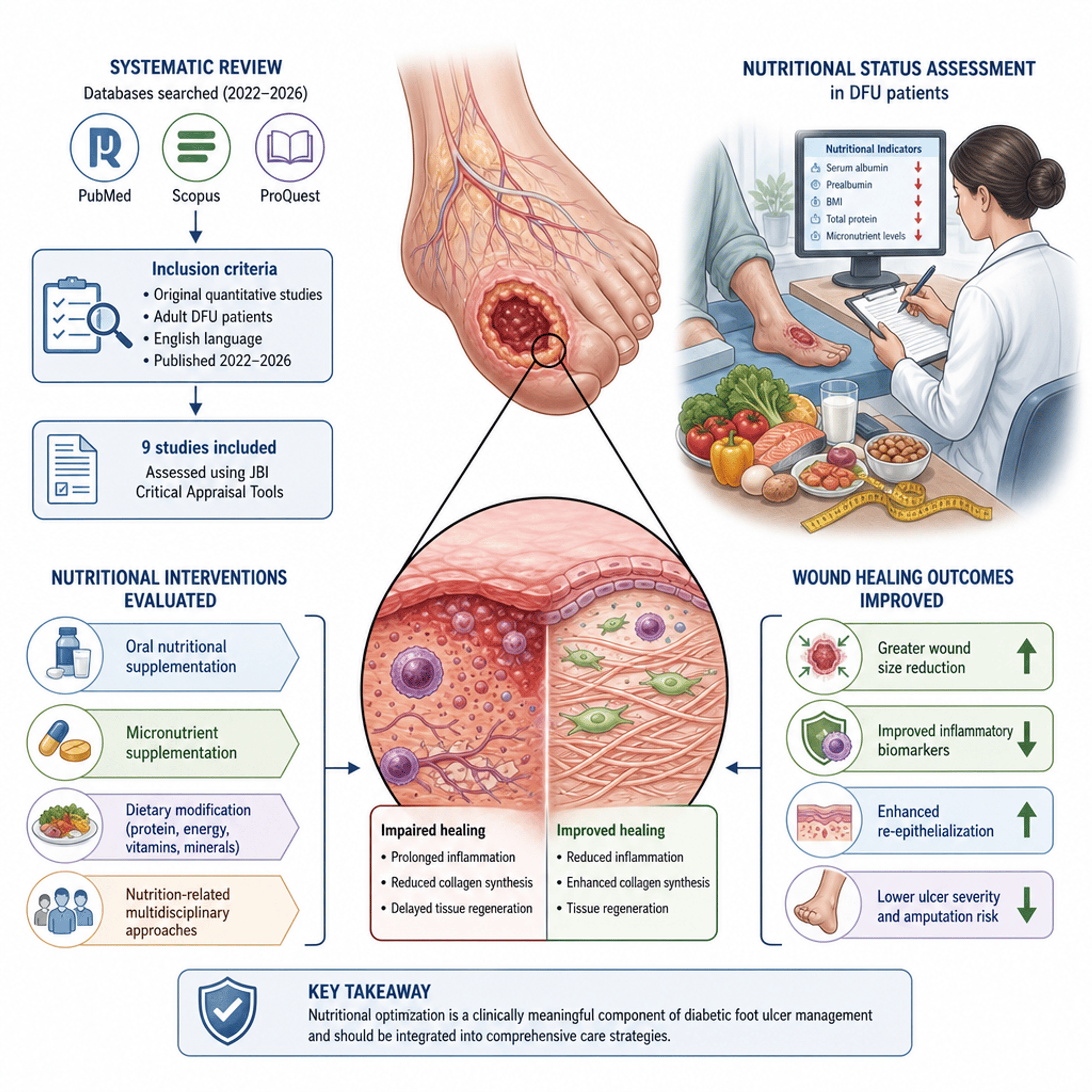
Diabetic foot ulcers (DFU) are a severe complication of diabetes mellitus that contribute to delayed wound healing, increased amputation risk, and substantial healthcare burden. Beyond vascular and metabolic abnormalities, malnutrition plays a critical role in prolonging inflammation, impairing collagen synthesis, and delaying tissue regeneration. Although nutritional support is increasingly incorporated into DFU management, its clinical effectiveness remains variably reported. Therefore, this study aimed to evaluate the effects of nutritional interventions and the association between nutritional status and wound healing outcomes in patients with DFU. This systematic review was conducted in accordance with PRISMA 2020 guidelines. The methodological quality of included studies was assessed using the Joanna Briggs Institute (JBI) Critical Appraisal Tools. The review protocol was not registered in PROSPERO. Articles were retrieved from PubMed, Scopus, and ProQuest using the keywords “diabetic foot ulcer”, “nutritional intervention”, and “wound healing”. Inclusion criteria comprised original quantitative studies published in English between 2022 and 2026 involving adult DFU patients. Data were extracted using structured tables and synthesized narratively. Nine eligible studies demonstrated that nutritional interventions, including oral nutritional supplementation, micronutrient supplementation, dietary modification, and nutrition-related multidisciplinary approaches, were associated with greater wound size reduction, improved inflammatory biomarkers, and enhanced re-epithelialization. Observational evidence consistently showed that poor nutritional status was linked to higher ulcer severity and increased amputation risk. Nutritional optimization appears to be a clinically meaningful component of DFU management and may be beneficial when integrated into comprehensive care strategies.
Downloads
References
Zhou B, Rayner AW, Gregg EW, Sheffer KE, Carrillo-Larco RM, Bennett JE, et al. Worldwide trends in diabetes prevalence and treatment from 1990 to 2022: a pooled analysis of 1108 population-representative studies with 141 million participants. The Lancet. 2024 Nov;404(10467):2077–93. doi:10.1016/S0140-6736(24)02317-1
World Health Organization. Diabetes [Internet]. World Health Organization; 2024 [cited 2026 Feb 28]. Available from: https://www.who.int/news-room/fact-sheets/detail/diabetes
Armstrong DG, Tan TW, Boulton AJM, Bus SA. Diabetic Foot Ulcers: A Review. JAMA. 2023 Jul 3;330(1):62. doi:10.1001/jama.2023.10578
Luo Y, Liu C, Li C, Jin M, Pi L, Jin Z. The incidence of lower extremity amputation and its associated risk factors in patients with diabetic foot ulcers: A meta‐analysis. International Wound Journal. 2024 Jul;21(7):e14931. doi:10.1111/iwj.14931
Hashempour R, MirHashemi S, Mollajafari F, Damiri S, ArabAhmadi A, Raei B. Economic burden of diabetic foot ulcer: a case of Iran. BMC Health Serv Res. 2024 Mar 21;24(1):363. doi:10.1186/s12913-024-10873-9
Maity S, Leton N, Nayak N, Jha A, Anand N, Thompson K, et al. A systematic review of diabetic foot infections: pathogenesis, diagnosis, and management strategies. Front Clin Diabetes Healthc. 2024 Aug 6;5:1393309. doi:10.3389/fcdhc.2024.1393309
Skórka M, Więch P, Przybek-Mita J, Malisiewicz A, Pytlak K, Bazaliński D. Nutritional Status of People with a Coexisting Chronic Wound and Extended Assessment Using Bioelectrical Impedance. Nutrients. 2023 Jun 25;15(13):2869. doi:10.3390/nu15132869
Oe M, Saad SS, Jais S, Sugama J. Impact of foot ulcer‐related factors on quality of life in patients with diabetes: Prospective observational study. International Wound Journal. 2024 May;21(5):e14895. doi:10.1111/iwj.14895
Lin C, Tian J, Zhang Z, Zheng C, Liu J. Risk factors associated with the recurrence of diabetic foot ulcers: A meta-analysis. Iqhrammullah M, editor. PLoS ONE. 2025 Feb 14;20(2):e0318216. doi:10.1371/journal.pone.0318216
Hu L, Liu W, Yin L, Yi X, Zou Y, Sheng X. Analysis of factors influencing the recurrence of diabetic foot ulcers. Skin Research and Technology. 2024 Jul;30(7):e13826. doi:10.1111/srt.13826
Zhou X, Guo YL, Xu C, Wang J. Macrophages: Key players in diabetic wound healing. World J Diabetes. 2024 Nov 15;15(11):2177–81. doi:10.4239/wjd.v15.i11.2177
Wang L, Jiang Y, Zhao C. The effects of advanced glycation end‐products on skin and potential anti‐glycation strategies. Experimental Dermatology. 2024 Apr;33(4):e15065. doi:10.1111/exd.15065
Jin Y, Huang Y, Zeng G, Hu J, Li M, Tian M, et al. Advanced glycation end products regulate macrophage apoptosis and influence the healing of diabetic foot wound through miR-361-3p/CSF1R and PI3K/AKT pathway. Heliyon. 2024 Jan;10(2):e24598. doi:10.1016/j.heliyon.2024.e24598
Shetty P, Dsouza R, Kumar B V. Matrix Metalloproteinase-9 as a Predictor of Healing in Diabetic Foot Ulcers. Cureus. 2024 Dec 11. doi:10.7759/cureus.75521
Yang Q, Fang D, Chen J, Hu S, Chen N, Jiang J, et al. LncRNAs associated with oxidative stress in diabetic wound healing: Regulatory mechanisms and application prospects. Theranostics. 2023;13(11):3655–74. doi:10.7150/thno.85823
Seth I, Lim B, Cevik J, Gracias D, Chua M, Kenney PS, et al. Impact of nutrition on skin wound healing and aesthetic outcomes: A comprehensive narrative review. JPRAS Open. 2024 Mar;39:291–302. doi:10.1016/j.jpra.2024.01.006
Kim J, Shim Y, Choo YH, Kim HS, Kim YR, Ha EJ. Protein Requirement Changes According to the Treatment Application in Neurocritical Patients. J Korean Neurosurg Soc. 2024 Jul 1;67(4):451–7. doi:10.3340/jkns.2023.0176
Mohsen G, Stroemer A, Mayr A, Kunsorg A, Stoppe C, Wittmann M, et al. Effects of Omega-3 Fatty Acids on Postoperative Inflammatory Response: A Systematic Review and Meta-Analysis. Nutrients. 2023 Jul 31;15(15):3414. doi:10.3390/nu15153414
Ran Q, Xu W, Zhao X, Sun H, Liu L, Luo Y. Risk factors for malnutrition in patients with diabetic foot ulcer and its association with prolonged length of hospitalization. Nutr Diabetes. 2024 May 16;14(1):26. doi:10.1038/s41387-024-00290-6
Lee SH, Kim SH, Kim KB, Kim HS, Lee YK. Factors Influencing Wound Healing in Diabetic Foot Patients. Medicina. 2024 Apr 27;60(5):723. doi:10.3390/medicina60050723
Donnelly HR, Collins CE, Clarke ED, Morrissey PI, Gilbertson‐Viljevac N, Leigh L, et al. Effectiveness of dietary interventions in individuals with diabetes for preventing and healing chronic wounds; a systematic review with meta‐analysis. Diabet Med. 2025 Sep;42(9):e70100. doi:10.1111/dme.70100
Bechara N, Tehan P, Gunton JE. Prospective Evaluation of Vitamin C, Vitamin D, and Zinc Deficiencies in Patients with Active Foot Ulceration. Advances in Wound Care. 2026 Feb;15(2):107–15. doi:10.1089/wound.2024.0063
Vuorlaakso M, Karèn V, Kiiski J, Lahtela J, Kaartinen I. Multidisciplinary management of diabetic foot infection associated with improved 8-year overall survival. Journal of Diabetes and its Complications. 2024 May;38(5):108719. doi:10.1016/j.jdiacomp.2024.108719
Staniszewska A, Game F, Nixon J, Russell D, Armstrong DG, Ashmore C, et al. Development of a Core Outcome Set for Studies Assessing Interventions for Diabetes-Related Foot Ulceration. Diabetes Care. 2024 Nov 1;47(11):1958–68. doi:10.2337/dc24-1112
Wondmeneh TG, Ebrahim OA. Systematic review and meta-analysis of diabetic foot ulcers and associated factors among adults in Ethiopia. Arch Public Health. 2025 Dec 22;83(1):309. doi:10.1186/s13690-025-01816-9
Zhang S, Wang Y, Wang L, Fan X, Zhao J, Wang Y, et al. Methodological panorama of clinical trials for diabetic foot ulcers: a scope review of design, implementation and reporting. Front Endocrinol. 2025 Nov 24;16:1710850. doi:10.3389/fendo.2025.1710850
Clark RK, Stampas A, Kerr KW, Nelson JL, Sulo S, Leon‐Novelo L, et al. Evaluating the impact of using a wound‐specific oral nutritional supplement to support wound healing in a rehabilitation setting. International Wound Journal. 2023 Jan;20(1):145–54. doi:10.1111/iwj.13849
Eliwa HE, Wakeel LME, Mahfouz AA, Sayed R. Impact of Cilostazol versus Cilostazol and Selenium Combination on The Healing of Diabetic Foot Ulcer Patients: A Randomized Controlled Trial. Diabetol Metab Syndr. 2026 Jan 6;18(1):36. doi:10.1186/s13098-025-02053-4
Zhu Y, Xu H, Wang Y, Feng X, Liang X, Xu L, et al. Risk factor analysis for diabetic foot ulcer‐related amputation including Controlling Nutritional Status score and neutrophil‐to‐lymphocyte ratio. International Wound Journal. 2023 Dec;20(10):4050–60. doi:10.1111/iwj.14296
Liu Y, Yu M, LaMantia JN, Mason Lobo J, Boutilier JJ, Liu Y, et al. Associations between specialty care and improved outcomes among patients with diabetic foot ulcers. Tan TW, editor. PLoS ONE. 2023 Dec 19;18(12):e0294813. doi:10.1371/journal.pone.0294813
Mutailipu M, Zhang B, Zhu H. Correlation Analysis of Nutritional Status of Diabetic Foot Patients with Different Wagner Grades. Int J Diabetes Dev Ctries. 2023 Aug 22. doi:10.1007/s13410-023-01224-1
Bubulac L, Gheorghe IR, Ungureanu E, Bogdan-Andreescu CF, Albu CC, Gheorghe CM, et al. Promoting Re-Epithelialization in Diabetic Foot Wounds Using Integrative Therapeutic Approaches. Bioengineering. 2025 Sep 29;12(10):1053. doi:10.3390/bioengineering12101053
Basiri R, Spicer M, Levenson C, Ledermann T, Akhavan N, Arjmandi B. Improving Dietary Intake of Essential Nutrients Can Ameliorate Inflammation in Patients with Diabetic Foot Ulcers. Nutrients. 2022 Jun 9;14(12):2393. doi:10.3390/nu14122393
Donnelly HR, Clarke ED, Collins CE, Collins RA, Armstrong DG, Mills JL, et al. Most individuals with diabetes‐related foot ulceration do not meet dietary consensus guidelines for wound healing. International Wound Journal. 2024 Mar;21(3):e14483. doi:10.1111/iwj.14483
Pangesti UN, Aisah A, Sari MT. The Correlation Between Nutritional Status and The Incidence of Hypertension in Productive Age. J Health Nutr Res. 2023 Nov 30;2(3):140–5. doi:10.56303/jhnresearch.v2i3.178
Ju M, Kim Y, Seo KW. Role of nutrition in wound healing and nutritional recommendations for promotion of wound healing: a narrative review. Ann Clin Nutr Metab. 2023 Dec 1;15(3):67–71. doi:10.15747/ACNM.2023.15.3.67
Stanescu C, Chiscop I, Mihalache D, Boev M, Tamas C, Stoleriu G. The Roles of Micronutrition and Nutraceuticals in Enhancing Wound Healing and Tissue Regeneration: A Systematic Review. Molecules. 2025 Aug 31;30(17):3568. doi:10.3390/molecules30173568
Kisil I, Gimelfarb Y. Long-term supplementation with a combination of beta-hydroxy-beta-methylbutyrate, arginine, and glutamine for pressure ulcer in sedentary older adults: a retrospective matched case-control study. JYMS. 2023 Oct 31;40(4):364–72. doi:10.12701/jyms.2022.00899
Melo PG, Mota JF, Nunes CADB, Malaquias SG, Coelho ASG, Soriano JV, et al. Effects of Oral Nutritional Supplementation on Patients with Venous Ulcers: A Clinical Trial. JCM. 2022 Sep 26;11(19):5683. doi:10.3390/jcm11195683
Karas RA, Alexeree S, Elsayed H, Attia YA. Assessment of wound healing activity in diabetic mice treated with a novel therapeutic combination of selenium nanoparticles and platelets rich plasma. Sci Rep. 2024 Mar 4;14(1):5346. doi:10.1038/s41598-024-54064-2
Han Y, Afshari H, Al-Attabi A, Kousha S. Fabrication and development of biogenic selenium nanoparticles incorporated alginate hydrogel wound care material: a pre-clinical study. Materials Technology. 2024 Dec 31;39(1):2391687. doi:10.1080/10667857.2024.2391687
Bădăluță VA, Curuțiu C, Dițu LM, Holban AM, Lazăr V. Probiotics in Wound Healing. IJMS. 2024 May 24;25(11):5723. doi:10.3390/ijms25115723
Deng K, Fan X, Yuan Z, Li D. Probiotic effects on skin health: comprehensive visual analysis and perspectives. Front Microbiol. 2024 Dec 3;15:1453755. doi:10.3389/fmicb.2024.1453755
Yoga Satriadinatha GB, Darwis P, Sartika Hutauruk PM, Nadya Prabawanty NM, Tasya Elfizri ZN, Putri RN, et al. Serum Albumin Levels as Predictors of Microvascular Health and Wound Healing Outcomes in Diabetic Foot Ulcers. J Angiotherapy. 2024 Dec 1;8(12):1–8. doi:10.25163/angiotherapy.81210100
Hong J, Huang QQ, Liu WY, Hu X, Jiang FF, Xu ZR, et al. Three Nutritional Indices Are Effective Predictors of Mortality in Patients With Type 2 Diabetes and Foot Ulcers. Front Nutr. 2022 Mar 15;9:851274. doi:10.3389/fnut.2022.851274
Zúnica-García S, Blanquer-Gregori J, Sánchez-Ortiga R, Jiménez-Trujillo MI, Chicharro-Luna E. Exploring the influence of dietary habits on foot risk in type 2 diabetes patients: An observational study. Clinical Nutrition. 2024 Jun;43(6):1516–21. doi:10.1016/j.clnu.2024.05.005
Sulfikar A, Mulyati M, Hasni H, Taher R, Lukman S, Muhammadong M, et al. Effectiveness of Wound Healing in Type 2 Diabetes Patients with Different Body Compositions: A Systematic Review. J Health Nutr Res. 2025 Aug 1;4(2):593–607. doi:10.56303/jhnresearch.v4i2.434
Jiang C, Guan RN, Shu Y, Zhang L, Mao XP, Nie Q, et al. Impact of multidisciplinary nursing interventions and blood glucose control on diabetic foot ulcer healing, patient emotions, and satisfaction. World J Psychiatry. 2025 Nov 19;15(11). doi:10.5498/wjp.v15.i11.106956
Ge L, Sun Y, Tan E, Liew H, Hoe J, Lin J, et al. Outcome evaluation and cost-effectiveness analysis for an integrated multidisciplinary diabetic limb salvage program: a combined observational and simulation study. Health services research. 2024.
Alasfour L, Alboloushi A, Kirwan E, McIntosh C, MacGilchrist C, Hurst JE. Mapping the evidence to determine the influence of stress, anxiety, and depression on wound healing in patients with diabetes-related foot ulcers: A scoping review. Journal of Tissue Viability. 2025 Aug;34(3):100935. doi:10.1016/j.jtv.2025.100935
Saritessa N, Ibrahim K, Haroen H. Booklet-Based Education in Diabetes Mellitus Patients: A Scoping Review. J Health Nutr Res. 2025 Apr 24;4(1):172–85. doi:10.56303/jhnresearch.v4i1.372
Published
How to Cite
Issue
Section
Copyright (c) 2026 Siti Kotijah, Nur Chayati, Shanti Wardaningsih, Fitri Arofiati

This work is licensed under a Creative Commons Attribution-NonCommercial-ShareAlike 4.0 International License.