Evaluation of Electronic Prescribing Systems (EPS) Acceptance among Doctors and Pharmacists at UNS Hospital using the Technology Acceptance Model (TAM)
Keywords:
Digital Health, Electronic Prescribing Systems, Healthcare Professionals, Technology Acceptance Model, User AcceptanceAbstract
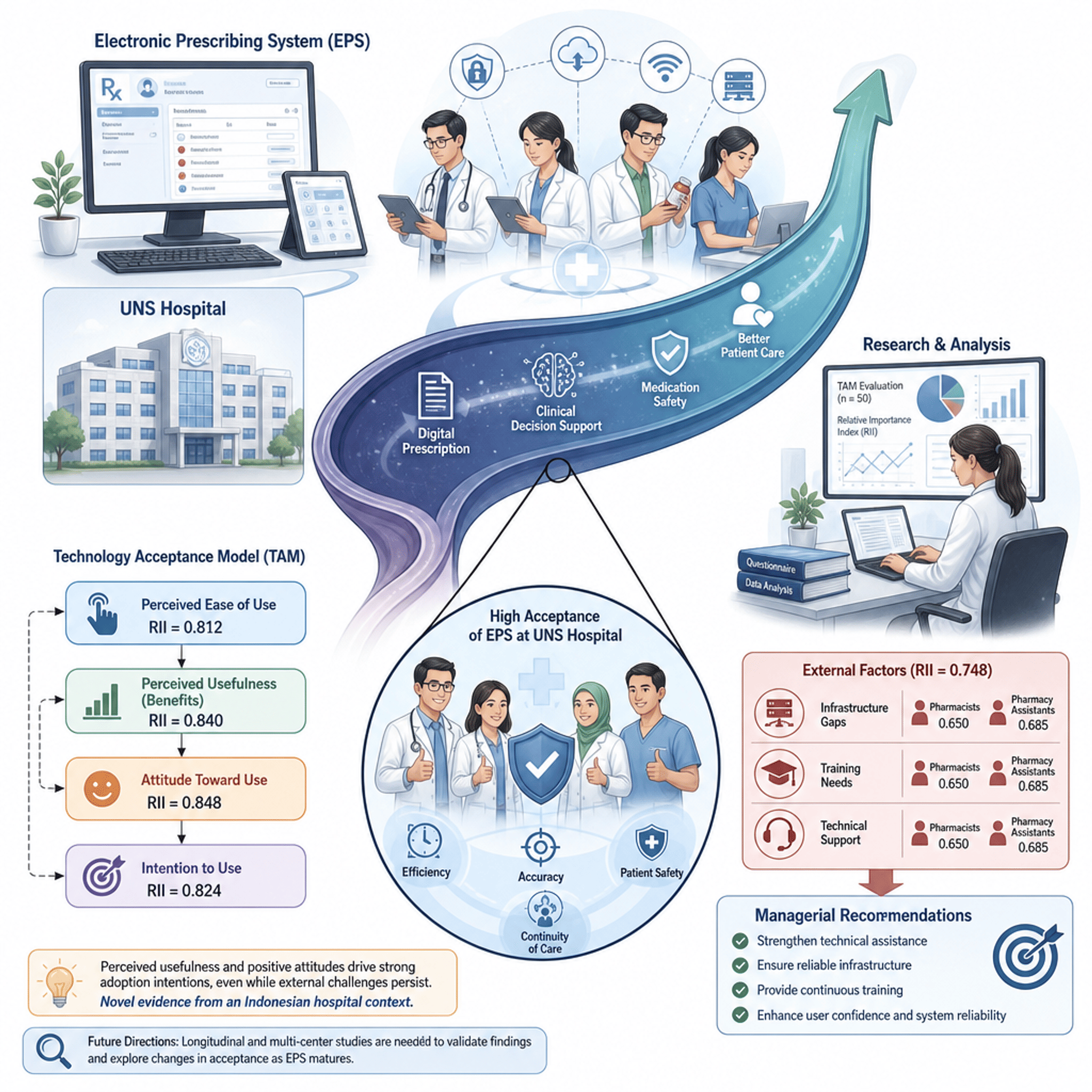
Implementing electronic prescribing systems (EPS) in hospitals is a complex process that extends beyond technological integration. It necessitates a comprehensive approach that considers the human factors involved, particularly the acceptance and willingness of healthcare professionals to adopt and utilize these systems effectively. This study aimed to evaluate the perceptions of doctors and pharmacists regarding the implementation of EPS at UNS Hospital using the Technology Acceptance Model (TAM). A validated questionnaire was administered to 50 respondents in UNS Hospital, assessing perceived ease of use, benefits, attitude towards usage, intention to use, and external factors. Most respondents (80%) agreed or strongly agreed that the system was easy to use. Furthermore, 90% acknowledged the benefits of EPS, including time savings, increased efficiency, accuracy, safety, and improved interprofessional communication. Attitudes towards usage were highly positive, with 92% of respondents expressing enthusiasm and comfort in transitioning to the electronic system. Intention to use was also high, with 86% committed to long-term adoption. However, external factors showed more varied results, with 66% agreeing or strongly agreeing, while 26% were doubtful and 8% disagreed, suggesting potential shortcomings in training, infrastructure, or technical assistance. These findings highlight the importance of addressing external factors to ensure the sustainability of EPS implementation Overall, the study indicates that the UNS Hospital EPS has the potential for widespread adoption and integration into healthcare services, given the positive perceptions of its ease of use, benefits, and user acceptance
Downloads
References
Benkhaial AA, Elsiaty AE, Alwarfly BE, Alhodere HA. The Knowledge and Attitude of Physicians working at the Benghazi Medical Center toward Electronic Prescribing Systems. Sci J Univ Benghazi. 2022 Jun;35(1).
Schiff G, Mirica MM, Dhavle AA, Galanter WL, Lambert B, Wright A. A prescription for enhancing electronic prescribing safety. Health Aff. 2018;37(11):1877–83.
Kenawy AS, Kett V. The impact of electronic prescription on reducing medication errors in an Egyptian outpatient clinic. Int J Med Inform [Internet]. 2019;127(April):80–7. Available from: https://doi.org/10.1016/j.ijmedinf.2019.04.005
Franklin BD, Puaar S. What is the impact of introducing inpatient electronic prescribing on prescribing errors? A naturalistic stepped wedge study in an English teaching hospital. Health Informatics J. 2020;26(4):3152–62.
Torres-Castaño A, González-González AI, Toledo-Chávarri A, Abt-Sack A, Bermejo-Caja CJ, Orrego C, et al. Healthcare {Professionals}’ {Perceptions} about the {Implementation} of {Shared} {Decision}-{Making} in {Primary} {Care}: {A} {Qualitative} {Study} from a {Virtual} {Community} of {Practice}. Int J Integr Care. 2024 Apr;24(2):8.
Grammatikopoulou M, Lazarou I, Giannios G, Kakalou CA, Zachariadou M, Zande M, et al. Electronic prescription systems in {Greece}: a large-scale survey of healthcare professionals’ perceptions. Arch Public Heal. 2024 May;82(1).
Pedersen CA, Schneider PJ, Ganio MC, Scheckelhoff DJ. {ASHP} national survey of pharmacy practice in hospital settings: {Prescribing} and transcribing-2019. Am J Heal Pharm. 2020 Jun;77(13):1026–50.
Davis FD, Venkatesh V. A critical assessment of potential measurement biases in the technology acceptance model: Three experiments. Int J Hum Comput Stud. 1996;45(1):19–45.
Lun L, Juan X, Fulai W, Zetian D, Hoe TW, Jiaxin D. Factors Influencing User Intentions on Interactive Websites: Insights From the Technology Acceptance Model. IEEE Access. 2024 Jan;12:122735–56.
Alipour J, Payandeh A, Hashemi A, Aliabadi A, Karimi A. Physicians’ {Perspectives} with the {E}-prescribing {System} in {Five} {Teaching} {Hospitals}. Appl Clin Inform. 2024 May;15(3):428–36.
Liu D, Niu Y, Lu W. Extended Technology-Acceptance Model to Make Smart Construction Systems Successful. J Constr Eng Manag. 2018 Mar;144(6).
Fecira D, Mohd T, Abdullah K. ANALISIS PENERIMAAN E-LEARNING. 2020;02(04):35–50.
Sakhare VD, Patil GS. Construction Equipment Monitoring : By Using Relative Important Indices ( Rii ) Analysis. 2019;261–3.
Aufegger L, Serou N, Chen S, Franklin BD. Evaluating users’ experiences of electronic prescribing systems in relation to patient safety: A mixed methods study. BMC Med Inform Decis Mak. 2020;20(1):1–8.
Dwi Lestari R, Sundari S, Trisnadi S. Systematic Literature Review on The Use of Electronic Prescribing (E-Prescribing) At Hospital Installation. J Aisyah J Ilmu Kesehat. 2024;9(2):1115–25.
Eltajoury WM, Maatuk AM, Denna I, Elberkawi EK. Physicians’ attitudes towards electronic prescribing software: Perceived benefits and barriers. ACM Int Conf Proceeding Ser. 2021;47–53.
Sema FD, Kebede AG, Soworsu GZ, Mengistu TT, Assen HE, Muche EA, et al. Perception of Healthcare Professionals towards Electronic-Prescribing at University of Gondar Comprehensive Specialized Hospital, Northwest Ethiopia: A Cross-Sectional Study. Biomed Res Int. 2024;2024.
United States Department of Health and Human Services. Electronic Health Record Adoption and Electronic Prescribing [Internet]. Official Website of the Assistant Secretary for Technology Policy/Office of the National Coordinator for Health IT; 2021. Available from: http://www.hhs.gov/healthit/onc/mission/
Radley DC, Wasserman MR, Olsho LEW, Shoemaker SJ, Spranca MD, Bradshaw B. Reduction in medication errors in hospitals due to adoption of computerized provider order entry systems. J Am Med Informatics Assoc. 2013;20(3):470–6.
Brabcová I, Tóthová V, Hajduchová H, Chloubová I, Červený M, Prokešová R, et al. Evaluation of medication errors in the hospital environment. Vnitr Lek. 2022 Oct;68(E-6):E03--E09.
Chan TKH. Association for Information Systems Challenges and Success Factors of Implementation of Electronic Prescription Service : A Comparative Study of England and Challenges and Success Factors of Implementation of Electronic Prescription Service : A Comparativ. AIS Electron Libr. 2022;
Hareem A, Lee J, Stupans I, Park JS, Wang K. Benefits and barriers associated with e-prescribing in community pharmacy – A systematic review. Explor Res Clin Soc Pharm [Internet]. 2023;12(August):100375. Available from: https://doi.org/10.1016/j.rcsop.2023.100375
Published
How to Cite
Issue
Section
Copyright (c) 2026 Joko Sudarsono, Satibi Satibi, Lutfan Lazuardi, Anna Wahyuni Widayanti

This work is licensed under a Creative Commons Attribution-NonCommercial-ShareAlike 4.0 International License.