Effect of Lemuru Fish–Based Local Snacks on HAZ and DHA Levels among Stunted Toddlers: A Quasi-Experimental Study
Keywords:
Stunting, lemuru fish, local snack, toddlerAbstract
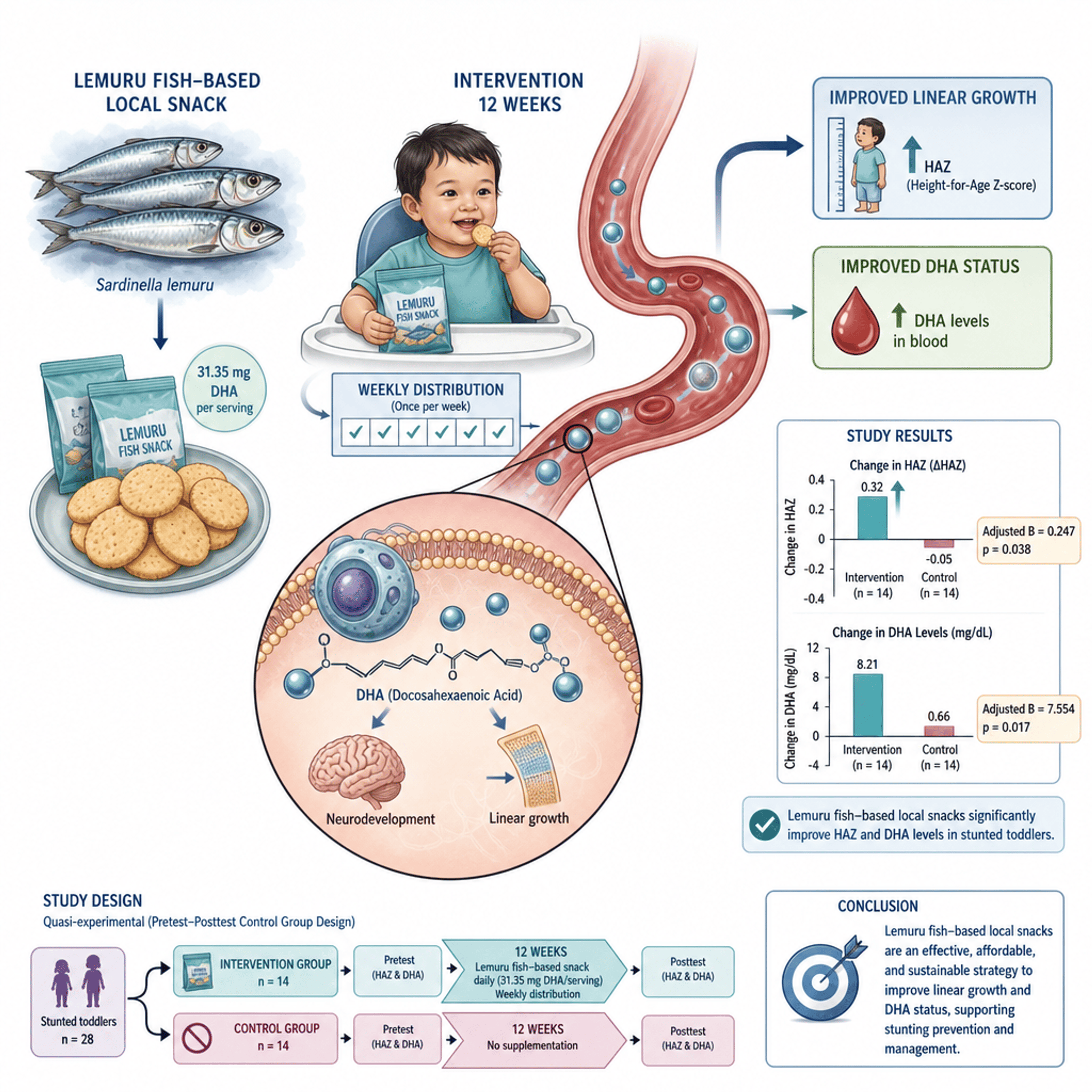
Stunting among toddlers remains a persistent public health problem in low- and middle-income countries and is strongly associated with chronic undernutrition, including inadequate intake of omega-3 long-chain polyunsaturated fatty acids such as docosahexaenoic acid (DHA), which are essential for optimal growth and development. Lemuru fish (Sardinella lemuru), a locally abundant and affordable source rich in DHA, has considerable potential as the basis for food based snacks in sustainable nutrition interventions. In this study, stunted toddlers in the intervention group received the lemuru fish–based snack daily for 12 weeks (each serving provided 31.35 mg DHA); DHA distribution was performed once weekly. This study aimed to evaluate the effect of lemuru fish–based local snacks on Height-for-Age Z-score (HAZ) and DHA levels among stunted toddlers. A quasi-experimental study with a pretest–posttest control group design was conducted involving 28 stunted toddlers, equally divided into an intervention group (n = 14) and a control group (n = 14). The intervention group received lemuru fish–based snacks during the intervention period, while the control group received no supplementation. Measurements of HAZ and DHA levels were obtained before and after the intervention. Bivariate analyses indicated greater improvements in HAZ and DHA levels in the intervention group compared with the control group. After adjustment for child and household characteristics using a general linear model (ANCOVA), the intervention was associated with significant improvements in HAZ (B = 0.247; p = 0.038) and DHA levels (B = 7.554 mg/dL; p = 0.017). These findings indicate that lemuru fish–based local snacks effectively improve linear growth and DHA status and represent a promising, locally sourced strategy for stunting prevention and management.
Downloads
References
World Health Organization. WHO Child Growth Standards: Length/height-for-age, weight-for-age, weight-for-length, weight-for-height and body mass index-for-age. Geneva: WHO; 2006.
Victora CG, Adair L, Fall C, Hallal PC, Martorell R, Richter L, et al. Maternal and child undernutrition: consequences for adult health and human capital. Lancet. 2008;371(9609):340–57.
doi:10.1016/S0140-6736(07)61692-4.
Black RE, Victora CG, Walker SP, Bhutta ZA, Christian P, de Onis M, et al. Maternal and child undernutrition and overweight in low-income and middle-income countries. Lancet. 2013;382(9890):427–51.doi:10.1016/S0140-6736(13)60937-X.
Danaei G, Andrews KG, Sudfeld CR, Fink G, McCoy DC, Peet E, et al. Risk factors for childhood stunting in 137 developing countries: A comparative risk assessment analysis. PLoS Med. 2016;13(11):e1002164. doi:10.1371/journal.pmed.1002164.
Hoppe C, Mølgaard C, Thomsen BL, et al. Protein intake at 9 months and linear growth from 9 to 18 months of age. Am J Clin Nutr. 2004;80(4):1027-33. Bzikowska-Jura A, Sobieraj P, Szostak-Węgierek D. Role of DHA in growth and development of infants and young children. Nutrients. 2022;14(4):785. doi:10.3390/nu14040785.
Cusick SE, Georgieff MK. The role of nutrition in brain development: The golden opportunity of the “first 1000 days”. J Pediatr. 2016; 175:16–21. doi: 10.1016/j.jpeds.2016.05.013.
FAO, WHO. Sustainable healthy diets – Guiding principles. Rome: FAO; 2019.
Harris AD, McGregor JC, Perencevich EN, Furuno JP, Zhu J, Peterson DE, et al. The use and interpretation of quasi-experimental studies in medical research. Clin Infect Dis. 2006;43(3):394–402.
doi:10.1086/505487.
Kirkwood BR, Sterne JAC. Essential Medical Statistics. 2nd ed. Oxford: Blackwell Science; 2003.
World Health Organization. WHO Anthro for personal computers, version 3.2.2. Geneva: WHO; 2011.
Willett W. Nutritional Epidemiology. 3rd ed. Oxford: Oxford University Press; 2013.
Field A. Discovering Statistics Using IBM SPSS Statistics. 5th ed. London: Sage Publications; 2018.
Vickers AJ, Altman DG. Statistics notes: Analysing controlled trials with baseline and follow up measurements. BMJ. 2001;323(7321):1123–4. doi:10.1136/bmj.323.7321.1123.
Tabachnick BG, Fidell LS. Using Multivariate Statistics. 7th ed. Boston: Pearson; 2019.
Leroy JL, Frongillo EA. Perspective: What does stunting really mean? A critical review of the evidence. Adv Nutr. 2019;10(2):196–204. doi:10.1093/advances/nmy101.
Thorne-Lyman AL, Valpiani N, Sun K, Semba RD. Consumption of animal-source foods and growth outcomes in children: A systematic review and meta-analysis. Am J Clin Nutr. 2014;100(2):366–79. doi:10.3945/ajcn.113.076901.
Kawarazuka N, Béné C. The potential role of small fish species in improving micronutrient deficiencies in developing countries. Public Health Nutr. 2011;14(11):1927–38. doi:10.1017/S1368980011000814.
Ruel MT, Alderman H; Maternal and Child Nutrition Study Group. Nutrition-sensitive interventions and programmes: How can they help to accelerate progress in improving maternal and child nutrition? Lancet. 2013;382(9891):536–51.doi:10.1016/S0140-6736(13)60843-0.
Victora CG, Christian P, Vidaletti LP, Gatica-Domínguez G, Menon P, Black RE. Revisiting maternal and child undernutrition in low-income and middle-income countries. Lancet. 2021;397(10282):1388–99.
doi:10.1016/S0140-6736(21)00394-9.
Lassi ZS, Rind F, Irfan O, Hadi R, Das JK, Bhutta ZA. Impact of infant and young child feeding interventions on growth and nutrition outcomes. Nutrients. 2020;12(8):2314. doi:10.3390/nu12082314.
Black RE, Laxminarayan R, Temmerman M, Walker N, editors. Disease Control Priorities, Third Edition (Volume 2): Reproductive, Maternal, Newborn, and Child Health. Washington (DC): World Bank; 2016.
Published
How to Cite
Issue
Section
Copyright (c) 2026 Estuasih Dyah Pertiwi, Sunarto Sunarto, Mohamad Reza Assidhiq, Arwin Muhlihsoh, Arvina Dian Wahyu Permatasari

This work is licensed under a Creative Commons Attribution-NonCommercial-ShareAlike 4.0 International License.
Most read articles by the same author(s)
- Sunarto Sunarto, Estuasih Dyah Pertiwi, Dyah Nur Subandriani, Addina Rizky Fitriyanti, Zuhria Ismawanti, Arwin Muhlihsoh, Mohamad Reza Assidhiq, Development and Evaluation of Local Snack-Based Complementary Foods for Toddlers Aged 12–23 Months: Nutritional Adequacy, Acceptability, and Cost Feasibility , Journal of Health and Nutrition Research: Vol. 5 No. 1 (2026)