The Role of Parental Motivation as a Mediator between Socioeconomic Factors and Temper Tantrum Incidents
Keywords:
Education, income, Occupation, Motivation, temper tantrumAbstract
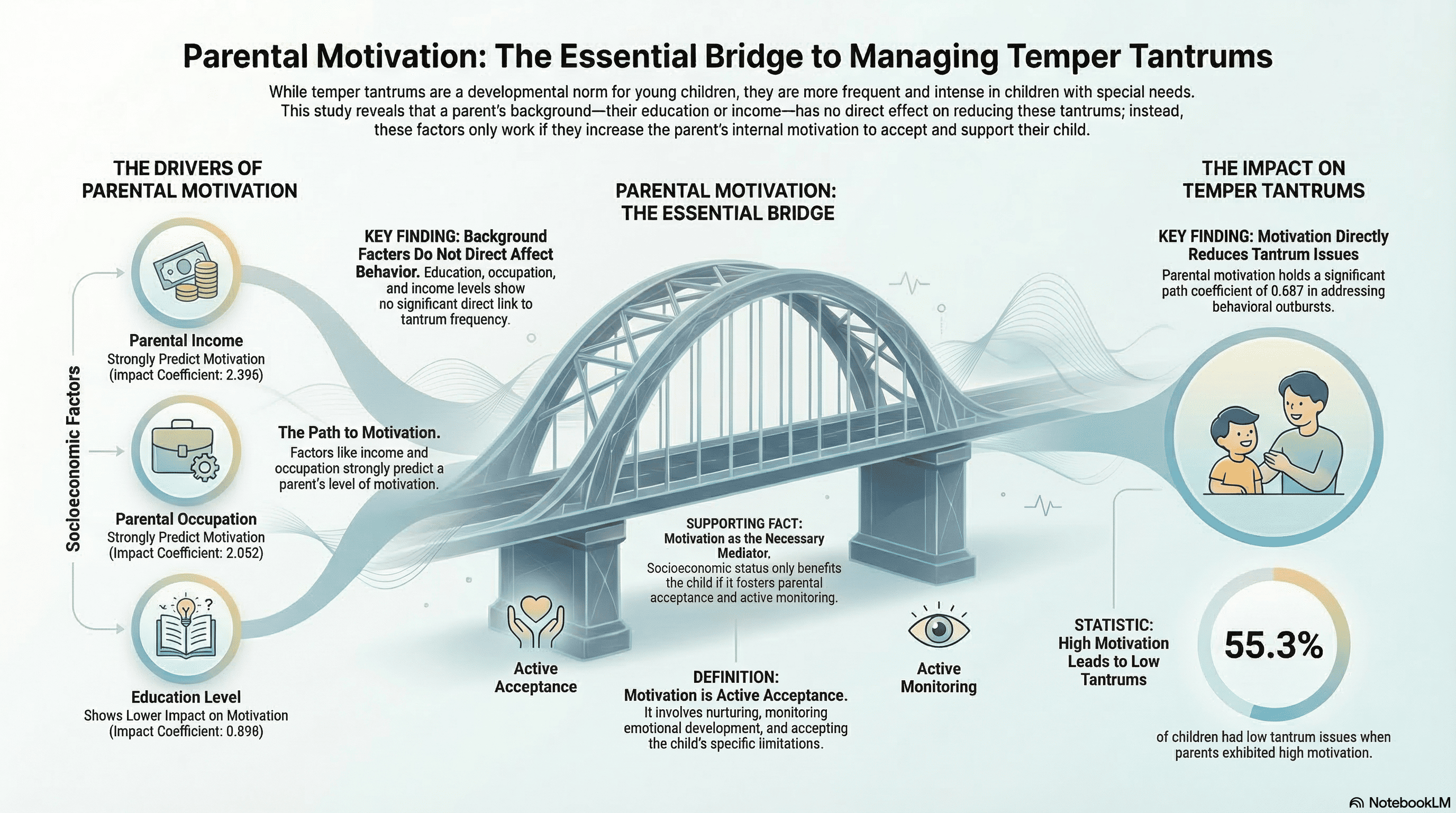
Parenting motivation is a critical factor in managing child behavior, as socioeconomic conditions often influence parental emotional responses and children's development. This study aims to analyze the impact of education level, occupation, and income on parental motivation and how this motivation subsequently influences the occurrence of temper tantrums in children with special needs. This research employed a quantitative path analysis design with a cross-sectional approach. The study was conducted at a Special Needs Primary School (SDLB) in Situbondo Regency, involving a total of 47 respondents selected through a total sampling technique. Data were collected via validated questionnaires and analyzed using multivariate linear regression to determine the mediating role of parental motivation. The findings reveal that socioeconomic factors significantly influence parental motivation, with path coefficients of 0.896 for education level, 2.062 for occupation, and 2.396 for income. Furthermore, parental motivation was found to have a direct and significant role in addressing temper tantrum issues, with a path coefficient of 0.68. Statistical analysis indicates that education, occupation, and income do not have a significant direct impact on temper tantrums in the absence of parental motivation. Parental motivation acts as a vital mediator between socioeconomic factors and the management of temper tantrums in children with special needs. The study underscores that while socioeconomic status provides a foundation, it is the parent’s internal motivation to accept and nurture their child that ultimately determines behavioral outcomes.
Downloads
References
Clifford P, Gevers C, Jonkman KM, Boer F, Begeer S. The effectiveness of an attention-based intervention for school-aged autistic children with anger regulating problems: A randomized controlled trial. Autism Research. 2022;15(10):1971–84. doi:10.1002/aur.2800 PubMed PMID: 36053934.
Van Den Akker AL, Hoffenaar P, Overbeek G. Temper Tantrums in Toddlers and Preschoolers: Longitudinal Associations with Adjustment Problems. Journal of Developmental and Behavioral Pediatrics. 2022;43(7):409–17. doi:10.1097/DBP.0000000000001071 PubMed PMID: 35316228.
Osgood J, de Rijke V. ‘That’s enough!’ (But it wasn’t): The generative possibilities of attuning to what else a tantrum can do. Global Studies of Childhood. 2022;12(3):235–48. doi:10.1177/20436106221117167
Wiliyanarti PF, Riswanti PI, Reliani R, Rofiqi E, Rozifa AW. Education, Income and Parenting Patterns in Relation to Toddler Temper Tantrum Incidents and Parents Using Smartphones. Gaceta Medica de Caracas. 2022;130(Supl 1):S137–42. doi:10.47307/GMC.2022.130.S1.25
Eppy Setiyowati, umi hanik, Ni Njoman Juliasih aimmatul C. The Impact Of Pcit (Parent Child Interaction Therapy) On Temper Tantrums In Pre-School. International Journal Of Pure Medical Research. 2022;2016(7):1–6.
Deichmann F, Ahnert L. The terrible twos: How children cope with frustration and tantrums and the effect of maternal and paternal behaviors. Infancy. 2021;26(3):469–93. doi:10.1111/infa.12389 PubMed PMID: 33729662.
Mohamadi Z, Shariatmadari F, Ranjbaran F, Yousefichaijan P, Rezaie M, Hosseini S, et al. Connection Between Tantrums and Voiding Dysfunction in Children: A Case-Control Study. Nephro-Urology Monthly. 2023;15(3). doi:10.5812/numonthly-139640
Rao RD, Nadeak Y. The Influence of Parenting Patterns on Tantrum Incidents in Toddlers in the Work Area of Rundeng Health Center, Rundeng District, Subulussalam City, Aceh Province in 2024. Journal of Physical Activity and Health. 2024;2(2):128–41.
Muharry A, Aisyah IS, Yogaswara D. Associations Between Digital Lifestyle , Social Factors , and Adolescent Obesity : A Case- Control Study in Tasikmalaya Regency , Indonesia Key Messages : Journal of Health and Nutrition Reseach. 2025;4(2):653–65. doi:https://doi.org/10.56303/jhnresearch.v4i2.447
Kemenkes BKPK. Survei kesehatan Indonesia (SKI). Kemenkes RI. Jakarta; 2023. Report No.
Fongaro E, Picot MC, Stringaris A, Belloc C, Verissimo AS, Franc N, et al. Parent training for the treatment of irritability in children and adolescents: a multisite randomized controlled, 3-parallel-group, evaluator-blinded, superiority trial. BMC Psychology. 2022;10(1):1–20. doi:10.1186/s40359-022-00984-5 PubMed PMID: 36414963.
Sambandam E. Parent apportions in pivotal response training on augmenting Joint attention and social-communication skills for children with autism. NeuroQuantology. 2022;20(22):1616–26. doi:10.48047/nq.2022.20.22.NQ10151 PubMed PMID: 2900743714.
Popow C, Ohmann S, Plener P. Practitioner’s review: medication for children and adolescents with autism spectrum disorder (ASD) and comorbid conditions. Neuropsychiatrie. 2021;35(3):113–34. doi:10.1007/s40211-021-00395-9 PubMed PMID: 34160787.
Tevis C, Matson JL. Challenging behaviour in children with developmental disabilities: an overview of behavioural assessment and treatment methods. BJPsych Advances. 2022;28(6):401–9. doi:10.1192/bja.2022.59
Abed Sakarneh M. The Extent to Which Teachers of Children With Autism Spectrum Disorder Know and Apply Behavior Modification Strategies. International Journal of Special Education. 2022;37(1):48–56. doi:10.52783/ijse.v37i1.4
Imran N, Zeshan M, Pervaiz Z. Mental health considerations for children & adolescents in covid-19 pandemic. Pakistan Journal of Medical Sciences. 2020;36(COVID19-S4):S67–72. doi:10.12669/pjms.36.COVID19-S4.2759
Kimonis ER. The Emotionally Sensitive Child-Adverse Parenting Experiences-Allostatic (Over)Load (ESCAPE-AL) Model for the Development of Secondary Psychopathic Traits. Clinical Child and Family Psychology Review. 2023;26(4):1097–114. doi:10.1007/s10567-023-00455-2 PubMed PMID: 37735279.
Lim T, Tan MY, Aishworiya R, Kang YQ. Autism Spectrum Disorder and COVID-19: Helping Caregivers Navigate the Pandemic. Annals of the Academy of Medicine, Singapore. 2020;49(6):384–6. doi:10.47102/annals-acadmedsg.2020112 PubMed PMID: 32712636.
Tan KH, Kasiveloo M, Abdullah IH. Token Economy for Sustainable Education in the Future: A Scoping Review. Sustainability (Switzerland). 2022;14(2). doi:10.3390/su14020716
Athbah SY. Evaluation the Level of Services Provided to ASD Students Spectrum Disorder in Special Education Centre’s in Saudi Arabia. Information Sciences Letters. 2023;12(2):707–16. doi:10.18576/isl/120214
Hornstra R, Onghena P, van den Hoofdakker BJ, van der Veen-Mulders L, Luman M, Staff AI, et al. Components of Behavioral Parent Training for Children With Attention-Deficit/Hyperactivity Disorder: A Series of Replicated Single-Case Experiments. Behavior Modification. 2023;47(5):1042–70. doi:10.1177/01454455231162003 PubMed PMID: 37056055.
Oktavia L, Astriana W, Akbar MA. The Effect of Peer Teaching Education on Diabetes Self-Care in Patients with Gestational Key Messages : Journal of Health and Nutrition Reseach. 2025;4(1):266–72.
Tomas Cano. Social Stratification and Mobility Social class , parenting , and child development : A multidimensional approach. Reseach in Social Stratification and Mobility. 2022;77(September 2021):1–12. doi:10.1016/j.rssm.2021.100648
Mangundap SA, Munir MA, Rahman N. The Association Between Parenting , Social Interaction , Social Values , and Adolescent Key Messages : Journal of Health and Nutrition Reseach. 2025;4(2):805–14. doi:https://doi.org/10.56303/jhnresearch.v4i2.496
Dan BA, Kovács KE, Bacskai K, Ceglédi T, Pusztai G. Family–SEN School Collaboration and Its Importance in Guiding Educational and Health-Related Policies and Practices in the Hungarian Minority Community in Romania. International Journal of Environmental Research and Public Health. 2023;20(3). doi:10.3390/ijerph20032054
Çelik S, Tomris G, Tuna DM. The COVID-19 pandemic: The evaluation of the emergency remote parent training program based on at-home support for children with down syndrome. Children and Youth Services Review. 2022;133(December 2021):106325. doi:10.1016/j.childyouth.2021.106325
Deliva LG, Rentino PNK, Leon DM De, R RA, Faderon KCM, Gavino KCT, et al. Exploring The Narratives Of Special Education Teachers In The First District Of Laguna: Basis For An Inclusivity Workshop. Ignatian International Journal for Multidisciplinary Research. 2024;2(5). doi:http://doi.org/10.5281/zenodo.11213143
Enav Y, Knudtson M, Goldenberg A, Gross JJ. Effect of partner presence on emotion regulation during parent–child interactions. Scientific Reports. 2024;14(1):1–9. doi:10.1038/s41598-024-60998-4 PubMed PMID: 38778131.
Carneiro P, Cattan S, Neves H. Theoretical and empirical perspectives on the link between poverty, parenting and children’s outcomes. Fiscal Studies. 2025;9–35. doi:10.1111/1475-5890.12404
Carlier S, Van der Paelt S, Ongenae F, De Backere F, De Turck F. Empowering children with ASD and their parents: Design of a serious game for anxiety and stress reduction†. Sensors (Switzerland). 2020;20(4). doi:10.3390/s20040966 PubMed PMID: 32054025.
Rohrer-Baumgartner N, Holthe IL, Svendsen EJ, Røe C, Egeland J, Borgen IMH, et al. Rehabilitation for children with chronic acquired brain injury in the Child in Context Intervention (CICI) study: study protocol for a randomized controlled trial. Trials. 2022;23(1):1–14. doi:10.1186/s13063-022-06048-8 PubMed PMID: 35193666.
Palacios-Ceña D, Güeita-Rodríguez J, Gil-Nagel A, Jimenez-Antona C, García-Bravo C, Velarde-García JF, et al. Health care concerns in parents of children with different genetic developmental and epileptic encephalopathies: A qualitative study. Developmental Medicine and Child Neurology. 2024;66(2):195–205. doi:10.1111/dmcn.15712 PubMed PMID: 37482918.
Soetjiningsing. Tumbuh kembang anak. Jakarta: EGC; 1995.
Al Hadhrami AS, Raja Al-Amrat MG, Khasawneh MAS, Darawsheh SR. Approach to Improve Reading Skill of Students with Dyslexia. Information Sciences Letters. 2022;11(6):2333–8. doi:10.18576/isl/110639
Wooden M, Wooden M. Early Interventions and Special Education Services for Children with Autism. Sarah Lawrence College; 2020.
Bozkus-genc G, Sani-bozkurt S. Since January 2020 Elsevier has created a COVID-19 resource centre with free information in English and Mandarin on the novel coronavirus COVID- 19 . The COVID-19 resource centre is hosted on Elsevier Connect , the company ’ s public news and information. Research in Developmental Disabilities. 2020;(January):1–11. doi:https://doi.org/10.1016/j.ridd.2022.104200
Published
How to Cite
Issue
Section
Copyright (c) 2026 Zainal Munir, Nyimas Heny Purwati, Achmad Fauzi

This work is licensed under a Creative Commons Attribution-NonCommercial-ShareAlike 4.0 International License.