The Impact of WhatsApp Chatbot-Based Educational Intervention on Nutritional Literacy of Pregnant Women: A Quasi-Experimental Study in the Cot Seumeureng Community Health Center Work Area
Keywords:
Pregnant Women, Nutritional Literacy, WhatsApp Chatbot, Digital Health InterventionAbstract
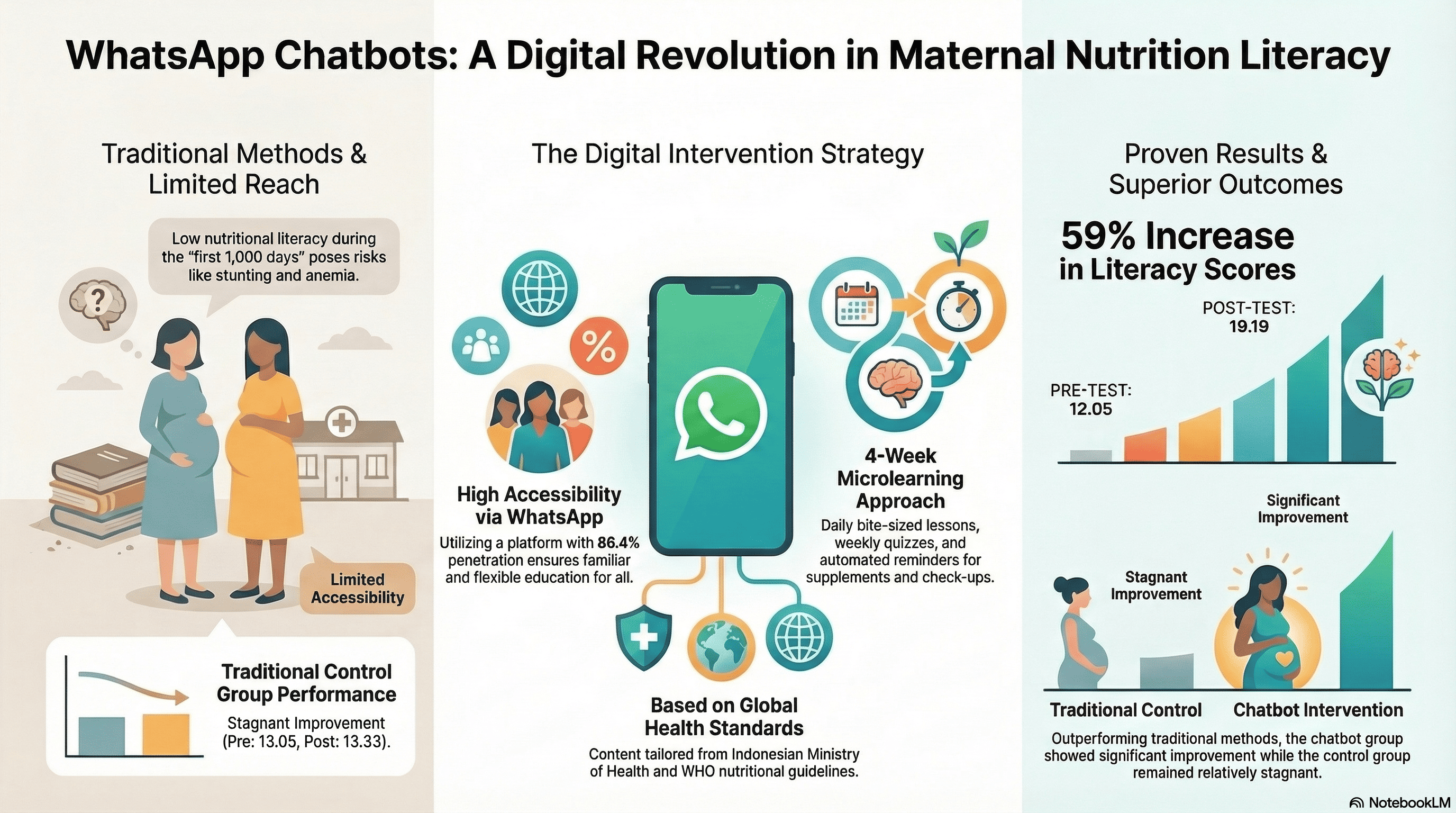
Ensuring optimal nutritional intake during pregnancy is fundamental to supporting healthy fetal growth and development. Consequently, enhancing the nutritional literacy of pregnant women is a critical public health objective to prevent adverse outcomes such as stunting and maternal anemia. This study aimed to evaluate the efficacy of a WhatsApp chatbot-based educational intervention in improving pregnant women's nutritional literacy. A quasi-experimental study with a pre-post test control-group design was conducted at the Cot Seumeureng Community Health Center in West Aceh. Using purposive sampling, 84 pregnant women were enrolled and divided into an intervention group (n=42) and a control group (n=42). The intervention group received structured nutrition education delivered via a WhatsApp chatbot over a four-week period, whereas the control group received standard antenatal services. Data were collected using a modified and validated Nutrition Literacy Assessment Instrument for Pregnant Women (NLAI-P) and analyzed using Paired and Independent Sample T-Tests. The findings indicated a substantial increase in the mean nutritional literacy scores of the intervention group, rising from 12.05 to 19.19. In contrast, the control group’s scores remained relatively stagnant, moving from 13.05 to 13.33. The Independent Sample T-Test confirmed a statistically significant difference in post-test outcomes between the two groups (t=−7.626;p=0.000), demonstrating the superior impact of the digital intervention. A WhatsApp chatbot-based educational intervention is a highly effective, accessible, and innovative modality for significantly enhancing maternal nutritional literacy.
Downloads
References
Agosti M, Tandoi F, Morlacchi L, Bossi A. Nutritional and metabolic programming during the first thousand days of life. Pediatr Med Chir. 2017;39(2):157.
Hsu CN, Tain YL. The first thousand days: Kidney health and beyond. Healthc. 2021;9(10):1–17.
Black RE, Victora CG, Walker SP, Bhutta ZA, Christian P, De Onis M, et al. Maternal and child undernutrition and overweight in low-income and middle-income countries. Lancet. 2013;382(9890):427–51.
Liyew AM, Tesema GA, Alamneh TS, Worku MG, Teshale AB, Alem AZ, et al. Prevalence and determinants of anemia among pregnant women in East Africa; A multi-level analysis of recent demographic and health surveys. PLoS One [Internet]. 2021;16(4 April 2021):1–15. Available from: http://dx.doi.org/10.1371/journal.pone.0250560
WHO. Guideline : Daily iron and folic acid supplementation in pregnant women. World Health Organization. Geneva: World Health Organization; 2012.
Kementerian Kesehatan Republik Indonesia. Buku Saku Pemantauan Status Gizi Tahun 2021. Jakarta: Kemenkes RI; 2021.
Candra A. Epidemiologi Stunting. Semarang: Fakultas Kedokteran Universitas Diponegoro; 2020.
Velardo S. The Nuances of Health Literacy, Nutrition Literacy, and Food Literacy. J Nutr Educ Behav. 47(4):385–9.
Reshid M, Anato A. Community-based nutrition education and counselling provided during pregnancy: Effects on knowledge and attitude towards iron-folic acid supplementation. J Nutr Sci. 2024;13:1–9.
Engidaw MT, Lee P, Fekadu G, Mondal P, Ahmed F. Effect of Nutrition Education During Pregnancy on Iron-Folic Acid Supplementation Compliance and Anemia in Low- and Middle-Income Countries: A Systematic Review and Meta-analysis. Nutr Rev [Internet]. 2024;00(0):1–16. Available from: http://www.ncbi.nlm.nih.gov/pubmed/39545365
Rosita E, Bancin R, Andriani R, Damayanti S, Nasution N, Zakiyah, et al. Hubungan Pengetahuan Ibu Hamil Dengan Kunjungan Jurnal Keperawatan Antenatal Care (ANC) Terpadu Di Wilayah Kerja Puskesmas Meureubo Kabupaten Aceh Barat. AKIMBA ( JUKA ). 2024;8(2).
Rhodes A, Smith AD, Chadwick P, Croker H, Llewellyn CH. Exclusively digital health interventions targeting diet, physical activity, and weight gain in pregnant women: Systematic review and meta-analysis. JMIR mHealth uHealth. 2020;8(7).
Wang J, Tang N, Jin C, Yang J, Zheng X, Jiang Q, et al. Association of Digital Health Interventions With Maternal and Neonatal Outcomes: Systematic Review and Meta-Analysis. J Med Internet Res. 2025;27.
Okonkwo CW, Ade-Ibijola A. Chatbots applications in education: A systematic review. Comput Educ Artif Intell [Internet]. 2021;2(October):100033. Available from: https://doi.org/10.1016/j.caeai.2021.100033
Deepak Bhagchandani. Statistik Pengguna WhatsApp Tahun 2024. DoubleTick [Internet]. 2024; Available from: https://doubletick.io/blog/whatsapp-user
Karjuan E. Cara WhatsApp Menjadi Platform Komunikasi Populer. Radia Republik Indonesia [Internet]. 2025; Available from: https://www.rri.co.id/iptek/1406272/cara-whatsapp-menjadi-platform-komunikasi-populer
WHO. Antenatal care recommendations: Nutritional interventions update. Geneva: WHO; 2020.
Kemenkes. Pedoman Gizi Seimbang Ibu Hamil dan Ibu Menyusui. Kementeri Kesehat Republik Indones. 2021;1–130.
Puspitasari IW, Rinawan FR, Purnama WG, Susiarno H, Susanti AI. Development of a Chatbot for Pregnant Women on a Posyandu Application in Indonesia: From Qualitative Approach to Decision Tree Method. Informatics. 2022;9(4).
Laymouna M, Ma Y, Lessard D, Schuster T, Engler K, Lebouché B. Roles, Users, Benefits, and Limitations of Chatbots in Health Care: Rapid Review. J Med Internet Res. 2024;26:1–28.
Montenegro JLZ, da Costa CA, da Rosa Righi R, Farias ER, Matté LB. Development and Validation of Conversational Agent to Pregnancy Safe-education. J Med Syst. 2023 Jan 10;47(7).
Amil S, Da SMAR, Plaisimond J, Roch G, Sasseville M, Bergeron F, et al. Interactive Conversational Agents for Perinatal Health: A Mixed Methods Systematic Review. Healthc. 2025;13(4):1–23.
Lee SH, Nurmatov UB, Nwaru BI, Mukherjee M, Grant L, Pagliari C. Effectiveness of mHealth interventions for maternal, newborn and child health in low- and middle-income countries: Systematic review and meta-analysis. J Glob Health. 2016;6(1).
Bi S, Yuan J, Wang Y, Zhang W, Zhang L, Zhang Y, et al. Effectiveness of Digital Health Interventions in Promoting Physical Activity Among College Students: Systematic Review and Meta-Analysis. J Med Internet Res. 2024;26:e51714.
Dahlan MS. Statistik untuk kedokteran dan kesehatan seri 1 edisi 6. Jakarta: Epidemiologi Indonesia; 2014.
Kang H. Sample size determination and power analysis using the G*Power software. J Educ Eval Health Prof. 2021;18:1–12.
Dahlan MS. Besar sampel dalam penelitian kedokteran dan kesehatan. Jakarta: epidemiologi indonesia; 2016.
Zhou Y, Lyu Y, Zhao R, Shi H, Ye W, Wen Z, et al. Development and Validation of Nutrition Literacy Assessment Instrument for Chinese Pregnant Women. Nutrients. 2022;14(14):1–15.
Stormacq C, Wosinski J, Boillat E, Den Broucke S Van. Effects of health literacy interventions on health-related outcomes in socioeconomically disadvantaged adults living in the community: A systematic review. JBI Evid Synth. 2020;18(7):1389–469.
Putri AP, Lu YY. Maternal Health Literacy in Pregnant Women: A Concept Analysis. Matern Child Health J. 2024 Aug 12;28(8):1272–82.
Chung K, Cho HY, Park JY. A chatbot for perinatal women⇔s and partners⇔ obstetric and mental health care: development and usability evaluation study. JMIR Med Informatics. 2021;9(3).
Kerimoglu Yildiz G, Turk Delibalta R, Coktay Z. Artificial intelligence-assisted chatbot: impact on breastfeeding outcomes and maternal anxiety. BMC Pregnancy Childbirth. 2025;25(1).
Kaneho AEA, Zrira N, Ouazzani-Touhami K, Khan HA, Nawaz S. Development of a bilingual healthcare chatbot for pregnant women: A comparative study of deep learning models with BiGRU optimization. Intell Med [Internet]. 2025;12(April):100261. Available from: https://doi.org/10.1016/j.ibmed.2025.100261
Lazzari C, Endrizzi B, Zorzi M, Purin B, Poggianella S, Taddei F. A chatbot-based nutritional coaching intervention for pregnant women. Ital J Gynaecol Obstet. 2024;36(Supplement 03):11.
Kim HK. The Effects of Artificial Intelligence Chatbots on Women’s Health: A Systematic Review and Meta-Analysis. Healthc. 2024;12(5).
Nur Aulia ES, Jati G, Wibowo I, Muhammad HN, Saepudin E. Chatbots Be Nutritionists: Exploring the Potential of AI-Powered to Improve Nutritional Counseling in Indonesia. J Sosioteknologi. 2024;23(3):324–35.
Published
How to Cite
Issue
Section
Copyright (c) 2026 Zakiyah Zakiyah, Anggi Maulida Sari

This work is licensed under a Creative Commons Attribution-NonCommercial-ShareAlike 4.0 International License.