Determinants of Work Productivity: The Roles of Health and Lifestyle among Government Employees
Keywords:
Nutritional Status, Breakfast Habit, Sedentary Lifestyle, Physical Fitness, Work ProductivityAbstract
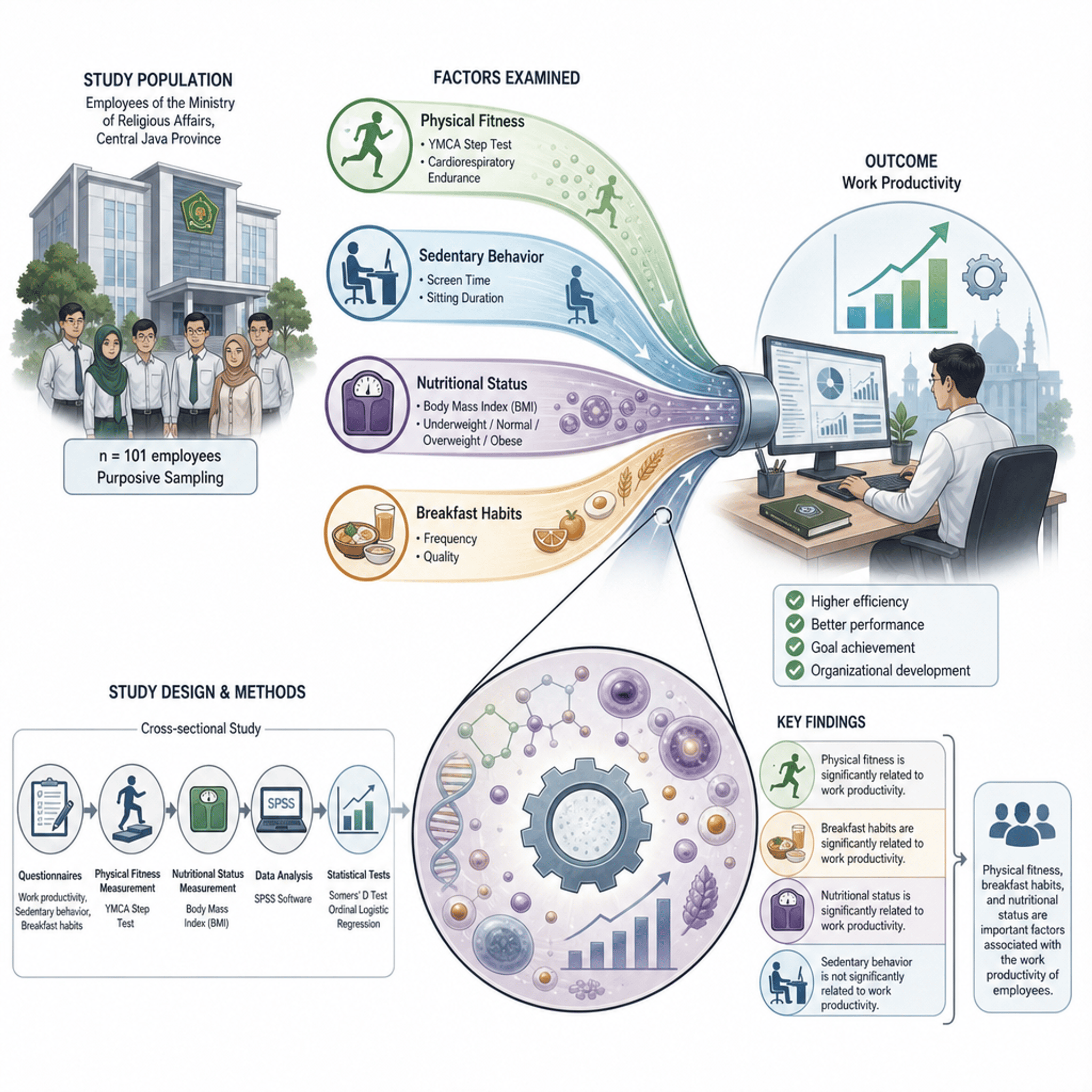
Work productivity is an important aspect for workers and institutions that is influenced by internal factors such as education level, discipline, attitude, work motivation, health, nutrition, and physical condition, as well as external factors associated with the environment, including workplace conditions, organizational policies, wages, and infrastructure. This study aims to determine the relationship between physical fitness, sedentary behavior, nutritional status, and breakfast habits with the work productivity of employees at the Ministry of Religious Affairs in Central Java Province. This study used a quantitative method with a cross-sectional design. A sample of 101 employees was selected using purposive sampling. Questionnaires were used to collect data on work productivity, sedentary activities, and breakfast habits. Physical fitness was measured using the YMCA step test method, and nutritional status was measured using body mass index. Data were analyzed using SPSS with Somers' D test and ordinal logistic regression. The results show that there is a significant relationship between physical fitness, breakfast habits, and nutritional status with work productivity while sedentary behavior is not related to work productivity. In conclusion, physical fitness, breakfast habits, and nutritional status are related to the work productivity of employees at the Ministry of Religious Affairs in Central Java Province.
Downloads
References
Wirawan PJ, Haris IA, Suwena KR. Pengaruh Disiplin Kerja terhadap Produktivitas Kerja Karyawan Bagian Produksi pada PT. Tirta Mumbul Jaya Abadi Tahun 2016. Jurnal Pendidikan Ekonomi Undiksha. 2018;10(1).
Asian Productivity Organization. APO Productivity Databook 2023. 2023.
Kementerian Agama Kantor Wilayah Jawa Tengah. Capaian Kinerja Kantor Wilayah Kemenag RI [Internet]. 2024 [cited 2025 May 21]. Available from: https://www.instagram.com/kemenag.jateng/p/DDrEaeGzgAE/?img_index=1
Douw NI, Maarif MS, Baga LM. Peningkatan Produktivitas Kerja Karyawan Development di Tambang Bawah Tanah DMLZ (Deep Mill Level Zone) PT Freeport Indonesia. Jurnal Aplikasi Bisnis dan Manajemen. 2021;7(2). doi:10.17358/jabm.7.2.316
Kerisnawati T, Roosita K. Konsumsi Pangan, Aktivitas Fisik, Status Gizi dan Produktivitas Kerja Pemetik Teh di Kabupaten Kepahiang Bengkulu pada Masa Pandemi Covid-19. Jurnal Gizi Dietetik. 2022;1(1):65–73.
Shafitra M, Permatasari P, Agustina A, Ery M. Hubungan Status Gizi, Pola Makan dan Aktivitas Fisik dengan Produktivitas Kerja Pada Pekerja di PT Gatra Tahun 2019. Media Kesehatan Masyarakat Indonesia. 2020;19(1):50–6. doi:10.14710/mkmi.19.1.50-56
Maedah AL, Sitoayu L, Melani V, Nuzrina R, Kuswari M. Status Gizi, Kebiasaan Sarapan Dengan Produktivitas Kerja Karyawan Startup Jakarta. Jurnal Gizi Kerja dan Produktivitas. 2023;4(2):206–15.
Wiguna AF, Stefani M. The Relationship between Nutritional Status, Breakfast Habits, and Sleep Duration on Workers’ Productivity at PT. Sejahtera Buana Trada Sunter. Amerta Nutrition. 2023;7(2):205–12. doi:10.20473/amnt.v7i2SP.2023.20
Harfika A, Arifin DZ, Herutomo T. Program pengukuran status gizi dan kebugaran jasmani dalam upaya peningkatan produktivitas pekerja di PT. Daido Indonesia Manufacturing. Journal of Holistic Community Service. 2024;1(2):43–9. doi:10.51873/jhcs.v1i2.35
Hua Z, Sun J. Investigating Morphological Changes of the Hippocampus After Prolonged Aerobic Exercise in Mice: Neural Function and Learning Capabilities. International Journal of Morphology. 2024;42(3):614–22. doi:10.4067/s0717-95022024000300614
Kementerian Kesehatan RI. Laporan Nasional Riset Kesehatan Dasar 2018. Kementerian Kesehatan RI. Jakarta: Badan Penelitian dan Pengembangan Kesehatan; 2019. PubMed PMID: 25246403.
Kementerian Kesehatan RI. Survei Kesehatan Indonesia (SKI) dalam Angka. 2023.
Rosenkranz SK, Mailey EL, Umansky E, Rosenkranz RR, Ablah E. Workplace sedentary behavior and productivity: A cross-sectional study. International Journal of Environmental Research and Public Health. 2020;17(18):1–14. doi:10.3390/ijerph17186535 PubMed PMID: 32911740.
Putra RSN, Sepriadi, Nirwandi, Wulandari I. Hubungan Kebugaran Jasmani dan Tingkat Konsentrasi Terhadap Hasil Belajar Pendidikan Jasmani, Olahraga dan Kesehatan Siswa Kelas VII di Madrasah Tsanawiyah Negeri 02 Agam. Jurnal Pendidikan dan Olahraga. 2023;6(10):16–24.
Syawang SDA, Azkia FI, Bahari I, Syamsina JN, Luthfiadi DH, Ramadhani AN, et al. Pengaruh Kebugaran Jasmani Dengan Produktivitas Individu di Era Industri 4.0. Jurnal Nakula : Pusat Ilmu Pendidikan, Bahasa dan Ilmu Sosial. 2024;2(3):221–33.
Mahindru A, Patil P, Agrawal V. Role of Physical Activity on Mental Health and Well-Being: A Review. Cureus. 2023;15(1). doi:10.7759/cureus.33475 PubMed PMID: 36756008.
Masturoh I, Anggita T. Metodologi Penelitian Kesehatan. Kementerian Kesehatan RI; 2018.
Bunarsi D, Lontoh SO. Pengaruh YMCA Step Test terhadap kebugaran fisik pada mahasiswa Fakultas Kedokteran Universitas Tarumanagara. Tarumanegara Medical Journal. 2020;3(1):22–9.
Purwanto. Teknik Penyusunan Instrumen Uji Validitas dan Reliabilitas. Magelang: Staia Press; 2018.
Sumardiyono, Ratnawati, Lestari N, Zulaikhah ST, Prakoso DA, Julianti HP, et al. Biostatistika Kedokteran dan Kesehatan. 2020. 1–358 p.
Zakariyah, Zain I. Analisis Regresi Logistik Ordinal pada Prestasi Belajar Lulusan Mahasiswa di ITS Berbasis SKEM. Jurnal Sains dan Seni ITS. 2015;4(1):121–6.
Dahlan SM. Statistik untuk Kedokteran dan Kesehatan. 4th ed. Jakarta: Epidemiologi Indonesia; 2016.
Hermawan I, Sonjaya AR, Raswan MS. Hubungan antara Tingkat Kebugaran Jasmani dengan Konsentrasi Belajar Pendidikan Jasamani Siswa. HOLISTIC JOURNAL OF SPORT EDUCATION. 2022;1(2):52–9.
Yi Q, Yang C, Qi Y, Feng X, Tan J, Song X, et al. Physical activity and cognitive function among community-dwelling older adults: a mediating role of functional fitness. BMC Public Health. 2025;25(1081). doi:10.1186/s12889-025-22321-2 PubMed PMID: 40119281.
Syam S, Sukirman PM, Suwendro NI, Lestari A. Smoking Behavior Among Adolescents at A Public Junior High School. Journal of Health and Nutrition Research. 2023;2(3):210–20.
Ubaidillah A, Wahjuni ES. Pengaruh Merokok terhadap Tingkat Kesegaran Jasmani. Jurnal Pendidikan Olahraga dan Kesehatan. 2021;9(2):421–5.
Purwaningsih NNA, Sutiari NK. Hubungan Status Gizi Dan Kebiasaan Merokok Dengan Kebugaran Jasmani Petugas Pemadam Kebakaran Bpbd Kota Denpasar. Arc Com Health. 2022;9(3):451–63.
Bryantara OF. Faktor Yang Berhubungan Dengan Kebugaran Jasmani (VO2 Maks) Atlet Sepakbola. Jurnal Berkala Epidemiologi. 2016;4(2):237–49. doi:10.20473/jbe.v4i2.2016.237
Bao MMN, Rante SDT, Manafe RRWDT. Hubungan Kebiasaan Berolahraga dengan Tingkat Stres pada Mahasiswa Preklinik Fakultas Kedokteran Universitas Nusa Cendana saat Masa Pandemi COVID-19. Cendana Medical Journal. 2022;23(1).
Febianti A, Shulthoni M, Masrur M, Safi’i MA. Pengaruh Tingkat Pendidikan, Umur, Jenis Kelamin, dan Pengalaman Kerja terhadap Produktivitas Kerja di Indonesia. Jurnal Sahmiyya. 2023;2(1):198–204.
Yanti P, Bausad AAP. Hubungan Masa Kerja, Beban Kerja, dan Kelelahan Kerja dengan Stres Kerja pada Pengrajin Batu Bata. Jurnal Kesehatan Ilmiah Indonesia (Indonesian Health Scientific Journal). 2025;10(1).
Taufik, Novaria AA, Utami RP, Wiryanto. The Relationship of Physical Activity, Energy, and Protein Intake with Nutritional Status in Adolescents at Junior High School. Journal of Health and Nutrition Research. 2024;3(1):46–52.
Bakri AS, Suharni, Hardi I, Septiyani. Hubungan Status Gizi Dengan Produktivitas Kerja Karyawan PT. Angkasa Pura I (PERSERO) Kota Makassar. Window of Public Health Journal. 2021;2(6):1043–9. doi:10.33096/woph.v2i6.313
Khasanah L, Rahmawati YD, Wahyani AD. Hubungan asupan kalori, kebiasaan sarapan dan status gizi dengan produktivitas kerja karyawan Universitas Muhadi Setiabudi. Jurnal Ilmiah Gizi dan Kesehatan (JIGK). 2023;4(2):20–5.
Erickson KI, Hillman C, Stillman CM, Ballard RM, Bloodgood B, Conroy DE, et al. Physical Activity, Cognition, and Brain Outcomes: A Review of the 2018 Physical Activity Guidelines. Med Sci Sports Exerc. 2019;51(6):1242–51. doi:10.1249/fit.0000000000000476
Ramadhanti AA. Status Gizi dan Kelelahan terhadap Produktivitas Kerja. Jurnal Ilmiah Kesehatan Sandi Husada. 2020;11(1):213–8. doi:10.35816/jiskh.v10i2.251
Kementerian Kesehatan RI. Peraturan Menteri Kesehatan Republik Indonesia Nomor 28 Tahun 2019 Tentang Angka Kecukupan Gizi Yang Dianjurkan Untuk Masyarakat Indonesia. 2019.
Yulia SA. Hubungan Kebiasaan Sarapan Pagi dengan Konsentrasi Belajar pada Anak Sekolah Dasar : Literature Review. SEHAT: Jurnal Kesehatan Terpadu. 2024;3(1). doi:10.56338/mppki.v6i8.3738
Husna A, Dwiriani CM, Kustiyah L. The Association of Breakfast Consumption with Blood Glucose Levels and Short-Term Memory in Primary School Children : A Cross-Sectional Study. Journal of Health and Nutrition Research. 2026;5(1):353–62.
Edefonti V, Rosato V, Parpinel M, Nebbia G, Fiorica L, Fossali E, et al. The effect of breakfast composition and energy contribution on cognitive and academic performance: A systematic review. American Journal of Clinical Nutrition. 2014;100:626–56. doi:10.3945/ajcn.114.083683 PubMed PMID: 24808492.
Song X, Jia X, Zhang B, Wang H. Breakfast consumption behavior was positively associated with cognitive function in Chinese adults aged 55 years and above. Journal of Nutrition, Health and Aging. 2025;29(10). doi:10.1016/j.jnha.2025.100662 PubMed PMID: 40886647.
Puri S, Shaheen M, Grover B. Nutrition and cognitive health: A life course approach. Frontiers in Public Health. 2023;11:1–11. doi:10.3389/fpubh.2023.1023907 PubMed PMID: 37050953.
Published
How to Cite
Issue
Section
Copyright (c) 2026 Wafa Ma'mun, Isna Qadrijati, Adi Magna Patriadi Nuhriawangsa

This work is licensed under a Creative Commons Attribution-NonCommercial-ShareAlike 4.0 International License.
Most read articles by the same author(s)
- Rici Riansyah, Tyas Lilia Wardani, Isna Qadrijati, Jihan Faradisha, Afrian Eskartya Harjono, Rizqy Kartika Sari, Rachmawati Prihantina Fauzi, Reni Wijayanti, Assessing Safety Climate Dimensions in the Textile Industry: A Correlational Study Using the NOSACQ-50 Framework , Journal of Health and Nutrition Research: Vol. 5 No. 2 (2026)