Metabolite Profiling Differences of Single and Physical Mixture of Moringa Leaves (Moringa oleifera) and Red Galangal (Alpinia purpurata (Vieill) K. Schum)
Keywords:
Alpinia purpurata, Moringa oleifera, Phytochemicals profiling, Secondary metabolite, UHPLC-HRMS methodAbstract
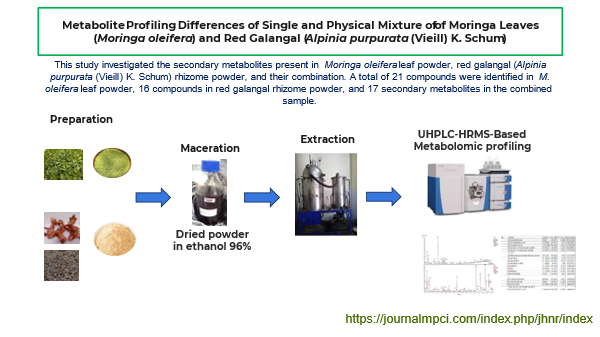
econdary metabolites are bioactive plant constituents that contribute to antioxidant, anti-inflammatory, and anti-microbial activities, making them valuable for functional food and nutraceuticals applications. This study aimed to characterize the secondary metabolites present in powdered Moringa oleifera leaves, red galangal (Alpinia purpurata (Vieill) K. Schum) rhizomes, and their combination. The 85:15 ratio used in the mixed powder was selected based on preliminary material composition considerations. Metabolite identification was conducted using Ultra High Performance Liquid Chromatography Tandem High Resolution Mass Spectrometry (UHPLC-HRMS). Data processing and compound annotation were performed using ChemSpider and mzCloud. A total of 21 metabolites were identified in moringa leaf powder, 16 compounds in red galangal rhizome, and 17 compounds in the combined preparation. Flavonoid were the dominant class in moringa leaves with quercitrin, 4-aminobenzoid acids, and pheophorbide A as the most abundant constituents. In contrast, phenolic compounds, particularly benzoic derivatives were predominant in red galangal, where menadiol, abietin, and sweroside were the major metabolites. The combined formulation retained key constituents from both plants, including cinnamaldehyde, 4-aminobenzoic acid, and pheophorbide A, and additionally showed an increased level of nictoflorin. These findings provide preliminary compositional evidence demostrating the distinct and complementary phytochemical profiles of moringa leaves and red galangal rhizomes. This information may guide future studies into potential functional food or nutraceutical formulations for further validation through bioactivity, bioavailability, and interaction studies.
Downloads
References
Khan A, Kanwal F, Ullah S, Fahad M, Tariq L, Altaf MT, et al. Plant Secondary Metabolites—Central Regulators Against Abiotic and Biotic Stresses. Metabolites. 2025;15(4):1–27. doi:10.3390/metabo15040276
Dongmo FFD, Mawamba AD, Etame RME, Asongni WD, Lienou LL, Tamgue O, et al. Enhancing health through phenolic compounds: A comprehensive review of spices and herbs consumed in Cameroon based on global research. Applied Food Research. 2025;5(1):100837. doi:10.1016/j.afres.2025.100837
González-Burgos E, Ureña-Vacas I, Sánchez M, Gómez-Serranillos MP. Nutritional value of moringa oleifera Lam. Leaf powder extracts and their neuroprotective effects via antioxidative and mitochondrial regulation. Nutrients. 2021;13(7). doi:10.3390/nu13072203 PubMed PMID: 34206952.
Khalid S, Arshad M, Mahmood S, Ahmed W, Siddique F, Khalid W, et al. Nutritional and phytochemical screening of Moringa oleifera leaf powder in aqueous and ethanol extract. International Journal of Food Properties. 2023;26(1):2338–48. doi:10.1080/10942912.2023.2246685
Pareek A, Pant M, Gupta MM, Kashania P, Ratan Y, Jain V, et al. Moringa oleifera: An Updated Comprehensive Review of Its Pharmacological Activities, Ethnomedicinal, Phytopharmaceutical Formulation, Clinical, Phytochemical, and Toxicological Aspects. International Journal of Molecular Sciences. 2023;24(3). doi:10.3390/ijms24032098 PubMed PMID: 36768420.
Nuraeni S, Supangkat B, Iskandar J. Kajian Etnobotani Tanaman Rempah sebagai Bumbu, Obat dan Kias. Umbara. 2022;7(2):27. doi:10.24198/umbara.v7i2.39395
Yuandani, Jantan I, Haque MA, Rohani AS, Nugraha SE, Salim E, et al. Immunomodulatory effects and mechanisms of the extracts and secondary compounds of Zingiber and Alpinia species: a review. Frontiers in Pharmacology. 2023;14(July):1–26. doi:10.3389/fphar.2023.1222195
Subbannayya Y, Karthikkeyan G, Pinto SM, Kapoor S, Tyagi A, Pervaje SK, et al. Global Metabolite Profiling and Network Pharmacology of. Vol. 9. 2018;9(2):101–14.
Fatmawati A, Sucianingsih D, Kurniawati R, Abdurrahman M. Microscopic Identification and Determination of Total Flavonoid Content of Moringa Leaves Extract and Ethyl Acetate Fraction (Moringa oleifera L.). Indonesian Journal of Pharmaceutical Science and Technology. 2022;1(1):66. doi:10.24198/ijpst.v1i1.36337
Fachruddin, Suprayogi A, Manalu W, Hanif N, Darusman HS. Data on characteristics of simplicia, phytoconstituents, and antioxidant activity of Moringa oleifera leaves ethanol extract. Data in Brief. 2024;54. doi:10.1016/j.dib.2024.110425
Twaij BM, Hasan MN. Bioactive Secondary Metabolites from Plant Sources: Types, Synthesis, and Their Therapeutic Uses. International Journal of Plant Biology. 2022;13(1):4–14. doi:10.3390/ijpb13010003
Elshafie HS, Camele I, Mohamed AA. A Comprehensive Review on the Biological, Agricultural and Pharmaceutical Properties of Secondary Metabolites Based-Plant Origin. International Journal of Molecular Sciences. 2023;24(4). doi:10.3390/ijms24043266 PubMed PMID: 36834673.
Hegde SN, K LD, Choudhary M, Menon N, Singh G. A comprehensive metabolome profiling of Terminalia chebula, Terminalia bellerica, and Phyllanthus emblica to explore the medicinal potential of Triphala. Scientific Reports. 2024;14(1):1–15. doi:10.1038/s41598-024-80544-6 PubMed PMID: 39738152.
Chuo SC, Nasir HM, Mohd-Setapar SH, Mohamed SF, Ahmad A, Wani WA, et al. A Glimpse into the Extraction Methods of Active Compounds from Plants. Critical Reviews in Analytical Chemistry. 2022;52(4):667–96. doi:10.1080/10408347.2020.1820851 PubMed PMID: 32954795.
Sun S, Yu Y, Jo Y, Han JH, Xue Y, Cho M, et al. Impact of extraction techniques on phytochemical composition and bioactivity of natural product mixtures. Frontiers in Pharmacology. 2025;16(July):1–14. doi:10.3389/fphar.2025.1615338
Lee CD, Kim EA, Rho HS, Lee S. Enzymatic Transformation of Secondary Metabolites in Abeliophyllum distichum Extract by Viscozyme® L Treatment. Chemosensors. 2025;13(9):1–12. doi:10.3390/chemosensors13090331
Chaleckis R, Meister I, Zhang P, Wheelock CE. Challenges, progress and promises of metabolite annotation for LC–MS-based metabolomics. Current Opinion in Biotechnology. 2019;55:44–50. doi:10.1016/j.copbio.2018.07.010 PubMed PMID: 30138778.
Akram SR, Rahmita, Hairudin. Minyak Atsiri Lengkuas Merah Alpinia Purpurata sebagai Anti Bakteri. Jurnal Life Science : Jurnal Pendidikan dan Ilmu Pengetahuan Alam. 2023;5(2):73–8. doi:10.31980/lsciences.v5i2.352
Mokh S, Portoles T, Gamir J. Analytical approaches for volatile organic compounds to understand plant communication. Current Plant Biology. 2025;44(August):100547. doi:10.1016/j.cpb.2025.100547
Teoh WY, Yong YS, Razali FN, Stephenie S. LC-MS / MS and GC-MS Analysis for the Identification of Bioactive Metabolites Responsible for the Antioxidant and. 2023.
Barthwal R, Mahar R. Exploring the Significance, Extraction, and Characterization of Plant-Derived Secondary Metabolites in Complex Mixtures. Metabolites. 2024;14(2). doi:10.3390/metabo14020119
Chen S, Su Y, Wu W, Chen Y, Lin T, Liu Y. Molecular mechanisms and therapeutic prospects of 4-aminobenzoic acid in neuropsychiatric disorders: a comprehensive review of neurotransmitter modulation, anti-inflammatory pathways, and antioxidant defense. Exploration of Drug Science. 2025;3:1–11. doi:10.37349/eds.2025.100898
Paul S, Pallavi A, Gandasi NR. Exploring the potential of pheophorbide A, a chlorophyll-derived compound in modulating GLUT for maintaining glucose homeostasis. Frontiers in Endocrinology. 2024;15(March):1–13. doi:10.3389/fendo.2024.1330058
Mezhoudi M, Salem A, Bouhamda T, Khorchani T, Jridi M, Zouari N. Moringa oleifera leaves: LC-ESI-MS analysis of phenolic compounds and antioxidant activities. Journal of Oasis Agriculture and Sustainable Development. 2022;4(1):1–6. doi:10.56027/joasd.012022
Bahramikia S, Shirzadi N, Akbari V. Protective effects of Pyrogallol and Caffeic acid against Fe2+ -Ascorbate-induced oxidative stress in the wistar rats liver: An in vitro study. Heliyon. 2025;11(3):e42518. doi:10.1016/j.heliyon.2025.e42518
Sukardi, Setyawan HY, Pulungan MH, Ariy IT. Ekstraksi minyak atsiri rimpang lengkuas merah (Alpinia purpurata, K.Schum.) metode destilasi uap dan air. Teknologi Pangan : Media Informasi dan Komunikasi Ilmiah Teknologi Pertanian. 2021;13(1):19–28. doi:10.35891/tp.v13i1.2741
de Lira CS, Pontual EV, de Albuquerque LP, Paiva LM, Paiva PMG, de Oliveira JV, et al. Evaluation of the toxicity of essential oil from Alpinia purpurata inflorescences to Sitophilus zeamais (maize weevil). Crop Protection. 2015;71:95–100. doi:10.1016/j.cropro.2015.02.004
Mulyaningsih S, Vieri Ansharullah A. Potensi Ekstrak Lengkuas Merah (Alpinia purpurata K. Schum) sebagai Cairan Pencuci Buah. Jurnal Sains dan Kesehatan. 2022;4(SE-1):48–54. doi:10.25026/jsk.v4ise-1.1689
Lallo S, Lewerissa AC, Rafi’i A, Usmar U, Ismail I, Tayeb R. Pengaruh ketinggian tempat tumbuh terhadap aktivitas antioksidan dan sitotoksik ekstrak rimpang lengkuas (Alpinia galanga L.). Majalah Farmasi dan Farmakologi. 2022;23(3):118–23. doi:10.20956/mff.v23i3.9406
Ruan Y, Zhu X, Shen J, Chen H, Zhou G. Mechanism of Nicotiflorin in San-Ye-Qing rhizome for anti-inflammatory effect in ulcerative colitis. Phytomedicine. 2024;129:155564. doi:10.1016/j.phymed.2024.155564 PubMed PMID: 38554577.
Hu S, Liu C, Liu X. Innovative Application of Metabolomics on Bioactive Ingredients of Foods. Foods. 2022;11(19). doi:10.3390/foods11192974
Swallah MS, Sun H, Affoh R, Fu H, Yu H. Antioxidant Potential Overviews of Secondary Metabolites (Polyphenols) in Fruits. International Journal of Food Science. 2020;2020. doi:10.1155/2020/9081686
Balgis YD, Katrin R, Hadi R, Fathimah F. Evaluation of Antioxidant Activity, α-Glucosidase Inhibition, and Malondialdehyde Reduction of Reformulated Galohgor Nutraceuticals from Sundanese-Indonesia. Journal of Health and Nutrition Research. 2025;4(1):211–9. doi:10.56303/jhnresearch.v4i1.362
Husein AS, Rezaldi F, Zubaidah E, Wijayanti W, Fadillah MF, Fathurrohim MF, et al. Biotechnology Products. Vol. 3. 2024;3(3):192–200.
Laila A, Alyensi F, Pertiwi R. Effect of Natural Antioxidant Supplementation of Rose Cider (Rosa damascena) on Oxidative Stress in High-Risk Pregnant Women: An Analysis of Malondialdehyde (MDA) Biomarkers. Journal of Health and Nutrition Research. 2025;4(2):633–40. doi:10.56303/jhnresearch.v4i2.442
Published
How to Cite
Issue
Section
Copyright (c) 2026 Martina Simbolon, Rimbawan Rimbawan, Kartin Roosita, I Made Artika

This work is licensed under a Creative Commons Attribution-NonCommercial-ShareAlike 4.0 International License.
Most read articles by the same author(s)
- Asnawi Baso, Rimbawan Rimbawan, Lilik Kustiyah, Effect of Non-Thermal Alkaline (Lime) Soaking on Amino Acid Profile of Maize (Zea mays L.): A Modified Nixtamalization Approach , Journal of Health and Nutrition Research: Vol. 5 No. 2 (2026)