Development and Validation of a Theory of Planned Behavior Based Instrument for Measuring Stunting Prevention Behavior Among Mothers of Children Under Five in Indonesia
Keywords:
Stunting prevention behavior, Theory of Planned Behavior, Validation, Mothers of under-five children, IndonesiaAbstract
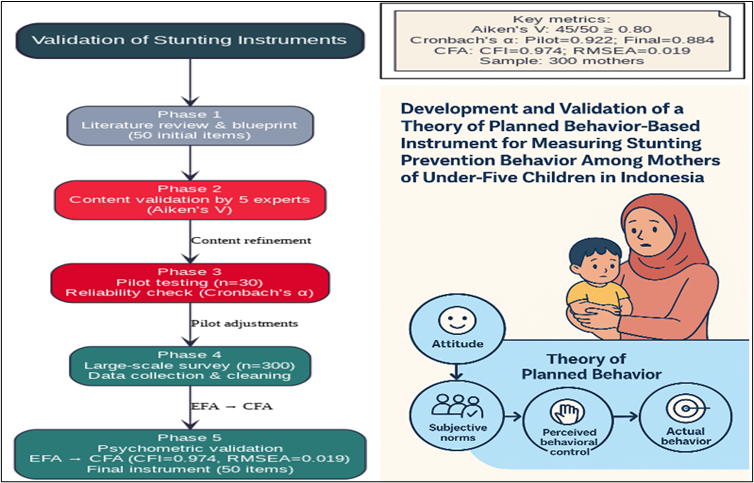
Stunting remains a critical public health issue in Indonesia, with a national prevalence of 19.8% in 2024 and 24.7% in urban areas, such as Palu City. Maternal behaviors play a pivotal role in prevention, yet no validated instrument has measured stunting prevention behaviors based on behavioral theory. To develop and validate a Theory of Planned Behavior (TPB) based instrument to assess stunting prevention behaviors among mothers of children under five in Indonesia. An instrument development and validation study was conducted in Palu City, Sulawesi Tengah, from May to December 2025. The study followed five phases: (1) literature review and blueprint construction (50 items), (2) content validation by five experts using Aiken’s V, (3) pilot testing with 30 mothers, (4) large-scale data collection from 300 purposively selected mothers, and (5) psychometric validation using Exploratory Factor Analysis (EFA) and Confirmatory Factor Analysis (CFA). Data analysis was performed with R software. Expert review confirmed 45 items (90%) valid (Aiken’s V ≥ 0.80). Pilot testing showed high reliability (Cronbach’s α = 0.922). EFA and CFA supported a five-factor structure consistent with TPB, with good model fit (CFI = 0.974, TLI = 0.973, RMSEA = 0.019, SRMR = 0.075). Internal consistency was strong (Cronbach’s α = 0.884). The TPB-Stunting Instrument is a reliable, valid, and culturally relevant tool for measuring maternal behaviors in stunting prevention programs.
Downloads
References
Kementerian Kesehatan RI, “Survei Status Gizi Indonesia SSGI 2024.” Kemenkes RI, 2025.
WHO, “Stunting in a Nutshell.” Geneva: World Health Organization, 2021.
E. Lestari, A. Siregar, A. K. Hidayat, and A. A. Yusuf, “Stunting and its association with education and cognitive outcomes in adulthood: A longitudinal study in Indonesia,” PLOS ONE, pp. 1–18, 2024.
Bapenas, “RPJMN 2025–2029: Strategi Nasional Penurunan Stunting.” 2025.
T. Taufiqurokhman, “Equality Strategy for Reducing Stunting Prevalence Rate: Case Study of DKI Jakarta Province,” J. Bina Praja, vol. 15, no. 3, pp. 495–506, Dec. 2023, doi: 10.21787/jbp.15.2023.495-506.
D. Setiawati and K. Virgian, “The influence of toddler mothers class application on maternal behavior in complementary breastfeeding,” Science Midwifery, vol. 12, no. 3, pp. 1073–1081, 2024.
W. Apriani, Irdayani, Hidayana, Nova Ratna Dewi, and Lisni, “Assistance in Strengthening MPASI Complementary Foods for Breast Milk Education for Optimizing Toddler Growth: Community Service in Lot Kala Village, Kebayakan District, Central Aceh Regency, Indonesia,” ICE Journal, vol. 4, no. 1, pp. 173–182, Jun. 2024, doi: 10.37275/icejournal.v4i1.58.
Y. Yusriadi et al., “Preventing stunting in rural Indonesia: A community-based perspective,” AJFAND, vol. 24, no. 9, pp. 24470–24491, Oct. 2024, doi: 10.18697/ajfand.134.24820.
Kementerian Kesehatan RI, “Survei Status Gizi Indonesia SSGI 2022.” Kemenkes RI, 2023.
I. Ajzen, “The theory of planned behavior: Frequently asked questions,” Human Behav and Emerg Tech, vol. 2, no. 4, pp. 314–324, Oct. 2020, doi: 10.1002/hbe2.195.
M. F. Ramadhan, R. A. Siroj, and M. W. Afgani, “Validitas and Reliabilitas,” joe, vol. 6, no. 2, pp. 10967–10975, Jan. 2024, doi: 10.31004/joe.v6i2.4885.
J. F. Hair, W. C. Black, B. J. Babin, and R. E. Anderson, Multivariate data analysis, 8th ed. Andover, Hampshire: Cengage, 2019.
B. M. Byrne, Structural Equation Modeling with AMOS: Basic Concepts, Applications, and Programming, 2nd ed. Routledge, 2022.
S. Azwar, Metode Penelitian Psikologi, Yogyakarta: Pustaka Pelajar, 2022.
H. Sujati, Sajidan, M. Akhyar, and Gunarhadi, “Testing the Construct Validity and Reliability of Curiosity Scale Using Confirmatory Factor Analysis,” JESR, vol. 10, no. 4, p. 229, Jul. 2020, doi: 10.36941/jesr-2020-0080.
A. Asmalinda and M. Rahayu, “Analysis of factors related to stunting prevention behavior in toddlers,” vol. 13, no. 2, pp. 273–281, Dec. 2024, doi: 10.35816/jiskh.v13i2.1215.
I. Ajzen, “Behavioral Interventions Based on the Theory of Planned Behavior,” 2019. Online. Available: https://people.umass.edu/aizen/pdf/tpb.intervention.pdf
Sudrajad A. Prediction of Healthy Feeding Behavior Among Caregivers of Stunted Toddlers Using TPB. Master Thesis, Universitas Airlangga; 2018.
Ferdianto R, Tiyas N, Amalia N. “Determinants of Parental Stunting Prevention Behavior Based on TPB.” Jurnal Ners. 2025.
Laksmi W, et al. Community Empowerment Training for Stunting Prevention Using Health Belief Model and TPB. Poltekkes Kemenkes Surabaya; 2023.
Sari DP, et al. “Application of TPB in Predicting Exclusive Breastfeeding Practices.” Jurnal Kesehatan YARSI. 2021.
S. Azwar, Reliabilitas dan Validitas, Yogyakarta: Pustaka Pelajar, 2022.
A. F. Nur and A. Arifuddin, “Scoring Predictor of Stunting Based on The Epidemiological Triad,” Healthy Tadulako Journal, vol. 9, no. 3, pp. 286–295, 2023.
A. Arifuddin et al., “Epidemiological Model of Stunting Determinants in Indonesia,” HTJ, vol. 9, no. 2, pp. 224–234, May 2023, doi: 10.22487/htj.v9i2.928.
A. F. Nur et al., “The village government’s communication model: A promotion strategy for stunting prevention in Indonesia,” Public Health of Indonesia, vol. 9, no. 4, pp. 186–196, Dec. 2023, doi: 10.36685/phi.v9i4.719.
M. Mutmaina et al., “Implementasi Program Health Education Class HEC Dalam Upaya Penanggulangan Masalah Stunting di Desa Maranatha,” JAI: Jurnal Abdimas Indonesia, vol. 5, no. 1, 2025.
J. W. Creswell and C. N. Poth, Qualitative Inquiry & Research Design Choosing Among Five Approaches, 4th ed. SAGE Publications, 2018.
I. Etikan, “Comparison of Convenience Sampling and Purposive Sampling,” AJTAS, vol. 5, no. 1, p. 1, 2016, doi: 10.11648/j.ajtas.20160501.11.
H. F. A. Subratha and K. T. S. Agustia, “Determinants Of Stunting Among Toddlers: A Systematic Literature Review,” vol. 9, 2024.
T. Beal, A. Tumilowicz, A. Sutrisna, D. Izwardy, and L. M. Neufeld, “A review of child stunting determinants in Indonesia,” Maternal & Child Nutrition, vol. 14, no. 4, p. e12617, Oct. 2018, doi: 10.1111/mcn.12617.
N. Kania, Y. S. Kusumah, J. A. Dahlan, E. Nurlaelah, F. Gürbüz, and E. Bonyah, “Constructing and providing content validity evidence through the Aiken’s V index based on the experts’ judgments of the instrument to measure mathematical problem-solving skills,” REiD, vol. 10, no. 1, pp. 64–79, Jun. 2024, doi: 10.21831/reid.v10i1.71032.
N. R. An Nabil, I. Wulandari, S. Yamtinah, S. R. D. Ariani, and M. Ulfa, “Analisis Indeks Aiken untuk Mengetahui Validitas Isi Instrumen Asesmen Kompetensi Minimum Berbasis Konteks Sains Kimia,” PAEDAGOGIA, Jurnal Penelitian Pendidikan, vol. 25, no. 2, p. 184, Sep. 2022, doi: 10.20961/paedagogia.v25i2.64566.
D. G. Bonett and T. A. Wright, “Cronbach’s alpha reliability: Interval estimation, hypothesis testing, and sample size planning,” J Organ Behavior, vol. 36, no. 1, pp. 3–15, Jan. 2015, doi: 10.1002/job.1960.
M. Tavakol and R. Dennick, “Making sense of Cronbach’s alpha,” Int. J. Medical Education, vol. 2, pp. 53–55, Jun. 2011, doi: 10.5116/ijme.4dfb.8dfd.
K. S. Taber, “The Use of Cronbach’s Alpha When Developing and Reporting Research Instruments in Science Education,” Res Sci Educ, vol. 48, no. 6, pp. 1273–1296, Dec. 2018, doi: 10.1007/s11165-016-9602-2.
Q. X. Ng et al., “A Systematic Review of the Reliability and Validity of the Patient Activation Measure Tool,” Healthcare, vol. 12, no. 11, p. 1079, May 2024, doi: 10.3390/healthcare12111079.
L. Badenes-Ribera, S. Georgieva, J. M. Tomás, and J. J. Navarro-Pérez, “Internal consistency and test-retest reliability: A reliability generalization meta-analysis of the Childhood Trauma Questionnaire – Short Form CTQ-SF,” Child Abuse & Neglect, vol. 154, p. 106941, Aug. 2024, doi: 10.1016/j.chiabu.2024.106941.
N. A. Ahmad Pouzi et al., “Validation and the associated factors of the Malay version of systemic lupus erythematosus-specific health-related quality of life questionnaires SLEQoL and LupusQoL,” PLoS ONE, vol. 18, no. 5, p. e0285461, May 2023, doi: 10.1371/journal.pone.0285461.
J. B. Hoelzle and G. J. Meyer, “Exploratory Factor Analysis: Basics and Beyond,” in Handbook of Psychology, 2nd ed., I. Weiner, Ed., Wiley, 2012, doi: 10.1002/9781118133880.hop202006.
S. S and T. Mohanasundaram, “Fit Indices in Structural Equation Modeling and Confirmatory Factor Analysis: Reporting Guidelines,” Asian J. Econ. Busin. Acc., vol. 24, no. 7, pp. 561–577, Jul. 2024, doi: 10.9734/ajeba/2024/v24i71430.
D. Goretzko, K. Siemund, and P. Sterner, “Evaluating Model Fit of Measurement Models in Confirmatory Factor Analysis,” Educ. Psychol. Meas., vol. 84, no. 1, pp. 123–144, Feb. 2024, doi: 10.1177/00131644231163813.
N. I. I. Tajuddin et al., “Content Validity Assessment Using Aiken’s V: Knowledge Integration Model for Blockchain in Higher Learning Institutions,” IJACSA, vol. 16, no. 6, 2025, doi: 10.14569/IJACSA.2025.0160659.
J. M. García-Ceberino, A. Antúnez, S. J. Ibáñez, and S. Feu, “Design and Validation of the Instrument for the Measurement of Learning and Performance in Football,” IJERPH, vol. 17, no. 13, p. 4629, Jun. 2020, doi: 10.3390/ijerph17134629.
M. A. Bujang, E. D. Omar, Clinical Research Centre, Serdang Hospital, Ministry of Health, Selangor, Malaysia, N. A. Baharum, and National Clinical Research Centre, Ministry of Health, Kuala Lumpur, Malaysia, “A Review on Sample Size Determination for Cronbach’s Alpha Test: A Simple Guide for Researchers,” MJMS, vol. 25, no. 6, pp. 85–99, 2018, doi: 10.21315/mjms2018.25.6.9.
B. Moeini, A. Erfani, M. Barati, A. Doosti-Irani, H. Hosseini, and M. Soheylizad, “Development and Psychometric Properties of an Extended Theory of Planned Behavior Questionnaire for Childbearing Intentions and Behaviors in Iran,” Korean J Fam Med, vol. 44, no. 2, pp. 109–116, Mar. 2023, doi: 10.4082/kjfm.22.0066.
N. Zarotti, K. H. O. Deane, C. E. L. Ford, and J. Simpson, “Perceived control as a predictor of medication adherence in people with Parkinson’s: a large-scale cross-sectional study,” Disability and Rehabilitation, vol. 46, no. 3, pp. 478–488, Jan. 2024, doi: 10.1080/09638288.2023.2181409.
Y. Lu, C. Liu, S. Fawkes, Z. Wang, and D. Yu, “Perceived extrinsic barriers hinder community detection and management of mild cognitive impairment: a cross-sectional study of general practitioners in Shanghai, China,” BMC Geriatr, vol. 22, no. 1, p. 497, Dec. 2022, doi: 10.1186/s12877-022-03175-4.
A. F. Nur and A. Arifuddin, “Development of TPB-based instrument for measuring stunting prevention behavior among mothers of toddlers in Indonesia,” HTJ, vol. 10, no. 1, pp. 45–57, 2025.
M. Rahayu and A. Asmalinda, “Psychometric Evaluation of a Maternal Behavior Questionnaire for Stunting Prevention,” JISKH, vol. 14, no. 1, pp. 65–78, 2025.
D. Setiawati, K. Virgian, and L. Apriani, “Community-Based Intervention for Stunting Prevention: Behavioral Outcomes among Mothers,” Science Midwifery, vol. 13, no. 2, pp. 101–112, 2025.
I. Ajzen, The Theory of Planned Behavior: Construct, Measurement, and Applications, 2nd ed., New York: Routledge, 2021.
Bapenas, “Strategi Nasional Penurunan Stunting: Evaluation Report,” Jakarta, 2025.
T. Taufiqurokhman, “Maternal Health Behavior Interventions in Indonesia: TPB Approach,” J. Bina Praja, vol. 16, no. 1, pp. 33–45, Mar. 2025, doi: 10.21787/jbp.16.2025.33-45.
W. Apriani et al., “Assessment of Complementary Feeding Education on Maternal Behavior in Indonesia: Multi-Site Study,” ICE Journal, vol. 5, no. 1, pp. 101–112, Jun. 2025, doi: 10.37275/icejournal.v5i1.72
Published
How to Cite
Issue
Section
Copyright (c) 2025 A Fahira Nur, Cicik Mujianti, Sherllia Sofyana, Adhar Arifuddin

This work is licensed under a Creative Commons Attribution-NonCommercial-ShareAlike 4.0 International License.
Most read articles by the same author(s)
- Fitrah Ivana Paisal, Hidayanti Arifuddin, Risa Arieska, Rasumawati Rasumawati, Wiwit Vitania, Adhar Arifuddin, Effectiveness of a Modified Pregnancy Support Belt in Reducing Back and Pelvic Pain in Pregnant Women: A Quasi-Experimental Study in South Jakarta , Journal of Health and Nutrition Research: Vol. 4 No. 3 (2025)
- Andi Saifah, Muh. Akbar Ardiputra, Miswan Miswan, Nur Annisa Safirah, Adhar Arifuddin, Musjaya Guli, Parmin Parmin, Ambient Air Pollution Exposure and Social Health Outcomes in Communities Near the Kawatuna Landfill, Palu, Indonesia , Journal of Health and Nutrition Research: Vol. 4 No. 2 (2025)
- I Gusti Agung Ayu Eka Mahastuti, Agus Fredy Maradona, Adhar Arifuddin, Hospital Tariff Setting, Patient Experience, and Patient Satisfaction under New Public Management Reforms: A Systematic Review , Journal of Health and Nutrition Research: Vol. 5 No. 2 (2026)