The Effect of Heel Raise and Sit-to-Stand (STS) Exercises on the Balance of Post-Stroke Patients: A Quasi-Experimental Study
Keywords:
Balance, Stroke, Heel Raise Exercise, Sit-to-stand (STS)Abstract
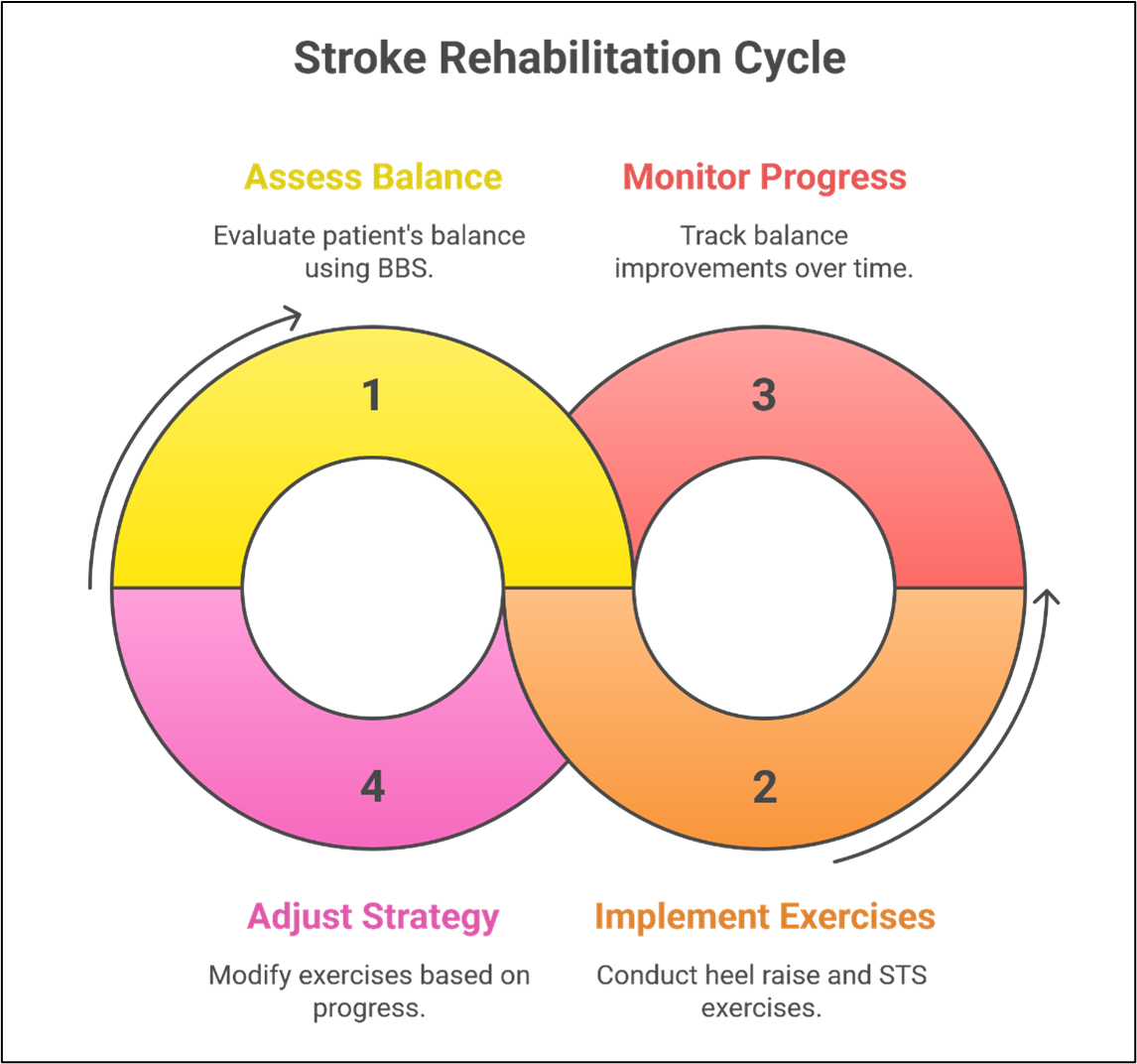
Brain blood vessels block or rupture in cerebrovascular disease (CVD), limiting oxygen and nutrient delivery to brain tissue. An untreated stroke can cause lasting brain damage, disability, or even death. Common complications include muscle weakness, coordination issues, difficulty swallowing, slurred speech, reduced sensitivity, facial or bodily paralysis, and balance problems. Stroke survivors are advised to engage in physical exercises such as heel raises and sit-to-stand (STS) movements to address balance impairments. This study aimed to evaluate the effect of heel raise and STS exercises on improving balance in post-stroke patients at the Sawah Lebar Public Health Center in Bengkulu Municipality. A quasi-experimental design was employed with 52 participants split evenly into intervention and control groups. Participants were selected using purposive sampling, and balance was measured using the Berg Balance Scale (BBS). The Mann-Whitney test revealed a significant difference in balance scores between groups (p-value = 0.000, p ≤ 0.05, indicating a positive effect of the intervention). Before intervention, both groups experienced balance impairments, with the intervention group scoring 33.04 (SD 6.095) and the control group 31.54 (SD 4.933). After the intervention, scores improved more notably in the intervention group (scored by 38.04, SD 5.744) compared to the control group (scored by 32.65, SD 5.012), p-value = 0.000 (Mann-Whitney). Intervention increased the average score by +5.00 and control by +1.12. Heel raise and sit-to-stand (STS) exercises significantly improved balance in post-stroke patients and may serve as effective rehabilitation strategies, although further larger randomized controlled trials are needed to confirm these findings.
Downloads
References
WHO. Noncommunicable diseases [Internet]. 2025 [cited 2025 Nov 23]. Available from: https://www.who.int/news-room/fact-sheets/detail/noncommunicable-diseases
Rusyda AL. Exploring the Non-Communicable Disease Burden in Indonesia – Findings from the 2023 Health Survey. Indonesian Journal of Public Health Nutrition (IJPHN). 2025 Apr 30;5(2):146–59.
Kuriakose D, Xiao Z. Pathophysiology and Treatment of Stroke: Present Status and Future Perspectives. Int J Mol Sci. 2020 Oct 15;21(20):7609.
Kemenkes. Survei Kesehatan Indonesia 2023 (SKI). Kemenkes. 2023;235.
Gobezie M, Kassa T, Suliman J, Eriku GA, Takele MD, Bitew DA, et al. Balance impairment and associated factors among stroke survivors in public hospitals of Amhara regional state: a multicenter cross-sectional study. BMC Neurol. 2024 Oct 14;24:387.
Moore SA, Boyne P, Fulk G, Verheyden G, Fini NA. Walk the Talk: Current Evidence for Walking Recovery After Stroke, Future Pathways and a Mission for Research and Clinical Practice. Stroke. 2022 Nov;53(11):3494–505.
Permadhi BA, Ludiana, Ayubbana S. Penerapan ROM pasif terhadap peningkatan kekuatan otot pasien dengan stroke non hemoragik. Jurnal Cendekia Muda. 2022;2(4):443–6.
Jung K sim, Jung J hwa, In T sung, Cho H young. Effectiveness of Heel-Raise-Lower Exercise after Transcutaneous Electrical Nerve Stimulation in Patients with Stroke: A Randomized Controlled Study. J Clin Med. 2020 Oct 31;9(11):3532.
Faizah I, Sari RY. Ergo care heel raise exercise berpengaruh terhadap keseimbangan lansia. Jurnal Ilmiah Permas: Jurnal Ilmiah STIKES Kendal. 2020;10(3):407–16.
Vive S, Zügner R, Tranberg R, Bunketorp-Käll L. Effects of enriched task-specific training on sit-to-stand tasks in individuals with chronic stroke. NeuroRehabilitation. 54(2):297–308.
Fujiwara K, Toyama H, Asai H, Yaguchi C, Irei M, Naka M, et al. Effects of regular heel-raise training aimed at the soleus muscle on dynamic balance associated with arm movement in elderly women. J Strength Cond Res. 2011 Sept;25(9):2605–15.
Versteeg CS, Ting LH, Allen JL. Hip and ankle responses for reactive balance emerge from varying priorities to reduce effort and kinematic excursion: a simulation study. J Biomech. 2016 Oct 3;49(14):3230–7.
Hyun SJ, Lee J, Lee BH. The Effects of Sit-to-Stand Training Combined with Real-Time Visual Feedback on Strength, Balance, Gait Ability, and Quality of Life in Patients with Stroke: A Randomized Controlled Trial. Int J Environ Res Public Health. 2021 Nov 21;18(22):12229.
Harrison LJ, Lepley LK, Stevens SL, Coons JM, Fuller DK, Caputo JL. The Relationship Between Functional Movement and Static and Dynamic Balance Ability. Athletic Training & Sports Health Care. 2021 Nov;13(6):e375–82.
Hyun SJ, Lee J, Lee BH. The effects of sit-to-stand training combined with real-time visual feedback on strength, balance, gait ability, and quality of life in patients with stroke: A randomized controlled trial. International Journal of Environmental Research and Public Health. 2021;18(22).
Putri wijaya eka. Effectiveness Heel-Raise-Lower Exercise and Dual Task Gait Training against a patient's Reversible Ischemic Neurologic Deficit Stroke (RIND) to improve: A Case Study. Academic Physiotherapy Conference Proceeding. 2021;957–66.
Published
How to Cite
Issue
Section
Copyright (c) 2025 Reza Adriyansar, Erni Buston, Pauzan Efendi, Husni Husni, Sahran Sahran

This work is licensed under a Creative Commons Attribution-NonCommercial-ShareAlike 4.0 International License.
Most read articles by the same author(s)
- Erni Buston, Pauzan Efendi, Sariman Pardosi, Yusniarita Yusniarita, Nurun Laasara, Effect of Peer Video Disaster Management on Knowledge, Attitude, and Skill Among Primary School Children in Bengkulu City , Journal of Health and Nutrition Research: Vol. 4 No. 1 (2025)