Interaction Model for Child to Cope Stress Using Virtual Reality and Watching Video during Venipuncture in the Emergency Department: A Literature Review
Keywords:
Children in the Emergency Department, Interaction Model, Stress Venipuncture, Virtual Reality, Watching VideosAbstract
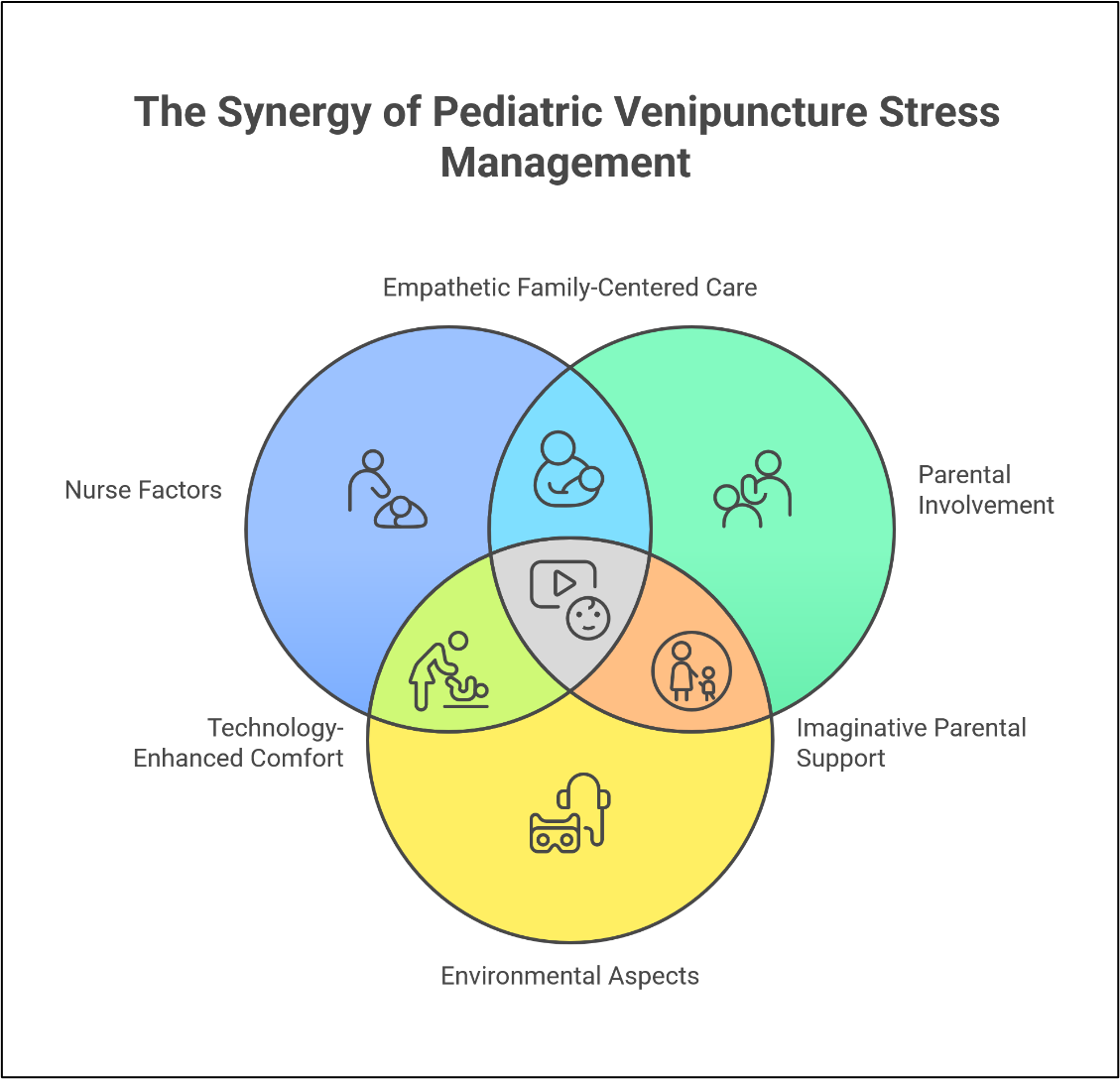
Venipuncture is the most painful and traumatic procedure often performed by nurses on pediatric patients. Innovation using technology-based interaction models is urgently needed in the emergency department. This study aims to determine the effectiveness of interaction models in reducing stress associated with venipuncture by utilizing virtual reality and video watching in the emergency department. This study employs a literature review, drawing on fourteen reputable articles from the ResearchGate, ScienceDirect, and SpringerLink databases. The results of the study based on the interaction model include (1) nurses must have a role in understanding children's stress, experience in managing children's stress, speed of completion of venipuncture procedures, and critical thinking in assessing the level of difficulty of venous access; (2) child attachment the with the importance of parental presence to suppress children's temperament; and (3) environmental aspects that support innovation in the use of virtual reality and watching videos as imaginative distraction techniques. The interaction model suggests that the roles of nurses, parental involvement, and environmental aspects can help manage the stress of children in pain in the emergency department.
Downloads
References
Friedrichsdorf SJ, Goubert L. Pediatric pain treatment and prevention for hospitalized children. Vol. 5, Pain Reports. Lippincott Williams and Wilkins; 2020. p. E804.
Sharma DK. Physiology of stress and its management. Journal of Medicine: Study & Research. 2018;1(1):1–5.
Thompson RA. Stress and child development. Future of Children. 2014;24(1):41–59.
Kuo HC, Pan HH, Creedy DK, Tsao Y. Distraction-based interventions for children undergoing venipuncture procedures: A randomized controlled study. Clin Nurs Res. 2018;27(4):467–82.
Trottier ED, Ali, Samina, Gravel J. Treating and reducing anxiety and pain in the paediatric emergency department: The TRAPPED survey. Pediatric Child Health. 2015;20(5):239–44.
Lunoe MM, Bolin AE, Drendel AL. An evaluation of high preprocedural anxiety and venipuncture pain experienced by young children. Pediatr Emerg Care. 2021;37(10). Available from: https://journals.lww.com/pec-online/Fulltext/2021/10000/An_Evaluation_of_High_Preprocedural_Anxiety_and.18.aspx
Orenius T, LicPsych, Säilä H, Mikola K, Ristolainen L. Fear of injections and needle phobia among children and adolescents: an overview of psychological, behavioral, and contextual factors. SAGE Open Nurs. 2018;4:1–8.
Cooke M, Ullman AJ, Ray-Barruel G, Wallis M, Corley A, Rickard CM. Not “just” an intravenous line: Consumer perspectives on peripheral intravenous cannulation (PIVC). An international cross-sectional survey of 25 countries. PLoS One. 2018 ;13(2).
Alligood. Nursing Theorists and Their Work [Internet]. Ninth Edition. United States of America: Elsevier; 2018. 618 p. Available from: https://www.academia.edu/57388621/Nursing_theorist_and_their_work
Dickson VV, Wright F. Nursing Theorists and Their Work (7th ed.) by M. R. Alligood and A. M. Tomey (Eds.) (Maryland Heights, MO: Mosby Elsevier, 2010). Nurs Sci Q. 2012;25(2):203–4.
Cunha ML da R, Brandi S, Bonfim GFT, Severino KG, Almeida GC de F, Campos PC, et al. Application program to prepare child/family for venipuncture: experience report. Rev Bras Enferm. 2018;71:1474–8.
Castaneda LM, Bindman SW, Cechony A, Sidhu M. The Disconnect between real and virtually real worlds: The challenges of using VR with adolescents. Presence: Teleoperators & Virtual Environments. 2016;25(2):81–107. Available from: http://www.mitpressjournals.org/doi/pdf/10.1162/PRES_a_00135
Snyder H. Literature review as a research methodology: An overview and guidelines. J Bus Res. 2019;104:333–9.
Page MJ, McKenzie JE, Bossuyt PM, Boutron I, Hoffmann TC, Mulrow CD, et al. The PRISMA 2020 statement: An updated guideline for reporting systematic reviews. International Journal of Surgery. 2021;88(1):1–9.
Hsu MF, Whu YW, Lin IC, Liu CY, Lai FC, Liu PC, et al. Effectiveness of virtual reality interactive play for children during intravenous placement: A randomized controlled trial. Asian Nurs Res (Korean Soc Nurs Sci). 2022;16(2):87–93.
Goldman RD, Behboudi A. Virtual reality for intravenous placement in the emergency department: A randomized controlled trial. European Journal. 2021;180:725–31. Available from: https://doi.org/10.1007/s00431-020-03771-9
Gerçeker GÖ, Bektaş M, Aydınok Y, Ören H, Ellidokuz H, Olgun N. The effect of virtual reality on pain, fear, and anxiety during access of a port with huber needle in pediatric hematology-oncology patients: Randomized controlled trial. European Journal of Oncology Nursing. 2021 ;50.
Gold JI, Soohoo M, Laikin AM, Lane AS, Klein MJ. Effect of an immersive virtual reality intervention on pain and anxiety associated with peripheral intravenous catheter placement in the pediatric setting a randomized clinical trial. JAMA Network. 2021;4(8):1–14.
Erdogan B, Ozdemir AA. The effect of three different methods on venipuncture pain and anxiety in children: distraction cards , virtual reality , and buzzy ® (randomized controlled trial). J Pediatr Nurs. 2021;58:54–62.
İnangil D, Şendir M, Büyükyılmaz F. Efficacy of cartoon viewing devices during phlebotomy in children: A randomized controlled trial. Journal of Perianesthesia Nursing. 2020 ;35(4):407–12.
Chan E, Hovenden M, Ramage E, Ling N, Pham JH, Rahim A, et al. Virtual reality for pediatric needle procedural pain: Two randomized clinical trials. J Pediatr. 2019;1–8. Available from: https://doi.org/10.1016/j.jpeds.2019.02.034
Chen Y ju, Cheng S fen, Lee P chang, Lai C hsiu, Hou I ching, Chen C wen, et al. Distraction using virtual reality for children during intravenous injections in an emergency department: A randomized trial. J Clin Nurs. 2019;(155).
Ugucu G, Akdeniz Uysal D, Guzel Polat O, Artuvan Z, Polat Kulcu D, Aksu D, et al. Effects of cartoon watching and bubble-blowing during venipuncture on pain, fear, and anxiety in children aged 6–8 years: A randomized experimental study. J Pediatr Nurs. 2022 ;65:e107–14.
Koc Ozkan T, Aslan S, Inci R. Effect of watching Cartoon during IV the treatment on Anxiety and Fear levels in Children: Randomized Controlled Trail. Clinical and Experimental Health Sciences. 2021;11(3):466-70.
Düzkaya DS, Bozkurt G, Ulupınar S, Uysal G, Uçar S, Uysalol M. The effect of a cartoon and an information video about intravenous insertion on pain and fear in children aged 6 to 12 years in the Pediatric Emergency Unit: A randomized controlled trial. J Emerg Nurs. 2021;47(1):76–87.
Inan G, Inal S. The impact of 3 different distraction techniques on the pain and anxiety levels of children during venipuncture: A clinical trial. Clinical Journal of Pain. 2019 ;35(2):140–7.
Bergomi P, Scudeller L, Pintaldi S, Dal Molin A. Efficacy of non-pharmacological methods of pain management in children undergoing venipuncture in a pediatric outpatient clinic: A randomized controlled trial of audiovisual distraction and external cold and vibration. J Pediatr Nurs. 2018;42:e66–72. Available from: https://doi.org/10.1016/j.pedn.2018.04.011
Hjelmgren H, Ygge BM, Nordlund B, Andersson N. Nurses’ experiences of blood sample collection from children: a qualitative study from Swedish paediatric hospital care. BMC Nurs. 2022;21(1).
Amri I, Rahma R, Hutasoit GA, Putri ASD, Harun H, Rasyid R. Comparison of neutrophile-to-lymphocyte ratio between dengue haemorrhagic fever and dengue shock syndrome in pediatric patients at Anutapura Hospital. Journal of Health and Nutrition Research. 2025;4(1):162–71.
Klok AM, Hoof R van, Dop MJCF. Preparing children for venepuncture. The effect of an integrated intervention on distress before and during venepuncture. BMC Res Notes. 2014;7(1).
Civetta G, Cortesi S, Mancardi M, de Pirro A, Vischio M, Mazzocchi M, et al. EA-DIVA score (enhanced adult DIVA score): a new scale to predict difficult preoperative venous cannulation in adult surgical patients. Journal of Vascular Access. 2019;20(3):281–9.
Wirakhmi IN, Purnawan I. Effectiveness of structured spiritual care models in improving psychological and physiological outcomes in Intensive Care Unit (ICU) Patients: a systematic review. Journal of Health and Nutrition Research. 2025;4(1):273–86.
Moline RL, McMurtry CM, Noel M, McGrath PJ, Chambers CT. Parent–child interactions during pediatric venipuncture: Investigating the role of parent traits, beliefs, and behaviors in relation to child outcomes. Canadian Journal of Pain. 2021;5(1):151–65.
Sulidah S, Damayanti A, Elmania E. Risk factors for stunting in children aged 6-36 months among seaweed farmers in coastal areas. Journal of Health and Nutrition Research. 2025;4(2):373–81.
Constantin KL, Moline RL, Riddell RP, Spence JR, McMurtry CM. Biopsychosocial contributors to parent behaviors during child venipuncture. Children. 2022 ;9(7).
Suleman SK, Atrushi A, Enskär K. Effectiveness of art-based distraction in reducing pain and anxiety of hospitalized children during cannulation procedure: A randomized controlled trial. Belitung Nurs J. 2022;8(3):213–21.
Lee HN, Bae W, Park JW, Jung JY, Hwang S, Kim DK, et al. Virtual reality environment using a dome screen for procedural pain in young children during intravenous placement : A pilot randomized controlled trial. PLoS One. 2021;16.
Published
How to Cite
Issue
Section
Copyright (c) 2025 Permaida Permaida, Jane Freyana Tedja

This work is licensed under a Creative Commons Attribution-NonCommercial-ShareAlike 4.0 International License.
Most read articles by the same author(s)
- Permaida Permaida, Uray Pardinan, Widia Sari, Titik Ambar Asmarini , Ina Yuhana, Juanda Mutifa, Nur Rahayu, Proactive Behavior in Basic Life Support Education for Adolescents in Densely Populated Areas , Journal of Health and Nutrition Research: Vol. 5 No. 1 (2026)