Activin A and Heart Function in Severe Preeclampsia: Insights From Global Longitudinal Strain
Keywords:
Preeclampsia, Severe Preeclampsia, Activin A, Angiogenic, Antiangiogenic, Cardiac GLSAbstract
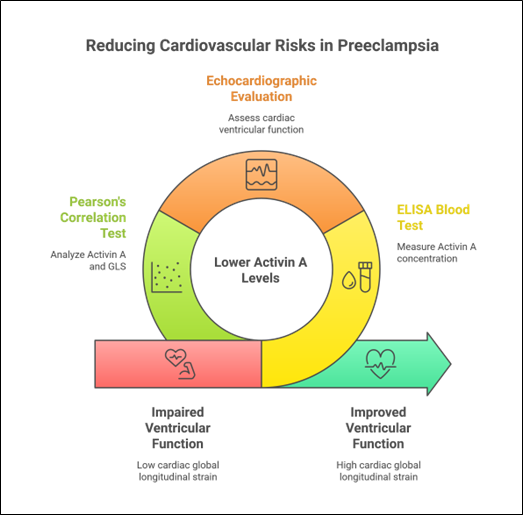
Preeclampsia, a serious pregnancy complication affecting 2–5% of women globally, is a leading cause of maternal and fetal mortality. Its prevalence in Indonesia ranges from 0.8–7% depending on parity. Associated with long-term cardiovascular risks, recent research suggests that elevated maternal activin A levels may play a causal role in linking severe preeclampsia to subsequent cardiovascular complications, particularly through mechanisms involving cellular damage, including to the heart. The aim of this study was to assess the correlation between Activin A circulating level and cardiac ventricular function as assessed by cardiac global longitudinal strain (GLS) in severe preeclampsia. A cross-sectional study was conducted at M. Djamil Hospital, Padang, West Sumatera, Indonesia with a total of 31 patients with severe preeclampsia. The Enzyme-Linked Immunosorbent Assay (ELISA) as used to determine the level of Activin A in the blood serum. Ventricular function was assessed from the global longitudinal strain using echocardiographic evaluation. The mean level of Activin A was 2.97 ± 1.91 ng/mL. From the echocardiographic evaluation, the mean cardiac GLS value was 18.01 ± 3.27%. The correlation between activin A levels and cardiac ventricular function was analyzed using Pearson's correlation test, which showed a strong negative correlation (r = -0.718, p < 0.001). This indicates that higher activin A levels are significantly associated with lower GLS values, demonstrating worse ventricular function.
Downloads
References
Mira Kusuma Wardhani. TNF-α, TNF-R1, TNF-R2 levels in women with normal pregnancy, preeclampsia, and preeclampsia with sepsis. World J Adv Res Rev. 2022 Sept 30;15(3):358–356.
Abou R, van der Bijl P, Bax JJ, Delgado V. Global longitudinal strain: clinical use and prognostic implications in contemporary practice. Heart. 2020 Sept;106(18):1438–44.
deMartelly VA, Dreixler J, Tung A, Mueller A, Heimberger S, Fazal AA, et al. Long‐Term Postpartum Cardiac Function and Its Association With Preeclampsia. Journal of the American Heart Association. 2021 Mar 2;10(5):e018526.
Fox R, Kitt J, Leeson P, Aye CYL, Lewandowski AJ. Preeclampsia: Risk Factors, Diagnosis, Management, and the Cardiovascular Impact on the Offspring. J Clin Med. 2019 Oct 4;8(10):1625.
Singh T, Khan H, Gamble DT, Scally C, Newby DE, Dawson D. Takotsubo Syndrome: Pathophysiology, Emerging Concepts, and Clinical Implications. Circulation. 2022 Mar 29;145(13):1002–19.
Gooding HC, Gidding SS, Moran AE, Redmond N, Allen NB, Bacha F, et al. Challenges and Opportunities for the Prevention and Treatment of Cardiovascular Disease Among Young Adults: Report From a National Heart, Lung, and Blood Institute Working Group. Journal of the American Heart Association. 2020 Oct 6;9(19):e016115.
Stepan H, Hund M, Andraczek T. Combining Biomarkers to Predict Pregnancy Complications and Redefine Preeclampsia: The Angiogenic-Placental Syndrome. Hypertension. 2020 Apr;75(4):918–26.
Ghossein-Doha C, Thilaganathan B, Vaught AJ, Briller JE, Roos-Hesselink JW. Hypertensive pregnancy disorder, an under-recognized women specific risk factor for heart failure? Eur J Heart Fail. 2025 Mar;27(3):459–72.
Severino P, Maestrini V, Mariani MV, Birtolo LI, Scarpati R, Mancone M, et al. Structural and myocardial dysfunction in heart failure beyond ejection fraction. Heart Fail Rev. 2020 Jan;25(1):9–17.
Gunderson EP, Greenberg M, Najem M, Sun B, Alexeeff SE, Alexander J, et al. Severe Maternal Morbidity Associated With Chronic Hypertension, Preeclampsia, and Gestational Hypertension. JAMA Netw Open. 2025 Jan 28;8(1):e2451406.
Biering-Sørensen T, Biering-Sørensen SR, Olsen FJ, Sengeløv M, Jørgensen PG, Mogelvang R, et al. Global Longitudinal Strain by Echocardiography Predicts Long-Term Risk of Cardiovascular Morbidity and Mortality in a Low-Risk General Population: The Copenhagen City Heart Study. Circ: Cardiovascular Imaging. 2017 Mar;10(3):e005521.
Barber C, Yap Y, Hannan NJ, Wallace EM, Marshall SA. Activin A causes endothelial dysfunction of mouse aorta and human aortic cells. Reproduction. 2022 Feb 14;163(3):145–55.
Bakrania BA, Spradley FT, Drummond HA, LaMarca B, Ryan MJ, Granger JP. Preeclampsia: Linking Placental Ischemia with Maternal Endothelial and Vascular Dysfunction. Compr Physiol. 2020 Dec 9;11(1):1315–49.
Li F, Long Y, Yu X, Tong Y, Gong L. Different Immunoregulation Roles of Activin A Compared With TGF-β. Front Immunol [Internet]. 2022 June 14 [cited 2025 Nov 29];13. Available from: https://www.frontiersin.org/journals/immunology/articles/10.3389/fimmu.2022.921366/full
Clemmensen TS, Christensen M, Kronborg CJS, Knudsen UB, Løgstrup BB. Long-term follow-up of women with early onset pre-eclampsia shows subclinical impairment of the left ventricular function by two-dimensional speckle tracking echocardiography. Pregnancy Hypertens. 2018 Oct;14:9–14.
Shahul S, Ramadan H, Nizamuddin J, Mueller A, Patel V, Dreixler J, et al. Activin A and Late Postpartum Cardiac Dysfunction Among Women With Hypertensive Disorders of Pregnancy. Hypertension. 2018 July;72(1):188–93.
Bakrania BA, Palei AC, Bhattarai U, Chen Y, Granger JP, Shahul S. Sustained Elevated Circulating Activin A Impairs Global Longitudinal Strain in Pregnant Rats: A Potential Mechanism for Preeclampsia-Related Cardiac Dysfunction. Cells. 2022 Feb 21;11(4):742.
Tsai YL, Chou RH, Kuo CS, Chang CC, Wu CH, Huang PH, et al. Circulating Activin A Is a Surrogate for the Incidence of Diastolic Dysfunction and Heart Failure in Patients With Preserved Ejection Fraction. Circ J. 2019 June 25;83(7):1514–9.
Roh JD, Hobson R, Chaudhari V, Quintero P, Yeri A, Benson M, et al. Activin type II receptor signaling in cardiac aging and heart failure. Sci Transl Med. 2019 Mar 6;11(482):eaau8680.
Published
How to Cite
Issue
Section
Copyright (c) 2025 Roza Sriyanti, Ressy Permatasari, Kino Kino

This work is licensed under a Creative Commons Attribution-NonCommercial-ShareAlike 4.0 International License.