Public Sentiment on Indonesia’s Free Nutritious Meal Program: A Mixed-Methods NLP Evaluation
Keywords:
Sentiment Analysis, Nutrition Intervention,, Public Policy, Free Nutritious Meal, Topic ModelingAbstract
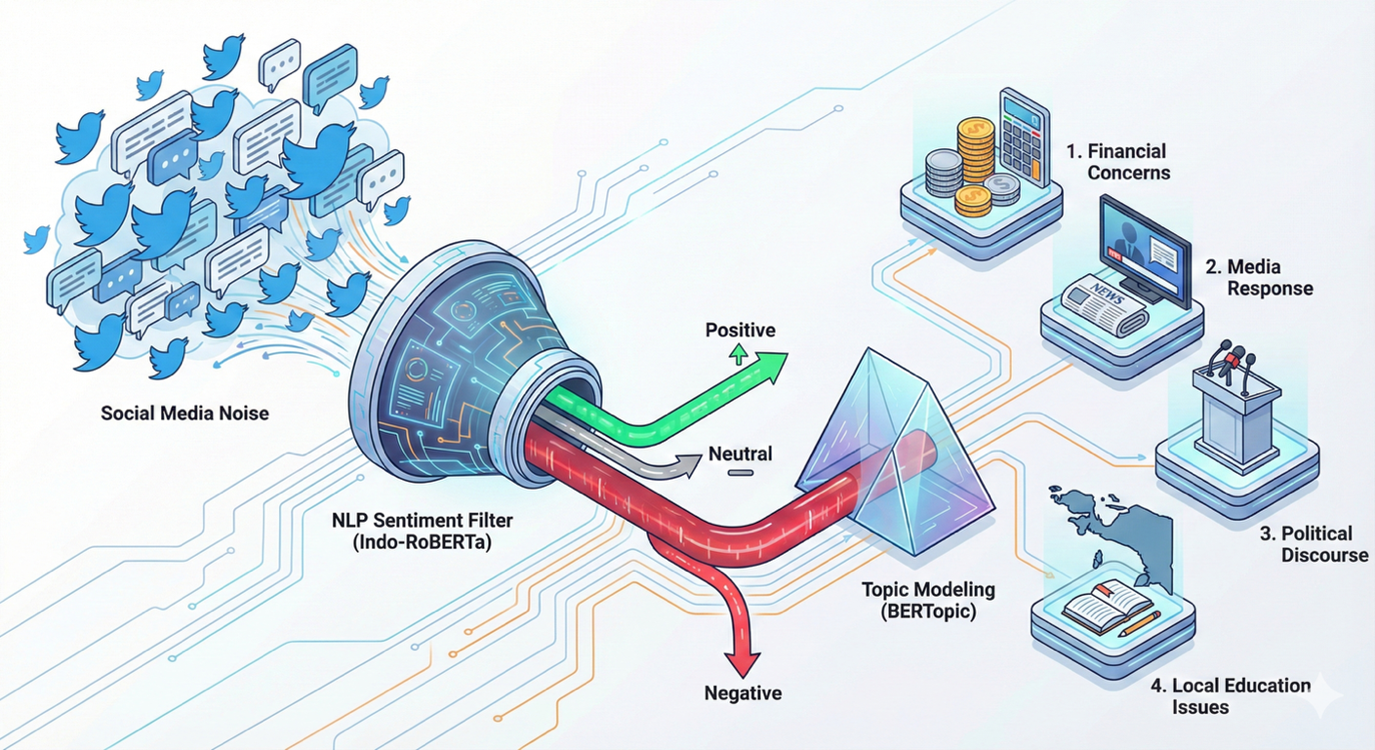
Large-scale nutrition intervention programs such as the Free Nutritious Meal Program (MBG) are likely to attract considerable attention on social media. While conventional evaluation techniques are often too slow to capture rapidly shifting sentiment, this study seeks to determine how sentiment can be evaluated. More specifically, we aimed to identify the key emerging issues. Methodology: In this study, one approach to examining emerging issues is to use a two-stage workflow in Natural Language Processing (NLP). The first step in sentiment analysis is using a transformer model (Indo-RoBERTa) to assign 'Positive', 'Negative', or 'Neutral' to 3,459 public texts from X (Twitter) social media. Secondly, we focused on 1,130 'Negative' texts. We used topic modeling (BERTopic) on this and identified the most critical clusters of issues to map and their relative importance. Results & Conclusions: Negative sentiment involves multiple factors, to which our model successfully highlighted four of the most impactful areas: (1) Financial concerns and budgetary priorities; (2) Responses to particular media coverage (e.g., Kompas); (3) Political general discourse; and (4) Expectations of particular local issues (education issues in Papua). Conclusion: Compared with the gaps in the program's nutrition components, the economic consequences, budget gaps, inequities, and regional policy deficiencies drew more public interest. Implications: The findings point to a clear need for a differentiated and open approach to communicating public policy. This approach should communicate the nutritional value and the need to align messaging with the public for the geographic and budgetary realities.
Downloads
References
Thawley C, Crystallin M, Verico K. Towards a Higher Growth Path for Indonesia. Bull Indones Econ Stud. 2024 Sept;60(3):247–82.
Sjarif DR, Yuliarti K, Gultom LC, Hafifah CN, Sidiartha IGL, Hanindita MH, et al. Effectiveness of a Tiered Referral System and Early Nutritional Intervention to Prevent and Recover Stunting in Under‐Five Indonesian Children. Food Sci Nutr. 2025 Oct;13(10):e70945.
Ridberg R, Sharib JR, Garfield K, Hanson E, Mozaffarian D. ‘Food Is Medicine’ In The US: A National Survey Of Public Perceptions Of Care, Practices, And Policies: Article examines the results of a national survey of US public awareness and perceptions of Food Is Medicine interventions. Health Aff (Millwood). 2025 Apr 1;44(4):398–405.
Sianturi HRP. Politics on a plate: equivocal communication in Indonesian presidential nutrition policy. Front Commun. 2025 Sept 30;10:1612652.
Soma RI, Azhar A, Uchiyama T. Food preferences in Indonesian schoolchildren and the parents’ perspectives on the upcoming nutritious free meal program. Azhar A, Wiraguna E, Sholeha NA, Siskandar R, Rahayu M, Fauzi AA, et al., editors. E3S Web Conf. 2024;577:02004.
Yeo G, Oh J. Perceptions Regarding Healthy Eating Based on Concept Mapping. Nutrients. 2025 Sept 12;17(18):2941.
Andreas M, Kaiser AK, Dhami R, Brugger V, Sniehotta FF. How beliefs and policy characteristics shape the public acceptability of nutritional policies—A survey study in Germany. Health Policy. 2025 Feb;152:105221.
Gomez-Donoso C, Kelly B, Martino F, Cameron AJ, Richter APC, Sacks G, et al. Public support for unhealthy food marketing policies in Australia: A cross-sectional analysis of the International Food Policy Study 2022. Aust N Z J Public Health. 2025 Apr;49(2):100231.
Li J, Zhang J, Hu X, Sun Y, Yu J, Wang P, et al. Factors influencing awareness of beverage grading policies and their association with beverage consumption patterns. J Health Popul Nutr. 2025 Aug 13;44(1):290.
Russell C, Herron L, Ferguson M, Deen C, Stubbs E, Fredericks B, et al. Public Narratives About Food Security Policies for Remote Aboriginal and Torres Strait Islander Communities. Health Promot J Austr. 2025 Oct;36(4):e70102.
Kröner S, Schreiweis B, Strotbaum V, Brandl LC, Pobiruchin M, Wiesner M. Consumer perspectives on the national electronic health record and barriers to its adoption in Germany: does health policy require a change in communication? BMC Health Serv Res. 2025 Jan 7;25(1):33.
Chepo M, Martin S, Déom N, Khalid AF, Vindrola-Padros C. Mind the gap: examining policy and social media discourse on Long COVID in children and young people in the UK. BMC Public Health. 2025 Apr 12;25(1):1373.
Agwu P, Mbachu C, Onwujekwe O. Enhancing the role of mass media in the translation of evidence from health policy and systems research in Nigeria. Health Res Policy Syst. 2025 Jan 30;23(1):16.
Li L, Yang X, Liu S, Deng F. AI big model and text mining-driven framework for urban greening policy analysis. Sci Rep. 2025 Aug 12;15(1):29587.
Chapagain S, Cascalheira CJ, Hamdi SM, Boubrahimi SF, Scheer JR. Advancing minority stress detection with transformers: insights from the social media datasets. Soc Netw Anal Min. 2025 Sept 3;15(1):95.
Ares G, Gómez Corona C, Antúnez L, Thow AM. Public perceptions of front-of-package warning label during policy design and implementation in Uruguay: A content analysis of social media narratives. Health Policy. 2025 Nov;161:105435.
Zharif Mustaqim I, Melani Puspasari H, Tri Utami A, Syalevi R, Ruldeviyani Y. Assessing public satisfaction of public service application using supervised machine learning. IAES Int J Artif Intell IJ-AI. 2024 June 1;13(2):1608.
Bell J, Westoby C. Public and mental health professionals’ perspectives on social media and suicide exposure. BMC Public Health. 2025 Apr 12;25(1):1380.
Caraka RE, Supardi K, Gio PU, Isnaniawardhani V, Djatmiko B, Putri RL, et al. Using Kolmogorov–Arnold network and ResNet for marine protein mapping in support of the Prabowo–Gibran MBG program. Discov Sustain. 2025 Oct 22;6(1):1131.
Nugraheni SA, Yuniastuti A, As’ad S, Fristiwi P, Aulia FAF, Kamila SA. Adaptation of Moringa Leaf Extract on Hemoglobin and Arm Circumference in Adolescent Girls Semarang. Media Kesehat Masy Indones. 2025 Sept 30;21(3):192–9.
Published
How to Cite
Issue
Section
Copyright (c) 2026 Firmansyah Ibrahim, Didik Dwi Prasetya, Andi Baso Kaswar, Hardyanti Pratiwi

This work is licensed under a Creative Commons Attribution-NonCommercial-ShareAlike 4.0 International License.