The Effect of External Weight Training on Body Fat and Muscle
Abstract
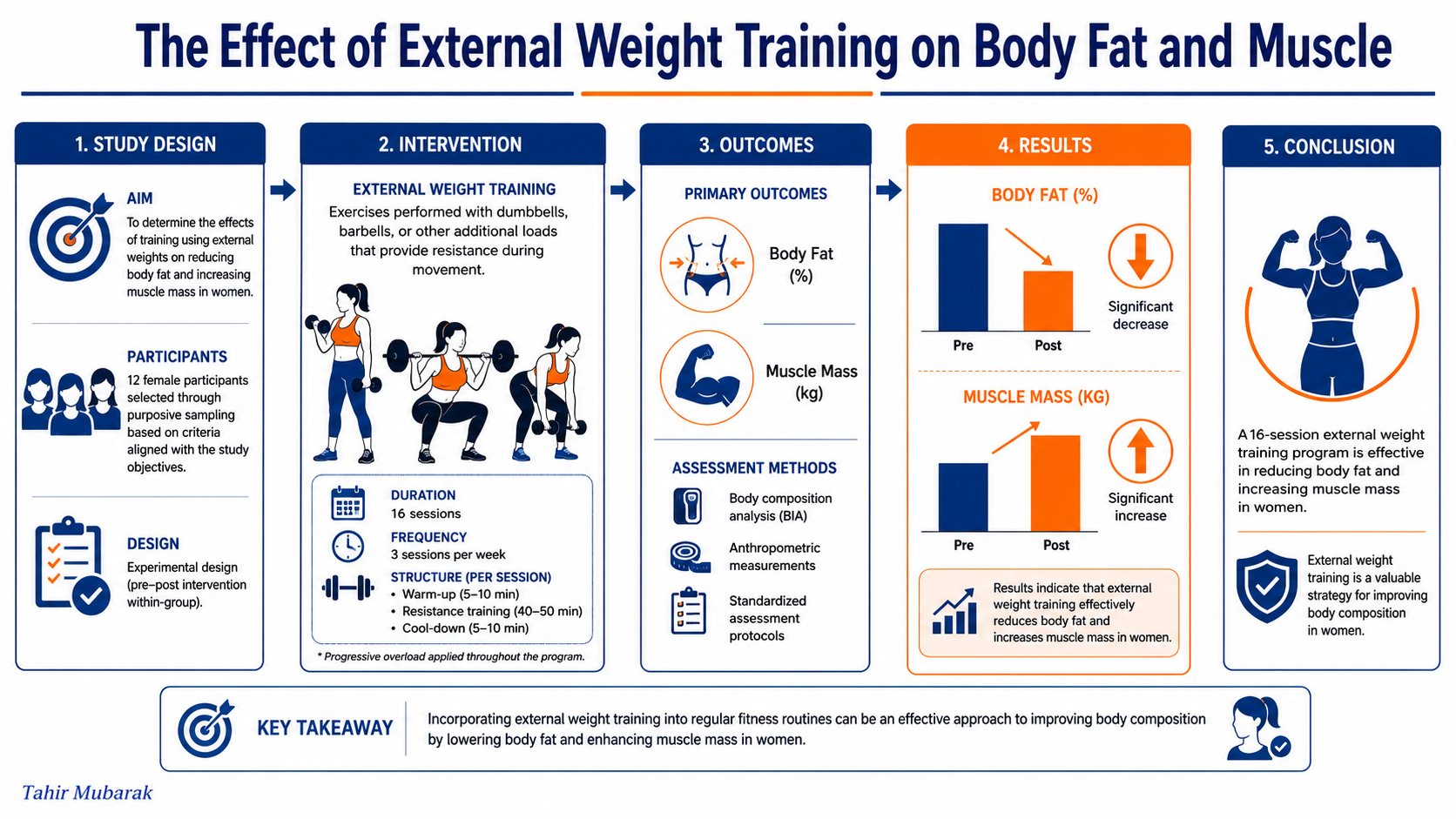
This study aims to determine the effects of training using external weights on reducing body fat and increasing muscle mass in women. The term external weight refers to exercises performed with dumbbells, barbells, or other additional loads that provide resistance during movement. The research employed an experimental design with 12 female participants selected through purposive sampling based on criteria aligned with the study objectives. The training program was conducted over 16 sessions with a frequency of three workouts per week to ensure consistency and the effectiveness of the intervention. Body composition measurements were taken before and after the treatment using a body composition analyzer, which provided accurate data on body fat percentage and muscle mass. The results showed a significant reduction in body fat after the training program, with an average change of 5.1583%, t-value = 10.127, and p < 0.001. The 95% confidence interval ranged from 4.0372 to 6.2795, indicating that the program was effective in reducing body fat. Regarding muscle mass, there was a significant increase of 2.79%, as indicated by the mean difference of –2.7917 (due to the Before – After calculation), t-value = –9.512, and p < 0.001, with a 95% confidence interval from –3.4376 to –2.1457. Overall, this training program proved to provide substantial benefits for women in improving body composition and may serve as motivation to engage in regular exercise for better health and a more ideal physical appearance.
Downloads
References
Afgenesya Novenda Denata, Hariadi Imam, & Fadhli Nurrul Riyad. (2024). Pengaruh Latihan Beban Terhadap Penurunan Berat Badan Dan Persentase Lemak. Jurnal Master Penjas & Olahraga, V, 386–393. https://www.jmpo.stkippasundan.ac.id/index.php/jmpo/article/view/100/61
Andini Azmy, & Indra Eka Novita. (2016). Perbedaan Pengaruh Frekuensi Latihan Senam Aerobik Terhadap Penurunan Persentase Lemak Tubuh Dan Berat Badan Pada Member Wanita. Medikora, Jurnal Ilmiah Kesehatan Olahraga, VX, 41–42. https://journal.uny.ac.id/index.php/medikora/article/view/10071/8654
Carneiro, M. A. S., Nunes, P. R. P., Souza, M. V. C., Assumpção, C. O., & Orsatti, F. L. (2024). Full-body resistance training promotes greater fat mass loss than a split-body routine in well-trained males: A randomized trial. European Journal of Sport Science, 24(6), 846–854. https://doi.org/10.1002/ejsc.12104
Hafni Sahir, S. (2021). Metodologi Penelitian (Koryati try, Ed.; 1st ed.). Penerbit KBM Indonesia. www.penerbitbukumurah.com
Lestari, A., & Nasrulloh, A. (2019). Efektivitas Latihan Body Weight Training Dengan Dan Tanpa Menggunakan Resistance Band Terhadap Penurunan Berat Badan Dan Persentase Lemak. MEDIKORA, 17(2), 91–101. https://doi.org/10.21831/medikora.v17i2.29180
Made, P., Rawita Atmaja, Y., Ketut, I., Astra, B., & Suwiwa, I. G. (2021). Aktivitas Fisik Serta Pola Hidup Sehat Masyarakat Sebagai Upaya Menjaga Kesehatan pada Masa Pandemi Covid-19. Jurnal Ilmu Keolahragaan Undiksha, 9(2), 129–130. https://ejournal.undiksha.ac.id/index.php/JJIK
Nasrulloh, A., & Wicaksono, I. S. (2020). Latihan bodyweight dengan total-body resistance exercise (TRX) dapat meningkatkan kekuatan otot. Jurnal Keolahragaan, 8(1), 52–62. https://doi.org/10.21831/jk.v8i1.31208
Purwanto Prabowo. (2016). Efektifitas Latihan Beban Dengan Metode Circuit Weight Training Dengan Superset Terhadap Penurunan Berat Badan Dan Prosentase Lemak pada Member Cakra Sport Club.
Romadhoni, W. N., Nasuka, N., Candra, A. R. D., & Priambodo, E. N. (2022). Aktivitas Fisik Mahasiswa Pendidikan Kepelatihan Olahraga selama Pandemi COVID-19. Gelanggang Olahraga: Jurnal Pendidikan Jasmani Dan Olahraga (JPJO), 5(2), 202–202. https://doi.org/10.31539/jpjo.v5i2.3470
Sidik Didik Zafar. (2022). Prinsip-Prinsip Latihan Atlet Pada Berbagai Periodisasi. Temu Ilmiah Nasional Persatuan Ahli Gizi Indonesia, 60–64.
Sri Mulyani, N., Hayatul Fitri, S., Gizi Politeknik Kesehatan Kemenkes Aceh, J., & dr Zainoel Abidin Banda Aceh, R. (2020). Faktor Penyebab Obesitas pada Remaja Putri di Aceh Besar Factors Causing Obesity in Adolescent Girl in Aceh. In Jurnal Riset Gizi (Vol. 8, Issue 1).
Sucipto, E., & Widiyanto, W. (2016). Pengaruh latihan beban dan kekuatan otot terhadap hypertrophy otot dan ketebalan lemak. Jurnal Keolahragaan, 4(1), 111. https://doi.org/10.21831/jk.v4i1.8131
Sugiyono. (2013). Metode Penelitian Kuantitatif, Kualitatif, dan R&D. https://digilib.stekom.ac.id/assets/dokumen/ebook/feb_35efe6a47227d6031a75569c2f3f39d44fe2db43_1652079047.pdf
Wilhelmina, M., Afriani, Y., Yuliati, E., Gizi, P., Ilmu Kesehatan, F., & Respati Yogyakarta, U. (2023). Hubungan Konsumsi Suplemen Protein Dengan Massa Otot Pada Anggota Lembah Fitness Centre Tajem, Yogyakarta. 12, 254–259. http://ejournal3.undip.ac.id/index.php/jnc/
Published
How to Cite
Issue
Section
Copyright (c) 2026 Rian Triprayogo, Tahir Mubarak, Ida Zubaida

This work is licensed under a Creative Commons Attribution-NonCommercial-ShareAlike 4.0 International License.
Most read articles by the same author(s)
- Fedayen Najma Haqq Winny, Danang Prama Dhani, Ida Zubaida, Comparative Analysis Of Resistance Band And Swim Parachute Belt Training On The Enhancement Of 50m Butterfly Stroke Swimming Speed , SPIN: Journal of Sport Performance Indonesia: Vol. 1 No. 1 (2026)
- Istiqomah isti, Rian Triprayogo, Dikdik Najmu Ramadan, Sendy Mohamad Anugrah, Analysis of Ball Possession and Shooting Frequency in the Men's Indoor Hockey Matches at the 2023 SEA Games , SPIN: Journal of Sport Performance Indonesia: Vol. 1 No. 1 (2026)