Comparative Analysis Of Resistance Band And Swim Parachute Belt Training On The Enhancement Of 50m Butterfly Stroke Swimming Speed
Keywords:
Resistance Band, Swim Parachute Belt, Butterfly Stroke, Swimming Speed, Power Training, Hydrodynamic DragAbstract
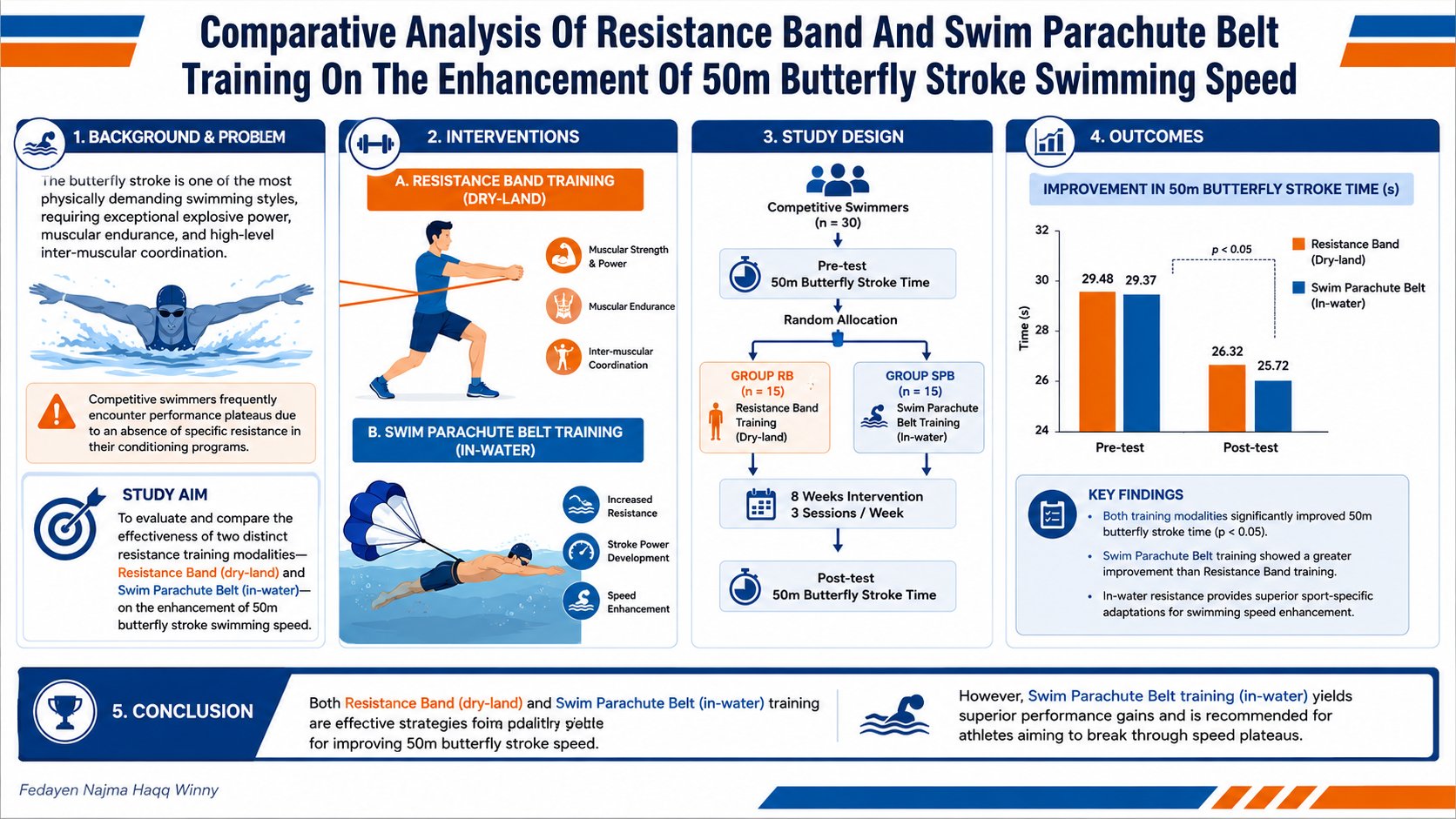
The butterfly stroke is widely recognized as one of the most physically demanding swimming styles, requiring exceptional explosive power, muscular endurance, and high-level inter-muscular coordination. Competitive swimmers frequently encounter performance plateaus due to an absence of specific resistance in their conditioning programs. This study aims to evaluate and compare the effectiveness of two distinct resistance training modalities—Resistance Band (dry-land) and Swim Parachute Belt (in-water)—on enhancing the 50-meter butterfly stroke speed. Utilizing a quantitative experimental method with an "Ordinal Pairing" pre-test and post-test design, twenty competitive swimmers from the Krakatau Atlantik Cilegon Club were purposively sampled. Participants were divided into two equal groups of ten, undergoing a specialized 16-session training program over a four-week period. Data were obtained through rigorous pre-test and post-test measurements of 50M butterfly swimming times using standardized chronometers. Statistical analysis involved prerequisite tests (Shapiro-Wilk for normality, Levene for homogeneity), followed by hypothesis testing utilizing Paired Sample and Independent T-Tests. Results indicated that Resistance Band training significantly improved speed (mean improvement = 3.086 seconds, p = 0.001), as did Swim Parachute Belt training (mean improvement = 2.167 seconds, p = 0.001). However, the Independent T-Test revealed no statistically significant difference in performance gains between the two modalities (p = 0.791). These findings robustly suggest both tools are equally effective in enhancing the power and propulsive force necessary for elite butterfly stroke performance. Coaches are advised to integrate both methods to prevent physiological adaptation and maximize power output.
Downloads
References
Ali, M., et al. (2024). Effectiveness of resistance band swimming training on muscle strength in swimmers. PJK, 5(2).
Al-Zoubi, M., et al. (2024). Exploring the Correlation between Physical Fitness and Kinematic Parameters in Butterfly Stroke. HRPUB, 12(4).
Bompa, T. O., & Buzzichelli, C. (2019). Periodization: Theory and Methodology of Training (6th ed.). Human Kinetics.
Chortane, O. G., et al. (2022). Effect of Concurrent Resistance Training on Lower Body Strength, Leg Kick Swimming, and Sport-Specific Performance in Competitive Swimmers. Journal of Functional Morphology and Kinesiology, 7(1).
Clark, M. A., Lucett, S. C., & Sutton, B. G. (2019). NASM Essentials of Personal Fitness Training (6th ed.). Jones & Bartlett Learning.
Kaya, Y. (2018). The effect of 8-week thera-band exercises on male swimmers' freestyle swimming performance. Journal of Human Sciences, 15(4).
Kocyigit, Z., et al. (2020). The effect of dry-land training on functional strength and swimming performance. Progress in Nutrition, 22(2).
Nilhakim, M. (2022). Strength and Conditioning Protocols for Aquatic Sports. Sports Science Review, 14(3).
Ratno, P., & Simanjuntak, V. G. (2022). Analisis Teknik Renang. Penerbit Olahraga Nusantara.
Strzala, M., et al. (2017). Butterfly Sprint Swimming Technique, Analysis of Somatic and Spatial-Temporal Coordination Variables. Journal of Human Kinetics, 60(1).
Tufano, J. J., et al. (2023). Acute Effect of Dryland Maximum Strength Training Session on Sport-Specific Performance Tests. MDPI Sports, 11(3).
Published
How to Cite
Issue
Section
Copyright (c) 2026 Fedayen Najma Haqq Winny, Danang Prama Dhani, Ida Zubaida

This work is licensed under a Creative Commons Attribution-NonCommercial-ShareAlike 4.0 International License.
Most read articles by the same author(s)
- Tahir Mubarak, Rian Triprayogo, Ida Zubaida, The Effect of External Weight Training on Body Fat and Muscle , SPIN: Journal of Sport Performance Indonesia: Vol. 1 No. 1 (2026)