Community Preparedness for Addressing Health Issues Following Tidal Floods: A Case Study of Sirenja Village, Donggala Regency
Keywords:
Tidal Floods, Community Preparedness, Post-Disaster HealthAbstract
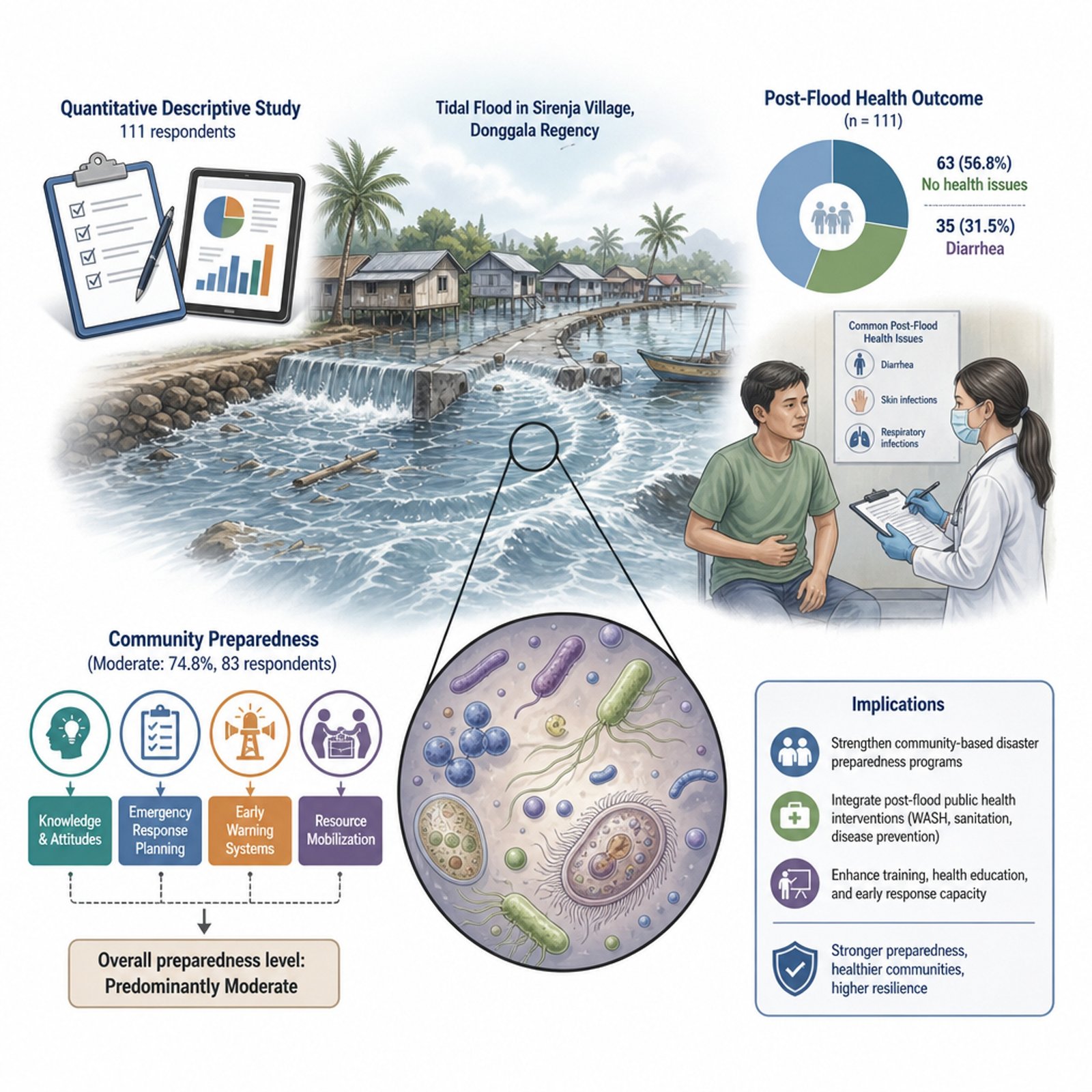
Indonesia is among the countries most affected by disaster-related mortality. Disasters in Indonesia are caused not only by its geographical characteristics but also by climate change. Tidal floods represent one of the climate-related hazards resulting from sea-level rise and land subsidence. In Central Sulawesi, particularly Donggala Regency, tidal flooding frequently affects coastal communities and may lead to various health problems. This study aims to describe the level of community preparedness and health problems experienced following tidal floods in Sirenja Village, Donggala Regency. A quantitative descriptive approach was applied using questionnaire-based data collection involving 111 respondents. Community preparedness was assessed through four parameters: knowledge and attitudes, emergency response planning, early warning systems, and resource mobilization. The findings indicate that community preparedness was predominantly classified as moderate, accounting for 83 respondents (74.8%). Regarding post-flood health outcomes, 63 respondents (56.8%) reported no health issues, while 35 respondents (31.5%) experienced diarrhea following tidal flood events. These findings suggest that although most communities demonstrate a moderate level of preparedness, gaps remain in preventing post-disaster health risks, particularly diarrhea. This study highlights the importance of strengthening community-based disaster preparedness programs and integrating post-flood public health interventions, including emergency response training, health education, and sanitation promotion. Such strategies may enhance community resilience and reduce disease vulnerability in coastal regions exposed to recurrent tidal flooding
Downloads
References
Badan Nasional Penanggulangan Bencana. Data dan informasi bencana Indonesia (DIBI) [Internet]. Jakarta: BNPB; 2024 [cited 2026 Jun 26]. Available from: https://dibi.bnpb.go.id/
Findayani A. Community preparedness in managing floods in Semarang City. J Geogr Media Inf Geogr Dev Prof. 2015;12(1):102–114.
Guha-Sapir P. 2018 review of disaster events (CRED) [Internet]. 2019 [cited 2026 Jun 28]. Available from: https://www.cred.be/publications
Intergovernmental Panel on Climate Change. Overarching frequently asked questions and answers. In: Sixth Assessment Report: Impacts, adaptation and vulnerability. 2022.
US Global Change Research Program. Sea level rise. In: Climate Science Special Report. 2017:333–363. doi:10.7930/J0VM49F2.12.1
U.S. Environmental Protection Agency. Climate change indicators: coastal flooding [Internet]. 2021 [cited 2026 Jun 28]. Available from: https://www.epa.gov/climate-indicators/climate-change-indicators-coastal-flooding
Noson L. Hazard mapping and risk assessment. In: Regional workshop on best in disaster mitigation. 2000:74.
Syafitri AW, Rochani A. Analysis of the causes of rob floods in coastal areas: case study North Jakarta, East Semarang, Brebes Regency, Pekalongan. J Assess Space. 2022;1(1):16. doi:10.30659/jkr.v1i1.19975
Martini. Identification of natural disaster sources and their solutions in Central Sulawesi. Infrastructure. 2011;1:96–102.
Jaya A, Nishikawa O, Jumadil S. Distribution and morphology of the surface ruptures of the 2018 Donggala–Palu earthquake, Central Sulawesi, Indonesia. Earth Planets Space. 2019;71:144. doi:10.1186/s40623-019-1126-3
Badan Nasional Penanggulangan Bencana. Infographic: rob flood in Kab. Donggala, Prov. Central Sulawesi [Internet]. 2022. Available from: https://pusdalops.bnpb.go.id/2022/12/26/infografis-banjir-rob-di-kab-donggala-prov-sulawesi-tengah/
Ministry of Health Indonesia. Beware of post-flood diseases [Internet]. 2022 [cited 2026 Jun 28]. Available from: https://pusatkrisis.kemkes.go.id/waspadai-penyakit-pasca-banjir
Yatnikasari Y, Maulana A. Natural disaster mitigation and preparedness. 2020.
Badan Nasional Penanggulangan Bencana. National disaster preparedness training manual. 2017. Available from: https://perpustakaan.bnpb.go.id/bulian/index.php?p=show_detail&id=845
Christian KR, Hendrasarie N, Ali M. Evaluation of the impact of floods on public health in Krapyak Village, Pekalongan City. 2023;4:1923–1932.
Huriani E, Sari YP, Harningsih NR. The relationship between knowledge, attitudes, and preparedness for facing earthquake and tsunami risks in high school students. World of Nursing J Nurs Health. 2021;9(3):334. doi:10.20527/dk.v9i3.8360
Suryadi T, Zulfitri Z, Harmas MI. Comparison of knowledge and preparedness attitudes in communities affected by direct and indirect impacts of the tsunami disaster in Banda Aceh City. J Kedokt Syiah Kuala. 2018;18(2):121–127. doi:10.24815/jks.v18i2.18006
Alfaruqi MF. Four stages of disaster management. ITS News [Internet]. 2022. Available from: https://www.its.ac.id/news/2022/12/01/empat-phase-penanggulangan-bencana/
Ministry of Public Works. Flood disaster management guidelines. 2014. Available from: https://simantu.pu.go.id/personal/img-post/superman/post/20181128104359__F__KMS_BOOK_20180724121506.pdf
Fadilah V. Disaster communication in handling Mount Agung eruption events. Surabaya: UIN Sunan Ampel Surabaya; 2019.
Bireuen K, Husna C, Azhari AP. Analysis of disaster response competency in nurses at Bireuen District Health Center, Aceh. J Nurs Med Surg. 2021;4(1):69–83. doi:10.32584/jikmb.v4i1.893
Sari GM, Sutrisna M, Fikhri D. Health education about diarrhea prevention in flood-prone areas, Bengkulu City. Siwalima Health Work. 2022;1(2):74–78. doi:10.54639/kks.v1i2.825
Published
How to Cite
Issue
Section
Copyright (c) 2026 Jusman Rau, Muhammad Sabri Syahrir, Stefiani Bengan Laba

This work is licensed under a Creative Commons Attribution-NonCommercial-ShareAlike 4.0 International License.
All published articles are licensed under the Creative Commons Attribution-NonCommercial-ShareAlike 4.0 International License.

You are free to:
- Share — copy and redistribute the material in any medium or format
- Adapt — remix, transform, and build upon the material
- The licensor cannot revoke these freedoms as long as you follow the license terms.
Under the following terms:
- Attribution — You must give appropriate credit, provide a link to the license, and indicate if changes were made. You may do so in any reasonable manner, but not in any way that suggests the licensor endorses you or your use.
- NonCommercial — You may not use the material for commercial purposes.
- ShareAlike — If you remix, transform, or build upon the material, you must distribute your contributions under the same license as the original.
- No additional restrictions — You may not apply legal terms or technological measures that legally restrict others from doing anything the license permits.