PowerPoint versus Leaflet Delivery of "CEMAS" Nutrition Education for Mothers of Stunted Children: A Quasi-Experimental Study in Balikpapan, Indonesia
Keywords:
Health Education Media, Maternal Knowledge, Nutrition Education, Parenting Practices, StuntingAbstract
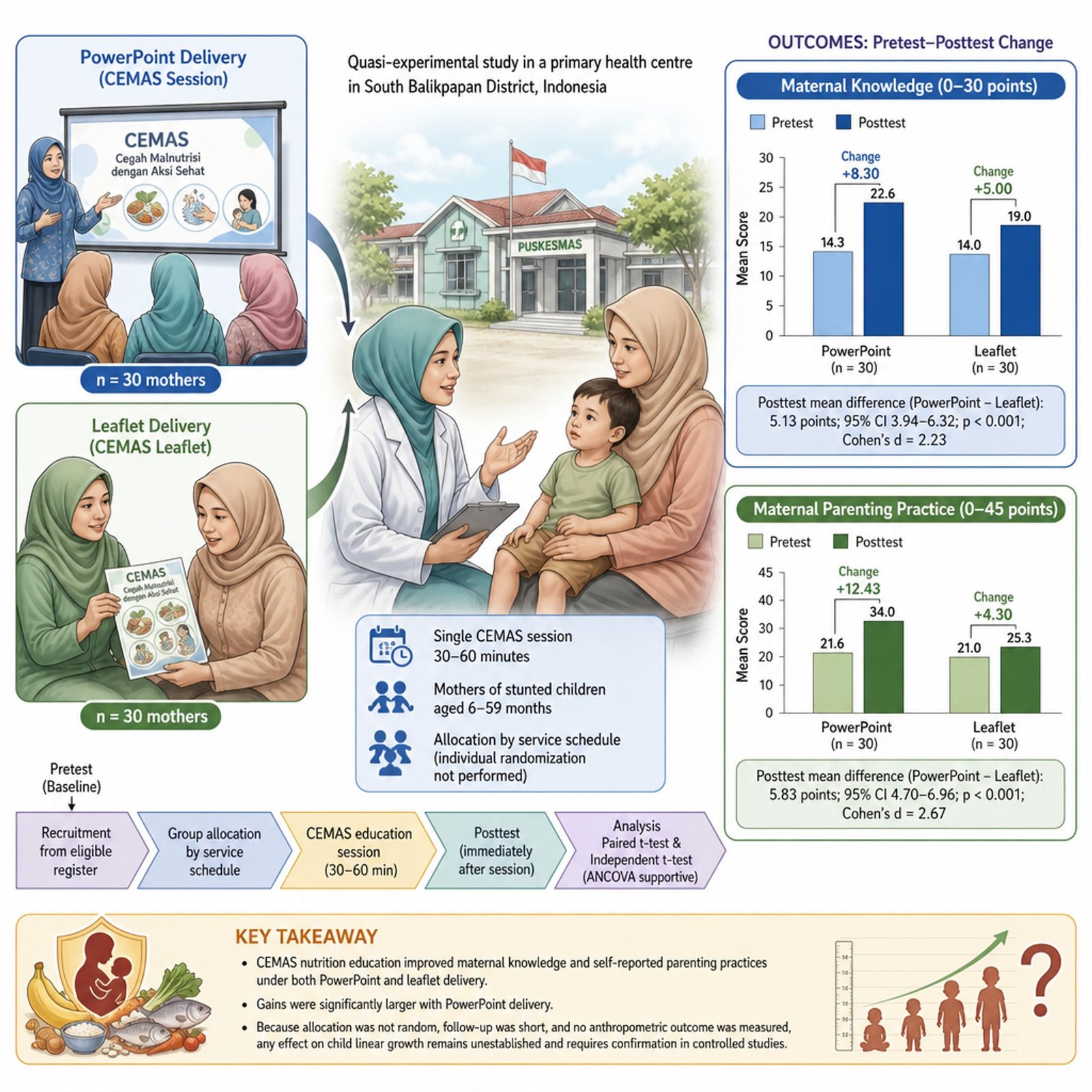
To compare the effect of "CEMAS" (Cegah Malnutrisi dengan Aksi Sehat / Preventing Malnutrition with Healthy Action) nutrition education delivered through a facilitated PowerPoint presentation versus a printed leaflet on maternal knowledge and self-reported parenting practices. In a two-group pretest posttest quasi-experimental study, 60 mothers of stunted children aged 6 59 months were randomly sampled from the eligible register of a primary health centre catchment area in South Balikpapan District and allocated by service schedule to a PowerPoint group (n = 30) or a leaflet group (n = 30); individual random assignment was not performed. Each group received a single 30 60 minute CEMAS session. Within-group change was tested with paired t-tests and between-group difference in change with independent-samples t-tests, with an analysis of covariance adjusting for baseline score as a supporting analysis. Knowledge and parenting-practice scores rose in both groups (all p < 0.001). The mean pre-to-post change was larger in the PowerPoint group for knowledge (8.30 versus 5.00 points) and for parenting practice (12.43 versus 4.30 points). Post-intervention scores also favoured PowerPoint for knowledge (mean difference 5.13; 95% CI 3.94 to 6.32; p < 0.001; Cohen's d = 2.23) and for parenting practice (mean difference 5.83; 95% CI 4.70 to 6.96; p < 0.001; Cohen's d = 2.67). Baseline scores differed between groups, so these estimates are not adjusted for the starting point unless stated. CEMAS-based nutrition education improved maternal knowledge and self-reported parenting practices under both delivery formats, with larger gains under the PowerPoint format. Because allocation was not random, follow-up was short and no anthropometric outcome was measured, any effect on child linear growth remains unestablished and requires confirmation in controlled studies.
Downloads
References
Abri N, Sirajuddin S, Bahar B, Jafar N, Russeng SS, Zakaria Z, et al. Determinants of incident stunting in elementary school children in endemic area iodine deficiency disorders Enrekang Regency. Open Access Maced J Med Sci. 2022;10:161 7.
Dewi NK, Kusumasari HAR, Andarini S, Indrawan IWA. Nutritional factors affecting stunting among toddlers. Amerta Nutr. 2023;7(1SP):25 9.
Abri N, Zakiah N, Risal AF. The relationship between early pregnancy, birth distance, and resident status with stunting incidence in elementary school children in Enrekang rural. J Health Nutr Res. 2023;2(2):70 8.
UNICEF, WHO, World Bank Group. Levels and trends in child malnutrition: joint child malnutrition estimates. Geneva: World Health Organization; 2020. Available from: https://www.who.int/publications/i/item/9789240003576
Pangestuti M, Khomsan A, Ekayanti I. Determinants of stunting in children aged 6 24 months in rural areas: case control study. AcTion Aceh Nutr J. 2023;8(3):318.
[ementerian Kesehatan RI. Laporan Studi Status Gizi Indonesia (SSGI) 2021. Jakarta: Badan Kebijakan Pembangunan Kesehatan; 2021.
Kementerian Kesehatan RI. Buku saku hasil Survei Status Gizi Indonesia (SSGI) 2022. Jakarta: Badan Kebijakan Pembangunan Kesehatan; 2022. p. 1 156.
Kementerian Kesehatan RI. Survei Kesehatan Indonesia (SKI) 2023: dalam angka. Jakarta: Badan Kebijakan Pembangunan Kesehatan; 2023.
Primary health centre routine nutrition surveillance records, South Balikpapan District, December 2024. Unpublished local programme data.
Black RE, Victora CG, Walker SP, Bhutta ZA, Christian P, de Onis M, et al. Maternal and child undernutrition and overweight in low-income and middle-income countries. Lancet. 2013;382(9890):427 51.
Beal T, Tumilowicz A, Sutrisna A, Izwardy D, Neufeld LM. A review of child stunting determinants in Indonesia. Matern Child Nutr. 2018;14(4):1 10.
Jihad FF, Sriwahyuni S, Darmawan D, Murdani I. Literature review: factors associated with malnutrition in children younger than five. J Nutr Sci. 2022;3(2):51 9.
Shekar M, Condo J, Pate MA, Nishtar S. Maternal and child undernutrition: progress hinges on supporting women and more implementation research. Lancet. 2021;397(10282):1329 31. Available from: http://dx.doi.org/10.1016/S0140-6736(21)00577-8
Heidkamp RA, Piwoz E, Gillespie S, Keats EC, D'Alimonte MR, Menon P, et al. Mobilising evidence, data, and resources to achieve global maternal and child undernutrition targets and the Sustainable Development Goals: an agenda for action. Lancet. 2021;397(10282):1400 18.
World Health Organization. WHO guideline for complementary feeding of infants and young children 6 23 months of age. Geneva: World Health Organization; 2023. 76 p. Available from: [insert the correct WHO URL the DOI in the previous version belonged to an unrelated journal]
Prasetyo YB, Permatasari P, Susanti HD. The effect of mothers' nutritional education and knowledge on children's nutritional status: a systematic review. Int J Child Care Educ Policy. 2023;17(1). Available from: https://doi.org/10.1186/s40723-023-00114-7
Gebretsadik MT, Tamiru D, Sisay AL, Belachew T. Effect of behavioural change communication through women development army on optimal complementary feeding practice among children aged 6 23 months in Southwest Ethiopia: a cluster randomized controlled trial. Nutr J. 2025;24(1).
Rezaeizadeh G, Mansournia MA, Keshtkar A, Farahani Z, Zarepour F, Sharafkhah M, et al. Maternal education and its influence on child growth and nutritional status during the first two years of life: a systematic review and meta-analysis. eClinicalMedicine. 2024;71:102574. Available from: https://doi.org/10.1016/j.eclinm.2024.102574
Abri N. Identification of socio-demographic factors with the incidence of stunting in elementary school children in rural Enrekang. J Health Nutr Res. 2022;1(2):88 94.
Setiadi Y, Imawati Q, Noviardhi A, Supadi J, Subandriani DN, Widiyanto SD. The effect of nutritional education with leaflet media on increasing maternal knowledge and intake of protein, zinc, calcium in stunting children aged 6 23 months. Int J Med Sci Clin Res Stud. 2023;3(10):2318 23.
Munthe J. The effect of leaflet media counseling to increase stunting knowledge on pregnant women. Sci Midwifery. 2021;9(2):595 9.
Achjar KAH, Marni NK, Lestari AS, Ribek IN. Health education with leaflet media on the level of knowledge of mothers about toddler rearing partners in stunting prevention. J Educ Res Eval. 2023;7(2):197 203.
Herlinadiyaningsih H, Arisani G. Efektivitas media video dan leaflet terhadap tingkat pengetahuan dan sikap tentang menstrual hygiene di MA Darul Ulum Palangka Raya. J Surya Med. 2022;8(2):193 207.
Carin V, Juwandhi AR, Anwar K, Setyowati A, Fitri YP. Pengaruh edukasi pencegahan stunting dengan media buku saku digital dan video animasi terhadap tingkat pengetahuan dan sikap ibu balita di Posyandu Merah Delima, Kota Tangerang. J Abdi Masy Indones. 2024;4(1):163 70.
Ruel MT, Alderman H. Nutrition-sensitive interventions and programmes: how can they help to accelerate progress in improving maternal and child nutrition? Lancet. 2013;382(9891):536 51. Available from: http://dx.doi.org/10.1016/S0140-6736(13)60843-0
Published
How to Cite
Issue
Section
Copyright (c) 2026 Lale Harwindi Silviana, Nur Abri, Satriani Satriani, Dwi Hendriani

This work is licensed under a Creative Commons Attribution-NonCommercial-ShareAlike 4.0 International License.
All published articles are licensed under the Creative Commons Attribution-NonCommercial-ShareAlike 4.0 International License.

You are free to:
- Share — copy and redistribute the material in any medium or format
- Adapt — remix, transform, and build upon the material
- The licensor cannot revoke these freedoms as long as you follow the license terms.
Under the following terms:
- Attribution — You must give appropriate credit, provide a link to the license, and indicate if changes were made. You may do so in any reasonable manner, but not in any way that suggests the licensor endorses you or your use.
- NonCommercial — You may not use the material for commercial purposes.
- ShareAlike — If you remix, transform, or build upon the material, you must distribute your contributions under the same license as the original.
- No additional restrictions — You may not apply legal terms or technological measures that legally restrict others from doing anything the license permits.
Most read articles by the same author(s)
- Nunik Purwandini, Satriani Satriani, Nur Abri, The Effect of Emotional Demonstration on Maternal Knowledge and Attitudes Regarding Infant and Young Child Feeding in Samarinda, Indonesia , Journal of Community Nutrition Intervention: Vol. 1 No. 2 (2026)