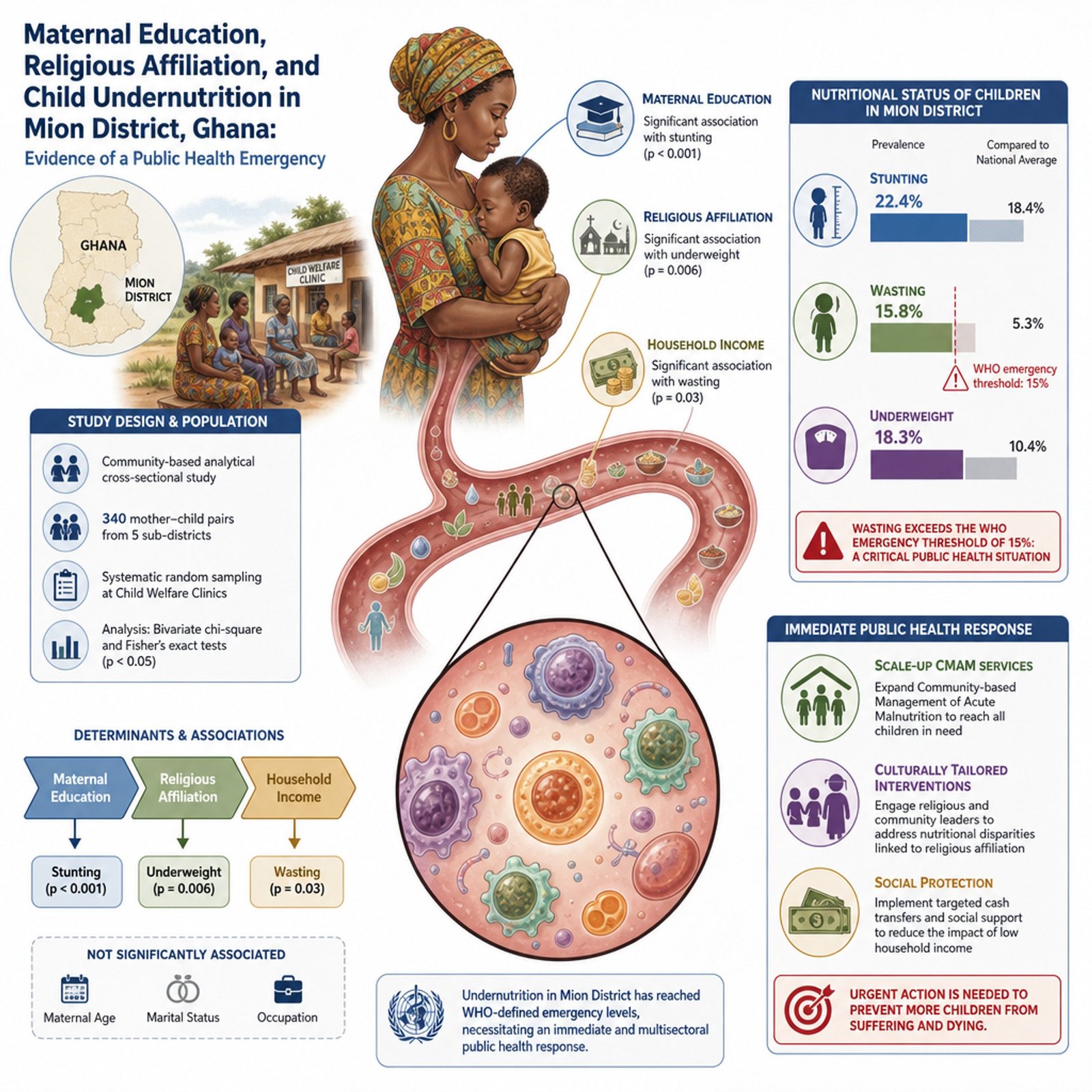
Maternal Education, Religious Affiliation, and Child Undernutrition in Mion District, Ghana: Evidence of a Public Health Emergency
Keywords:
Child Undernutrition, Stunting, Wasting, Maternal FactorsAbstract
This study addresses this evidence gap by investigating maternal determinants of child nutritional status in a predominantly rural district where no prior published study had examined these relationships. A community-based analytical cross-sectional study was conducted among 340 mother-child pairs. Systematic random sampling was employed at Child Welfare Clinics across five sub-districts of Mion District. Associations between maternal factors and nutritional outcomes were assessed via bivariate chi-square and Fisher's exact tests at p < 0.05. Prevalence of stunting (22.4%), wasting (15.8%), and underweight (18.3%) significantly exceeded national averages of 18.4%, 5.3%, and 10.4% respectively. Notably, wasting exceeded the WHO emergency threshold of 15%, indicating a critical public health situation. Significant associations were identified between household income and wasting (p = 0.03), maternal religious affiliation and underweight (p = 0.006), and maternal educational level and stunting (p < 0.001). Stunting prevalence unexpectedly increased with maternal education, likely attributable to small sample sizes in higher education tiers and uncontrolled confounding. Maternal age, marital status, and occupation were not significantly associated with any nutritional outcome. Undernutrition in Mion District has reached WHO-defined emergency levels, necessitating an immediate scale-up of Community-based Management of Acute Malnutrition (CMAM) services. Interventions must be culturally tailored, engaging religious and community leaders to address nutritional disparities linked to religious affiliation, while integrating social protection programmes, including targeted cash transfers, to mitigate the impact of low household income on acute malnutrition.
Downloads
References
UNICEF, WHO, World Bank Group. Levels and Trends in Child Malnutrition: UNICEF/WHO/World Bank Group Joint Child Malnutrition Estimates, Key Findings of the 2023 Edition. Geneva: World Health Organization; 2023.
UNICEF, WHO, World Bank Group. Levels and Trends in Child Malnutrition: UNICEF/WHO/World Bank Group Joint Child Malnutrition Estimates, Key Findings of the 2025 Edition. Geneva: World Health Organization; 2025.
Black RE, Victora CG, Walker SP, Bhutta ZA, Christian P, de Onis M, et al. Maternal and child undernutrition and overweight in low-income and middle-income countries. The Lancet. 2013;382(9890):427-51.
Boah M, Azupogo F, Amporfro DA, Abada LA. The epidemiology of undernutrition and its determinants in children under five years in Ghana. PLOS ONE. 2019;14(7):e0219665.
Mensah GP, Nuotol RK, Jnr JAB. Trends and determinants of under-five malnutrition in Ghana: evidence from the Ghana Demographic and Health Surveys 1993-2022. BMC Nutrition. 2024;10(1):18.
Sewor C, Jayalakshmi R. Spatial distribution of under-five undernutrition in Ghana: a secondary analysis using the 2022 Multiple Indicator Cluster Survey. BMC Nutrition. 2024;10(1):76.
Ghana Statistical Service, Ghana Health Service, ICF International. Ghana Demographic and Health Survey 2014. Rockville (MD): GSS, GHS and ICF International; 2015.
Antwi KD, Lyford CP. Household food insecurity is associated with child's dietary diversity score among primary school children in two districts in Ghana. Food and Nutrition Research. 2023;66.
Ali Z, Saaka M, Adams AG, Kamwininaang SK, Abizari AR. The effect of maternal and child factors on stunting, wasting and underweight among preschool children in Northern Ghana. BMC Nutrition. 2017;3(1):31.
World Food Programme. Ghana: Comprehensive Food Security and Vulnerability Assessment 2020. Accra: World Food Programme Ghana Country Office; 2020.
UNICEF. Strategy for Improved Nutrition of Children and Women in Developing Countries. New York: UNICEF; 1990.
Atsu BK, Guure C, Laar AK. Determinants of overweight with concurrent stunting among Ghanaian children. BMC Pediatrics. 2015;15(1):151.
Darko MY, Sewor C, Aryee AN, Nsiah-Asamoah C. Predictors of stunting in children under five years in northern Ghana: insights from the 2022 MICS. BMC Nutrition. 2024;10(1):42.
Cochran WG. Sampling Techniques. 3rd ed. New York: John Wiley and Sons; 1977.
Saaka M, Wemakor A, Abizari AR, Aryee P. How well do WHO complementary feeding indicators relate to nutritional status of children aged 6-23 months in rural northern Ghana? BMC Public Health. 2015;15(1):1157.
World Health Organization. WHO Child Growth Standards: Length/Height-for-Age, Weight-for-Age, Weight-for-Length, Weight-for-Height and Body Mass Index-for-Age: Methods and Development. Geneva: World Health Organization; 2006.
World Health Organization. WHO Anthro for Personal Computers, Version 3.2.2: Software for Assessing Growth and Development of the World's Children. Geneva: World Health Organization; 2011.
UNICEF, WHO, World Bank Group. Levels and Trends in Child Malnutrition: UNICEF/WHO/World Bank Group Joint Child Malnutrition Estimates, Key Findings of the 2021 Edition. Geneva: World Health Organization; 2021.
Abizari AR, Azupogo F, Nagasu M, Creemers N, Brouwer ID. Seasonality affects dietary diversity of women of reproductive age in northern Ghana. PLoS ONE. 2017;12(9):e0183193.
Johnson FA. Intra-household gender inequality and child nutritional status in sub-Saharan Africa: evidence from Ghana. Journal of Biosocial Science. 2022;54(3):445-62.
Kukeba M, Abizari AR, Daliri S. Undernutrition and associated factors among children 6-23 months in a rural district in northern Ghana: a cross-sectional study. Journal of Nutritional Science. 2021;10:e90.
Victora CG, Adair L, Fall C, Hallal PC, Martorell R, Richter L, et al. Maternal and child undernutrition: consequences for adult health and human capital. The Lancet. 2008;371(9609):340-57.
Shrimpton R, Victora CG, de Onis M, Lima RC, Blossner M, Clugston G. Worldwide timing of growth faltering: implications for nutritional interventions. Pediatrics. 2001;107(5):e75.
Frempong RB, Annim SK. Dietary diversity and child malnutrition in Ghana. Heliyon. 2017;3(5):e00298.
Wamani H, Astrom AN, Peterson S, Tumwine JK, Tylleskar T. Boys are more stunted than girls in sub-Saharan Africa: a meta-analysis of 16 demographic and health surveys. BMC Pediatrics. 2007;7(1):17.
Smith LC, Ramakrishnan U, Ndiaye A, Haddad L, Martorell R. The Importance of Women's Status for Child Nutrition in Developing Countries. Research Report 131. Washington (DC): International Food Policy Research Institute; 2004.
USAID. Feed the Future Ghana: Northern Ghana Nutrition and Agriculture Action. Washington (DC): USAID; 2014.
Quashie NT, Aryeetey GC, Tettey P. Women's economic empowerment and child nutrition outcomes in rural northern Ghana. Food Policy. 2023;116:102434.
Aboh IK, Appoh L. Religion and complementary feeding practices among mothers of children under two years in Ghana. Journal of Nutritional Disorders and Therapy. 2014;4(1):1-7.
Abizari AR, Buxton C, Kwara L, Mensah-Homiah J, Armar-Klemesu M, Diosady LL. School feeding contributes to micronutrient adequacy of Ghanaian schoolchildren. British Journal of Nutrition. 2020;108(6):1019-33.
Ayoola O, Gemmell I, Alamu EO, Maziya-Dixon B. Associations between maternal factors and nutritional status of children under five years in Nigeria. African Journal of Food, Agriculture, Nutrition and Development. 2012;12(4).
Nshimyiryo A, Hedt-Gauthier B, Mutaganzwa C, Kirk CM, Beck K, Ndayisaba A, et al. Risk factors for stunting among children under five years: a cross-sectional population-based study in Rwanda using the 2015 Demographic and Health Survey. BMC Public Health. 2024;19(1):175.
Mabon P, Wemakor A, Abizari AR. Severe acute malnutrition in northern Ghana: seasonal variation and its implications for case management. Maternal and Child Nutrition. 2021;17(4):e13218.
Wemakor A, Garti H, Azongo T, Garti H, Atosona A. Young maternal age is a risk factor for child undernutrition in Tamale Metropolis, Ghana. BMC Research Notes. 2018;11(1):877.
Published
How to Cite
Issue
Section
Copyright (c) 2026 Noble Tiire, Augustina Attiah, Seidu Abdul Hanan

This work is licensed under a Creative Commons Attribution-NonCommercial-ShareAlike 4.0 International License.
All published articles are licensed under the Creative Commons Attribution-NonCommercial-ShareAlike 4.0 International License.

You are free to:
- Share — copy and redistribute the material in any medium or format
- Adapt — remix, transform, and build upon the material
- The licensor cannot revoke these freedoms as long as you follow the license terms.
Under the following terms:
- Attribution — You must give appropriate credit, provide a link to the license, and indicate if changes were made. You may do so in any reasonable manner, but not in any way that suggests the licensor endorses you or your use.
- NonCommercial — You may not use the material for commercial purposes.
- ShareAlike — If you remix, transform, or build upon the material, you must distribute your contributions under the same license as the original.
- No additional restrictions — You may not apply legal terms or technological measures that legally restrict others from doing anything the license permits.